
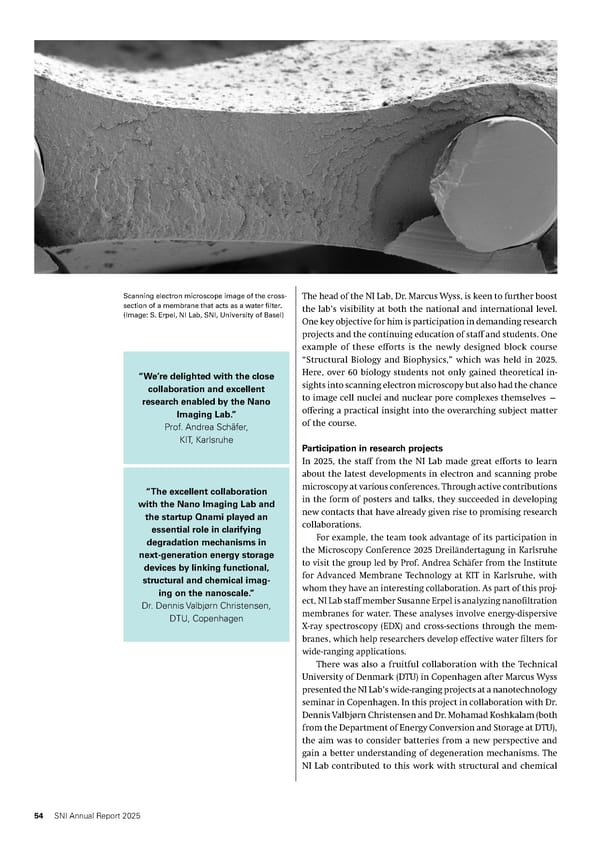
Scanning electron microscope image of the cross- section of a membrane that acts as a water filter. (Image: S. Erpel, NI Lab, SNI, University of Basel) The head of the NI Lab, Dr. Marcus Wyss, is keen to further boost the lab’s visibility at both the national and international level. One key objective for him is participation in demanding research projects and the continuing education of staff and students. One example of these efforts is the newly designed block course “Structural Biology and Biophysics,” which was held in 2025. Here, over 60 biology students not only gained theoretical in- sights into scanning electron microscopy but also had the chance to image cell nuclei and nuclear pore complexes themselves — offering a practical insight into the overarching subject matter of the course. Participation in research projects In 2025, the staff from the NI Lab made great efforts to learn about the latest developments in electron and scanning probe microscopy at various conferences. Through active contributions in the form of posters and talks, they succeeded in developing new contacts that have already given rise to promising research collaborations. For example, the team took advantage of its participation in the Microscopy Conference 2025 Dreiländertagung in Karlsruhe to visit the group led by Prof. Andrea Schäfer from the Institute for Advanced Membrane Technology at KIT in Karlsruhe, with whom they have an interesting collaboration. As part of this proj- ect, NI Lab staff member Susanne Erpel is analyzing nanofiltration membranes for water. These analyses involve energy-dispersive X-ray spectroscopy (EDX) and cross-sections through the mem- branes, which help researchers develop effective water filters for wide-ranging applications. There was also a fruitful collaboration with the Technical University of Denmark (DTU) in Copenhagen after Marcus Wyss presented the NI Lab’s wide-ranging projects at a nanotechnology seminar in Copenhagen. In this project in collaboration with Dr. Dennis Valbjørn Christensen and Dr. Mohamad Koshkalam (both from the Department of Energy Conversion and Storage at DTU), the aim was to consider batteries from a new perspective and gain a better understanding of degeneration mechanisms. The NI Lab contributed to this work with structural and chemical “The excellent collaboration with the Nano Imaging Lab and the startup Qnami played an essential role in clarifying degradation mechanisms in next-generation energy storage devices by linking functional, structural and chemical imag- ing on the nanoscale.” Dr. Dennis Valbjørn Christensen, DTU, Copenhagen “We’re delighted with the close collaboration and excellent research enabled by the Nano Imaging Lab.” Prof. Andrea Schäfer, KIT, Karlsruhe 54 SNI Annual Report 2025
 Annual Report 2025 - Swiss Nanoscience Institute Page 53 Page 55