Annual Report 2025 - Swiss Nanoscience Institute
This document presents the 2025 annual report for the Swiss Nanoscience Institute, showcasing their research developments and achievements.
Annual Report 2025 Swiss Nanoscience Institute
3 Editorial 4 2025 in brief 6 Swiss Nanoscience Institute: The center of excellence for nanosciences in Northwestern Switzerland 12 Nanoscience program: Over 20 years of successful graduates – 20 years since the first bachelor’s graduates: Anni- versary at Volkshaus Basel – Master’s prize for work in in- dustry: Katja Ammann develops an efficient screening method for proteins – Block courses and SmallTalk: An intensive final stretch for the bachelor’s program – New faces on the board: Fresh momentum at AlumniNano 16 SNI PhD School: Network for interdisciplinary doctoral dissertations – Assembly of nanoharpoon in response to attack – Machine learning for protein optimization – Measuring system for tiny electric effects – Surface properties of spintronic materials – Floating thanks to acoustics – On the road to new metal-orga- nic materials – Temperature sensors for fuel cells – Nanowires as highly sensitive sensors – Magnetic vortices for data sto- rage – Supportive network: How doc- toral students see the SNI PhD School – Communication and entrepre- neurial spirit: Tailored courses for SNI doctoral students 24 Research: Focus on nanoimaging and nanofabrication 38 Nano-Argovia program: Networking between research and industry 52 Nano Technology Center: Expertise, collaboration, and continuous development – Nano Imaging Lab: Improving analyses, developing contacts, sharing knowledge – Nano Fabrication Lab: Safe and clean conditions for micro and nanofabrication 62 Network: A basis for innova- tive research and education – Nano community in North- western Switzerland: Partners in the network – Information and networks: Events for specific target groups – Research funding for nano- research: Successful SNI members 66 Communication and outreach: Successful formats for different target groups – Local and international: Broad range of activities 68 Financial report 70 Organization – Committees and teams – Lists of members and projects – Link to the scientific supple- ment and additional informa- tion about this publication www.nanoscience.ch Follow us on: Scientific supplement Scientific reports from the Nano-Argovia program and SNI PhD School from 2025 can be found on our website or by scan- ning the QR code. https://bit.ly/3N5YePz 2 SNI Annual Report 2025
Dear colleagues and nanoenthusiasts, Over the course of 2025, we continued helping to solve current and future chal- lenges with nanoscience and nanotech- nology through our work as part of inter- disciplinary teams. We do this not only by training excellent early career re- searchers as they progress from their bachelor’s and master’s to a doctorate but also through our commitment to re- search in the life sciences and the fields of quantum, materials and environmen- tal science. Our work is underpinned by the inter- action between basic research projects in our focal areas of nanoimaging and nano- fabrication, on the one hand, and appli- cation-oriented research in close collabo- ration with industrial companies from the region, on the other. Other key pillars of the SNI include the services of the Nano Technology Center and public rela- tions work — topics that we address in greater detail in the various sections of this annual report. In turn, all of these activities are sup- ported by people who have contributed to the achievements showcased in this report with their considerable commit- ment, creativity and expertise. Everyone involved in the SNI is organized within an interdisciplinary network that extends across institutional and disciplinary boundaries — and it is this network that makes the SNI unique. This annual report highlights the di- versity of our activities in 2025, which we were able to carry out thanks to the sup- port of the Canton of Aargau and the two half-cantons of Basel-Stadt and Basel- Landschaft. If you want to dig deeper into the top- ics of our research, I recommend check- ing out the scientific supplement, which includes detailed project descriptions from the Nano-Argovia program and the SNI PhD School. We hope you enjoy reading this report and exploring our work. Professor Martino Poggio SNI Director 3 SNI Annual Report 2025
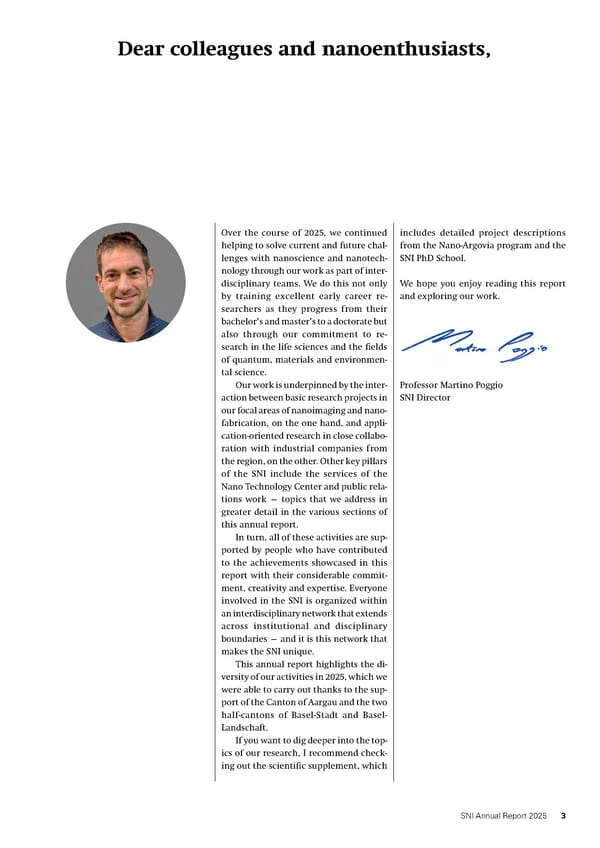
With new equipment, the teams at the Nano Technology Center are expanding their range of possible applications— here with a new 3D microscope in the Nano Fabrication Lab. 2025 in brief Successful completion Eleven students successfully completed their bachelor’s degree in nanoscience in 2025. Eleven students also completed their master’s degree. Page 12 First bachelor ’ s degree awarded 20 years ago In 2025, we celebrated the 20 th anniversa- ry of the first bachelor’s degree in nano- science at the University of Basel with numerous students and alumni. Page 13 New board for the alumni organization At the end of 2025, a new board took over the management of the AlumniNano organization. Page 15 Diverse doctoral theses Nine SNI doctoral students completed their theses in 2025. They conducted their research at the University of Basel’s De- partments of Biozentrum, Chemistry and Physics, at the Paul Scherrer Institute PSI, and at the FHNW School of Life Sciences. Page 16 The path to founding a company In 2025, t he “From Lab to Startup” work- shop was once again a great success. Du- ring the workshop, doctoral students learned how to successfully present their own business ideas to investors. Page 21 Supportive network Doctoral students at the SNI PhD School ap- preciate the supportive, international and interdisciplinary community at the SNI. Page 20 Services and research The Nano Technology Center, with its two units Nano Imaging Lab and Nano Fabrication Lab, provides the SNI network with services in the field of nanoimaging and nanofabrication. In 2025, the two teams were able to expand their equipment and make significant contributions to numerous diverse research projects. Page 52 Networking events To ensure exchange within the interdisciplinary network with researchers from various academic institutions in Northwestern Switzerland, the SNI organized various events such as the Annual Meeting and the NanoTec Apéro. Page 63 4 SNI Annual Report 2025
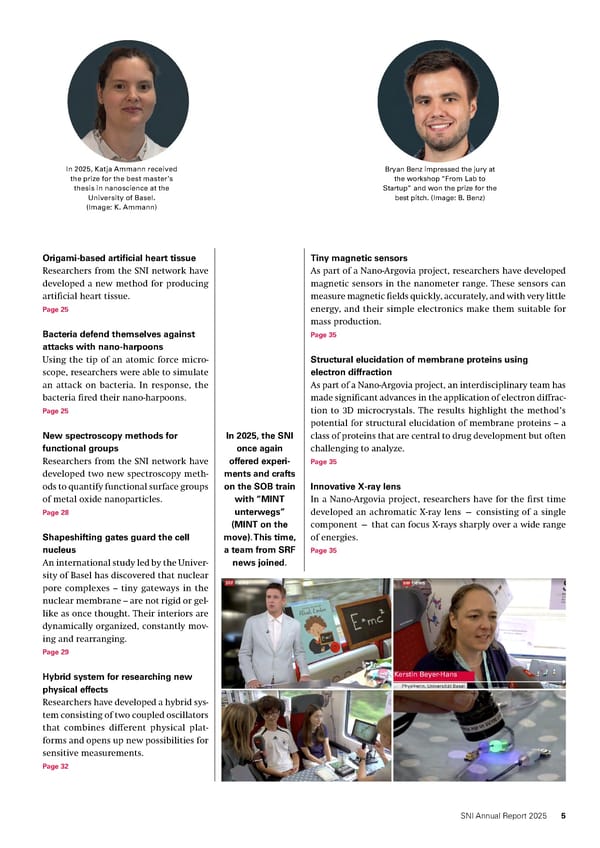
In 2025, the SNI once again offered experi- ments and crafts on the SOB train with “MINT unterwegs” (MINT on the move). This time, a team from SRF news joined. Tiny magnetic sensors As part of a Nano-Argovia project, researchers have developed magnetic sensors in the nanometer range. These sensors can measure magnetic fields quickly, accurately, and with very little energy, and their simple electronics make them suitable for mass production. Page 35 Structural elucidation of membrane proteins using electron diffraction As part of a Nano-Argovia project, an interdisciplinary team has made significant advances in the application of electron diffrac- tion to 3D microcrystals. The results highlight the method’s potential for structural elucidation of membrane proteins – a class of proteins that are central to drug development but often challenging to analyze. Page 35 Innovative X-ray lens In a Nano-Argovia project, researchers have for the first time developed an achromatic X-ray lens — consisting of a single component — that can focus X-rays sharply over a wide range of energies. Page 35 Origami-based artificial heart tissue Researchers from the SNI network have developed a new method for producing artificial heart tissue. Page 25 Bacteria defend themselves against attacks with nano-harpoons Using the tip of an atomic force micro- scope, researchers were able to simulate an attack on bacteria. In response, the bacteria fired their nano-harpoons. Page 25 New spectroscopy methods for functional groups Researchers from the SNI network have developed two new spectroscopy meth- ods to quantify functional surface groups of metal oxide nanoparticles. Page 28 Shapeshifting gates guard the cell nucleus An international study led by the Univer- sity of Basel has discovered that nuclear pore complexes – tiny gateways in the nuclear membrane – are not rigid or gel- like as once thought. Their interiors are dynamically organized, constantly mov- ing and rearranging. Page 29 Hybrid system for researching new physical effects Researchers have developed a hybrid sys- tem consisting of two coupled oscillators that combines different physical plat- forms and opens up new possibilities for sensitive measurements. Page 32 Bryan Benz impressed the jury at the workshop “From Lab to Startup” and won the prize for the best pitch. (Image: B. Benz) In 2025, Katja Ammann received the prize for the best master‘s thesis in nanoscience at the University of Basel. (Image: K. Ammann) Kerstin Beyer-Hans 5 SNI Annual Report 2025
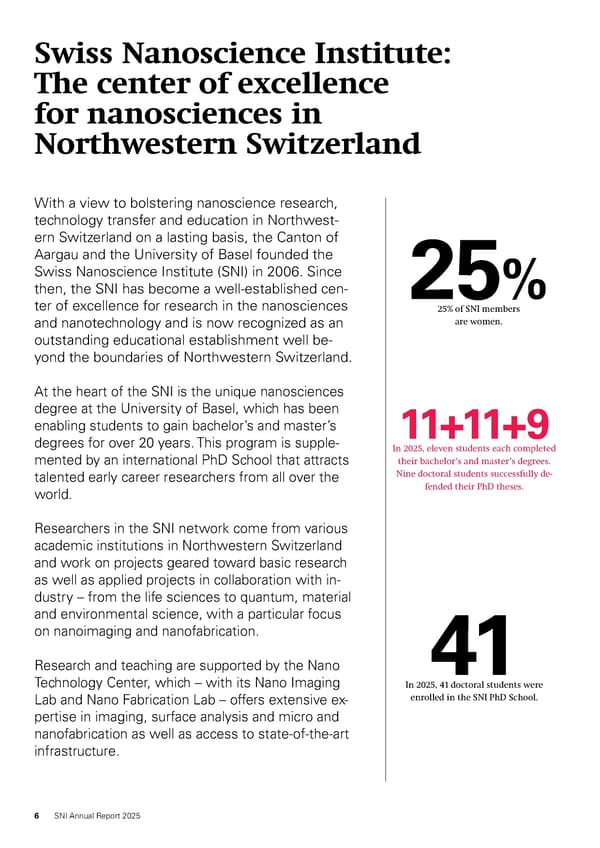
25 % 25% of SNI members are women. 11+11+9 In 2025, eleven students each completed their bachelor’s and master’s degrees. Nine doctoral students successfully de- fended their PhD theses. 41 In 2025, 41 doctoral students were enrolled in the SNI PhD School. Swiss Nanoscience Institute: The center of excellence for nanosciences in Northwestern Switzerland With a view to bolstering nanoscience research, technology transfer and education in Northwest- ern Switzerland on a lasting basis, the Canton of Aargau and the University of Basel founded the Swiss Nanoscience Institute (SNI) in 2006. Since then, the SNI has become a well-established cen- ter of excellence for research in the nanosciences and nanotechnology and is now recognized as an outstanding educational establishment well be- yond the boundaries of Northwestern Switzerland. At the heart of the SNI is the unique nanosciences degree at the University of Basel, which has been enabling students to gain bachelor’s and master’s degrees for over 20 years. This program is supple- mented by an international PhD School that attracts talented early career researchers from all over the world. Researchers in the SNI network come from various academic institutions in Northwestern Switzerland and work on projects geared toward basic research as well as applied projects in collaboration with in- dustry – from the life sciences to quantum, material and environmental science, with a particular focus on nanoimaging and nanofabrication. Research and teaching are supported by the Nano Technology Center, which – with its Nano Imaging Lab and Nano Fabrication Lab – offers extensive ex- pertise in imaging, surface analysis and micro and nanofabrication as well as access to state-of-the-art infrastructure. 6 SNI Annual Report 2025
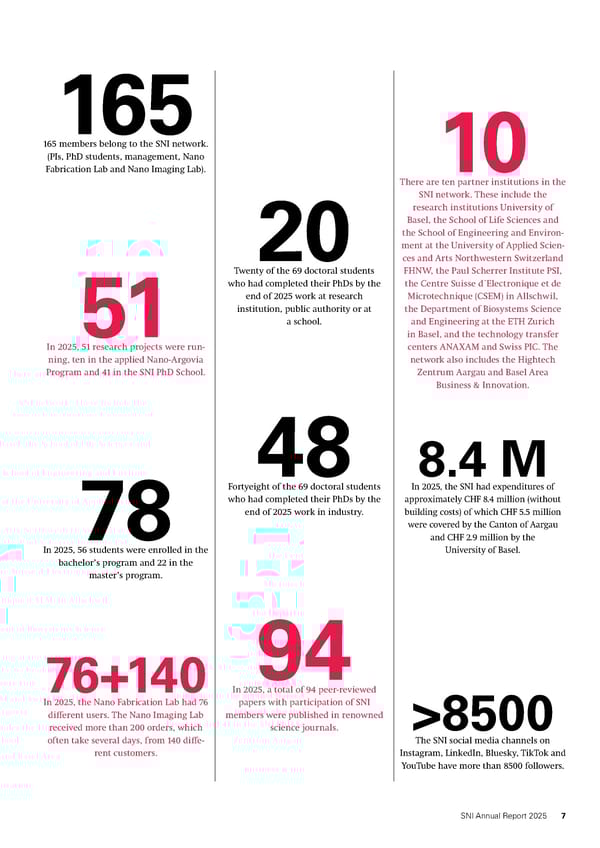
165 165 members belong to the SNI network. (PIs, PhD students, management, Nano Fabrication Lab and Nano Imaging Lab). 78 In 2025, 56 students were enrolled in the bachelor’s program and 22 in the master’s program. 8.4 M In 2025, the SNI had expenditures of approximately CHF 8.4 million (without building costs) of which CHF 5.5 million were covered by the Canton of Aargau and CHF 2.9 million by the University of Basel. 51 In 2025, 51 research projects were run- ning, ten in the applied Nano-Argovia Program and 41 in the SNI PhD School. 10 There are ten partner institutions in the SNI network. These include the research institutions University of Basel, the School of Life Sciences and the School of Engineering and Environ- ment at the University of Applied Scien- ces and Arts Northwestern Switzerland FHNW, the Paul Scherrer Institute PSI, the Centre Suisse d`Electronique et de Microtechnique (CSEM) in Allschwil, the Department of Biosystems Science and Engineering at the ETH Zurich in Basel, and the technology transfer centers ANAXAM and Swiss PIC. The network also includes the Hightech Zentrum Aargau and Basel Area Business & Innovation. 94 In 2025, a total of 94 peer-reviewed papers with participation of SNI members were published in renowned science journals. 48 Fortyeight of the 69 doctoral students who had completed their PhDs by the end of 2025 work in industry. 20 Twenty of the 69 doctoral students who had completed their PhDs by the end of 2025 work at research institution, public authority or at a school. >8500 The SNI social media channels on Instagram, LinkedIn, Bluesky, TikTok and YouTube have more than 8500 followers. 76+140 In 2025, the Nano Fabrication Lab had 76 different users. The Nano Imaging Lab received more than 200 orders, which often take several days, from 140 diffe- rent customers. 7 SNI Annual Report 2025
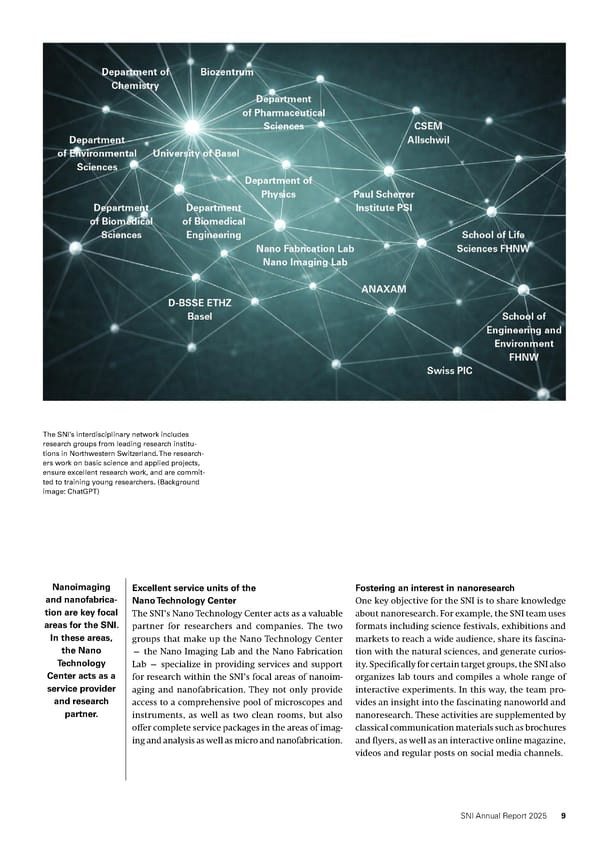
Joint initiative In 2006, the Canton of Aargau and the University of Basel founded the Swiss Nanoscience Institute (SNI) with a view to bolstering research, knowledge and technology transfer, and training in the nanosci- ences in Northwestern Switzerland. Over the last 20 years, the SNI has established itself as an internationally recognized center for the nanosciences and nanotechnology — and it will con- tinue to make valuable contributions to the life sci- ences and to the fields of quantum, materials and environmental science in the future. Researchers in the SNI network work not only on projects in the area of basic research but also on collaborations with companies from the Cantons of Aargau, Solothurn, Basel-Stadt and Basel-Landschaft with a key focus on nanoimaging and nanofabrication. In 2025, the SNI spent approximately 8.4 million Swiss francs, of which some 5.5 million were pro- vided by the Canton of Aargau and 2.9 million by the University of Basel. A lively, diverse network One special feature of the SNI is its dynamic, inter- disciplinary network, which connects researchers from leading scientific institutions in Northwestern Switzerland. Within the network, researchers work on various applied and basic research projects across the boundaries between institutions and disciplines. The SNI’s partner institutions include: the University of Basel with numerous departments; the University of Applied Sciences Northwestern Switzerland with its School of Life Sciences in Muttenz and School of Engineering and Environment in Windisch ; the Paul Scherrer Institute PSI; the De- partment of Biosystems Science and Engineering at ETH Zurich in Basel; the Centre Suisse d’Electronique et de Microtechnique (CSEM) in Allschwil; and the two technology transfer centers ANAXAM and Swiss PIC. The SNI also engages in collaborations with the Hightech Zentrum Aargau in Brugg and with Basel Area Business & Innovation in relation to knowledge and technology transfer. Excellent interdisciplinary training One of the SNI’s key tasks is to train excellent early career researchers. This centers around the bache- lor’s and master’s program in nanosciences at the University of Basel, in which students first gain a comprehensive grounding in the natural sciences before focusing on their principal areas of interest in the fields of nanobiology, nanochemistry, nano- physics or medical nanosciences. So far, over 300 students have earned a bachelor’s degree in nanosciences in Basel, and 240 students have successfully completed the nanosciences mas- ter’s program. At the end of 2025, there were 56 stu- dents enrolled on the bachelor’s program and 22 early career researchers enrolled on the master’s program. The education provided by the SNI is supple- mented by the SNI PhD School. For a period of about four years, doctoral students from national and in- ternational universities work intensively on nano- science topics, many of which are interdisciplinary in nature. In 2025, a total of 41 doctoral students were enrolled in the SNI PhD School — and nine of them successfully completed their projects in that year. Six new doctoral students began their doctor- ates in 2025, and six further projects were approved, which will begin in 2026. At the end of 2025, some 70% of the 69 existing graduates of the SNI PhD School were working at an industrial company, while around 30% were working at a research institution, public authority or school. Support for research In addition to PhD projects, the SNI supports the research of a number of professors. For example, the two Argovia professors Roderick Lim (cellular trans- port processes) and Martino Poggio (nanomechanics & nanomagnetism) received support from the SNI. For their part, the professors make a considerable contribution to the SNI’s international visibility with their commitment to teaching and research. The SNI also supports the three titular profes- sors Thomas Jung, Michel Kenzelmann and Frithjof Nolting, who lecture at the Department of Physics of the University of Basel and conduct research to- gether with their groups at the Paul Scherrer Insti- tute PSI. Collaboration with industry Knowledge and technology transfer represent further cornerstones of the SNI’s activities. In projects as part of the Nano-Argovia program, which has existed since the Swiss Nanoscience Institute was founded, at least two academic partners from the SNI network collab- orate on applied research with an industrial company from Northwestern Switzerland. So far, the SNI has supported this knowledge and technology transfer with well over 100 Nano-Argovia projects. In 2025, ten of these applied research projects received financial support. The partner companies for six of the projects hailed from the Canton of Aargau, while two each came from one of the two Basel half-cantons and Solothurn. Likewise, collabo- ration with industry is supported by the two tech- nology transfer centers ANAXAM and Swiss PIC, which are also partners in the SNI network. Members of the SNI network in- clude researchers from leading scientific institu- tions in Northwestern Switzerland. The Canton of Aargau and the University of Basel founded the SNI. One of the SNI’s core tasks is to train early career researchers. 8 SNI Annual Report 2025
The SNI’s interdisciplinary network includes research groups from leading research institu- tions in Northwestern Switzerland. The research- ers work on basic science and applied projects, ensure excellent research work, and are commit- ted to training young researchers. (Background image: ChatGPT) Excellent service units of the Nano Technology Center The SNI’s Nano Technology Center acts as a valuable partner for researchers and companies. The two groups that make up the Nano Technology Center — the Nano Imaging Lab and the Nano Fabrication Lab — specialize in providing services and support for research within the SNI’s focal areas of nanoim- aging and nanofabrication. They not only provide access to a comprehensive pool of microscopes and instruments, as well as two clean rooms, but also offer complete service packages in the areas of imag- ing and analysis as well as micro and nanofabrication. Fostering an interest in nanoresearch One key objective for the SNI is to share knowledge about nanoresearch. For example, the SNI team uses formats including science festivals, exhibitions and markets to reach a wide audience, share its fascina- tion with the natural sciences, and generate curios- ity. Specifically for certain target groups, the SNI also organizes lab tours and compiles a whole range of interactive experiments. In this way, the team pro- vides an insight into the fascinating nanoworld and nanoresearch. These activities are supplemented by classical communication materials such as brochures and flyers, as well as an interactive online magazine, videos and regular posts on social media channels. Nanoimaging and nanofabrica- tion are key focal areas for the SNI. In these areas, the Nano Technology Center acts as a service provider and research partner. 9 SNI Annual Report 2025
10 SNI Annual Report 2025
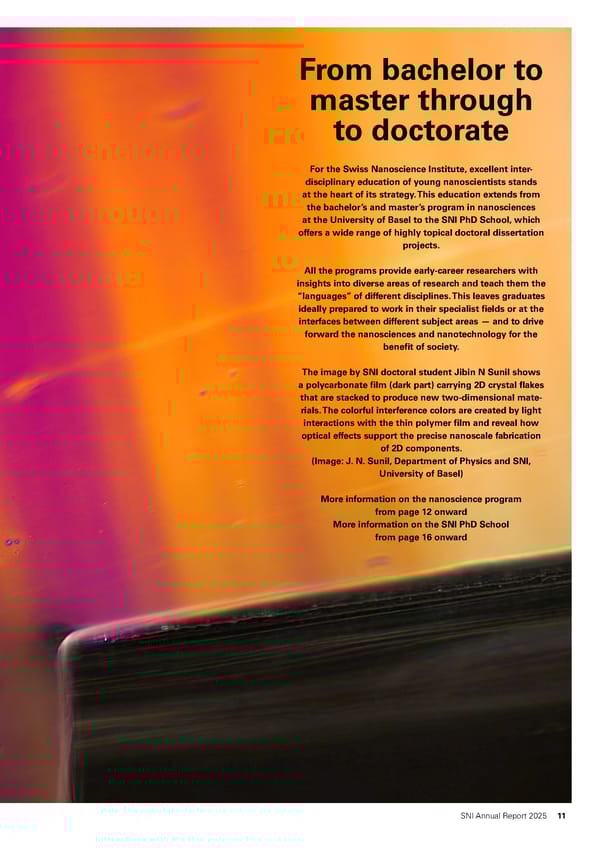
From bachelor to master through to doctorate For the Swiss Nanoscience Institute, excellent inter- disciplinary education of young nanoscientists stands at the heart of its strategy. This education extends from the bachelor’s and master’s program in nanosciences at the University of Basel to the SNI PhD School, which offers a wide range of highly topical doctoral dissertation projects. All the programs provide early-career researchers with insights into diverse areas of research and teach them the “languages” of different disciplines. This leaves graduates ideally prepared to work in their specialist fields or at the interfaces between different subject areas — and to drive forward the nanosciences and nanotechnology for the benefit of society. The image by SNI doctoral student Jibin N Sunil shows a polycarbonate film (dark part) carrying 2D crystal flakes that are stacked to produce new two-dimensional mate- rials. The colorful interference colors are created by light interactions with the thin polymer film and reveal how optical effects support the precise nanoscale fabrication of 2D components. (Image: J. N. Sunil, Department of Physics and SNI, University of Basel) More information on the nanoscience program from page 12 onward More information on the SNI PhD School from page 16 onward 11 SNI Annual Report 2025
Nanoscience program: Over 20 years of successful graduates In 2005, the first students completed their bachelor’s in nanoscienc- es at the University of Basel. Since then, this ambitious, interdisci- plinary course of studies has steadily evolved to meet new require- ments, adding formats such as the mini conference “SmallTalk” and numerous new block courses over the years. Likewise, the new spe- cialization in medical nanoscience as part of the master’s program has enriched the course of studies and has been well received by students. What has not changed is the ambition to train early career research- ers who have a broad footing in biology, chemistry, physics and mathematics, are fluent in the “languages” of these disciplines and can effectively tackle problems at the interfaces between them. So far, more than 300 students have completed the bachelor’s in na- nosciences, and around 240 have completed a master’s. These grad- uates are now working in wide-ranging fields – in industry, at re- search institutions or at public authorities. In order to keep this diverse network thriving, the SNI supports the AlumniNano organiza- tion, which has had a new board since late 2025. In 2025, there were 56 students enrolled in the bachelor’s program and 22 in the master’s program in nanosciences. Of these, eleven have now successfully completed their bachelor’s and eleven their master’s. Five of these students have specialized in the fledgling fo- cal area of medical nanosciences – three of them choosing physics, two of them chemistry and one molecular biology. 12 SNI Annual Report 2025
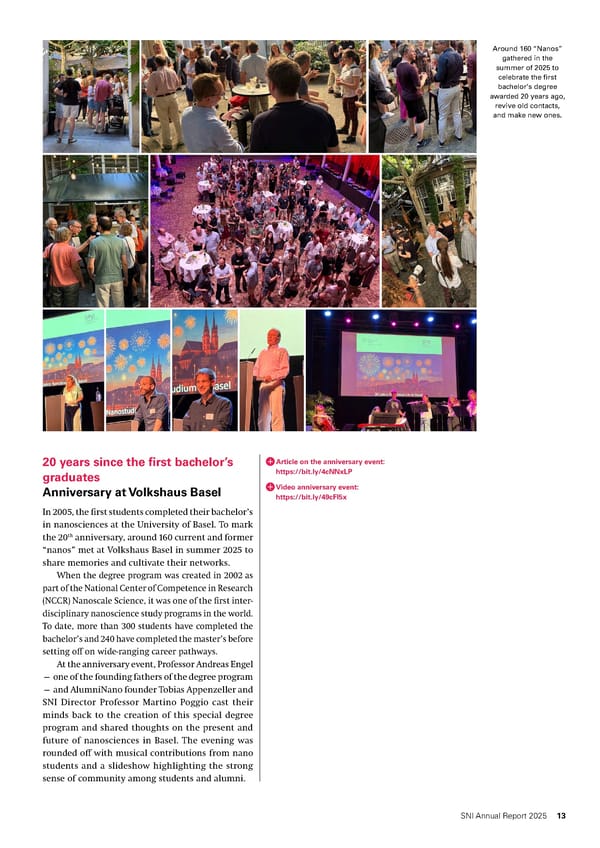
Around 160 “Nanos” gathered in the summer of 2025 to celebrate the first bachelor‘s degree awarded 20 years ago, revive old contacts, and make new ones. 20 years since the first bachelor’s graduates Anniversary at Volkshaus Basel In 2005, the first students completed their bachelor’s in nanosciences at the University of Basel. To mark the 20 th anniversary, around 160 current and former “nanos” met at Volkshaus Basel in summer 2025 to share memories and cultivate their networks. When the degree program was created in 2002 as part of the National Center of Competence in Research (NCCR) Nanoscale Science, it was one of the first inter- disciplinary nanoscience study programs in the world. To date, more than 300 students have completed the bachelor’s and 240 have completed the master’s before setting off on wide-ranging career pathways. At the anniversary event, Professor Andreas Engel — one of the founding fathers of the degree program — and AlumniNano founder Tobias Appenzeller and SNI Director Professor Martino Poggio cast their minds back to the creation of this special degree program and shared thoughts on the present and future of nanosciences in Basel. The evening was rounded off with musical contributions from nano students and a slideshow highlighting the strong sense of community among students and alumni. Article on the anniversary event: https://bit.ly/4cNNxLP Video anniversary event: https://bit.ly/49cFl5x 13 SNI Annual Report 2025
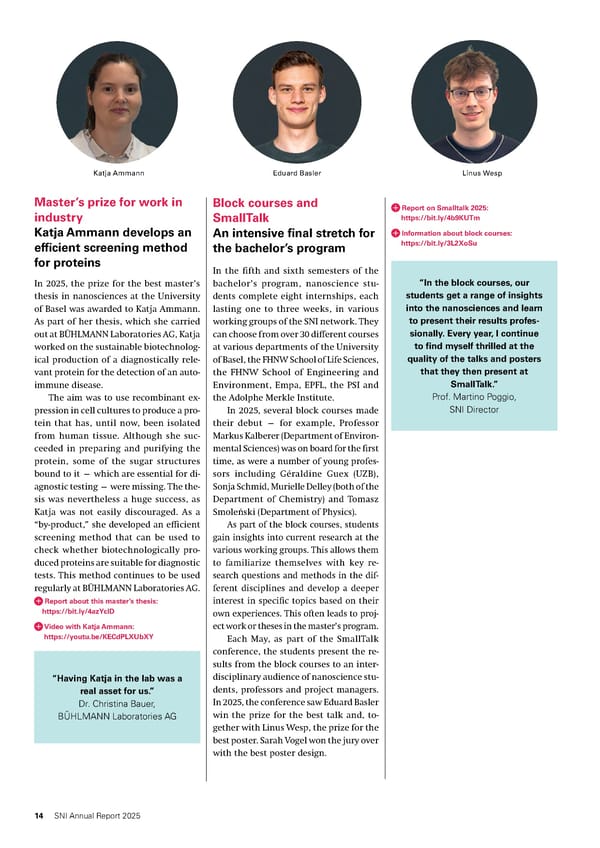
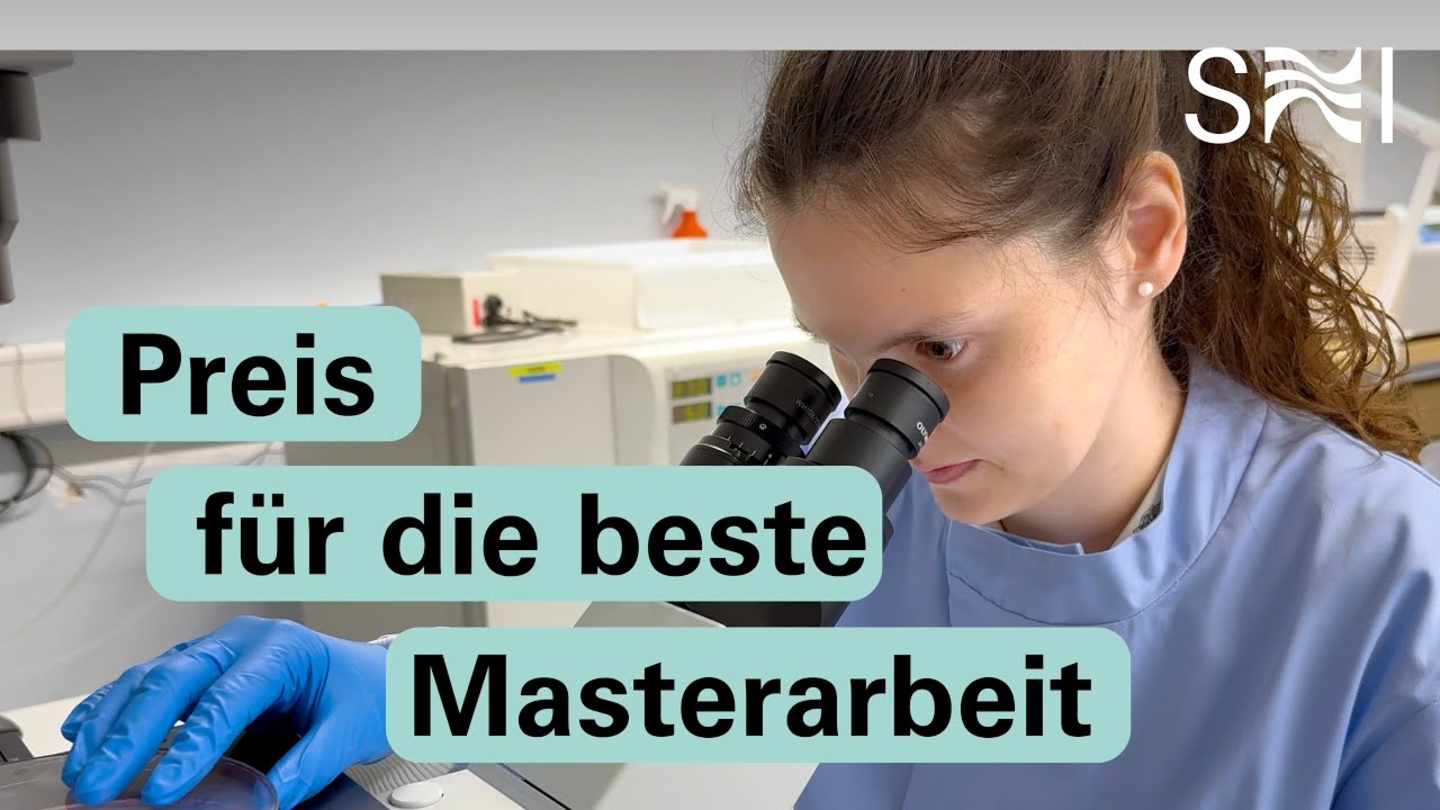
Master’s prize for work in industry Katja Ammann develops an efficient screening method for proteins In 2025, the prize for the best master’s thesis in nanosciences at the University of Basel was awarded to Katja Ammann. As part of her thesis, which she carried out at BÜHLMANN Laboratories AG, Katja worked on the sustainable biotechnolog- ical production of a diagnostically rele- vant protein for the detection of an auto- immune disease. The aim was to use recombinant ex- pression in cell cultures to produce a pro- tein that has, until now, been isolated from human tissue. Although she suc- ceeded in preparing and purifying the protein, some of the sugar structures bound to it — which are essential for di- agnostic testing — were missing. The the- sis was nevertheless a huge success, as Katja was not easily discouraged. As a “by-product,” she developed an efficient screening method that can be used to check whether biotechnologically pro- duced proteins are suitable for diagnostic tests. This method continues to be used regularly at BÜHLMANN Laboratories AG. Report about this master’s thesis: https://bit.ly/4azYcID Video with Katja Ammann: https://youtu.be/KECdPLXUbXY “Having Katja in the lab was a real asset for us.” Dr. Christina Bauer, BÜHLMANN Laboratories AG Block courses and SmallTalk An intensive final stretch for the bachelor’s program In the fifth and sixth semesters of the bachelor’s program, nanoscience stu- dents complete eight internships, each lasting one to three weeks, in various working groups of the SNI network. They can choose from over 30 different courses at various departments of the University of Basel, the FHNW School of Life Sciences , the FHNW School of Engineering and Environment , Empa, EPFL, the PSI and the Adolphe Merkle Institute. In 2025, several block courses made their debut — for example, Professor Markus Kalberer (Department of Environ- mental Sciences) was on board for the first time, as were a number of young profes- sors including Géraldine Guex (UZB), Sonja Schmid, Murielle Delley (both of the Department of Chemistry) and Tomasz Smoleński (Department of Physics). As part of the block courses, students gain insights into current research at the various working groups. This allows them to familiarize themselves with key re- search questions and methods in the dif- ferent disciplines and develop a deeper interest in specific topics based on their own experiences. This often leads to proj- ect work or theses in the master’s program. Each May, as part of the SmallTalk conference, the students present the re- sults from the block courses to an inter- disciplinary audience of nanoscience stu- dents, professors and project managers. In 2025, the conference saw Eduard Basler win the prize for the best talk and, to- gether with Linus Wesp, the prize for the best poster. Sarah Vogel won the jury over with the best poster design. Report on Smalltalk 2025: https://bit.ly/4b9KUTm Information about block courses: https://bit.ly/3L2XoSu “In the block courses, our students get a range of insights into the nanosciences and learn to present their results profes- sionally. Every year, I continue to find myself thrilled at the quality of the talks and posters that they then present at SmallTalk.” Prof. Martino Poggio, SNI Director Katja Ammann Eduard Basler Linus Wesp 14 SNI Annual Report 2025
New faces on the board Fresh momentum at AlumniNano In late 2025, Tobias Appenzeller ended his 11-year tenure as pres- ident of the AlumniNano organization and handed over to the new president, Milan Liepelt. Working with a dedicated board, Appenzeller built up an active network over recent years, bring- ing together current and former nanoscience students and fa- cilitating regular meetups in Basel and Zurich. The reunion in 2025 bid farewell to the old board and welcomed the new team, which is keen to further expand the network with new ideas. The young team, consisting of Milan Liepelt (president), Alexa Dani and Timon Flathmann (communication), Gregory Zaugg (events) and Niels Burzan (finances), combines experience in quantum computing, medtech, nano drug delivery and phar- maceutical analytics, as well as risk management and venture capital. With fresh energy, the board aims to further strengthen links between students, alumni and the SNI. AlumniNano is to enjoy greater visibility — for example, at the general assembly of the nano student association, the master’s degree ceremony or at informal get-togethers. There are also plans to provide greater support for lunchtime lectures and, in the long term, to build up a mentoring program. For all alumni, the team is planning additional events, a more active LinkedIn group and initiatives to incorporate additional members. Moreover, the aim is to collaborate with other alumni groups and companies in order to promote dialog and new career opportunities. SNI INSight article on the new board: https://bit.ly/4rOzgTK Brochure with brief portraits of various career pathways of nanoscience graduates (in German): https://bit.ly/3XZ7hUe Gregory Zaugg, Timon Flathmann, Alexa Dani and Milan Liepelt (from left to right) are the new board members of the AlumniNano organization, commit- ted to fostering a vibrant network of “nanos. ” Niels Burzan, who is also on the board, is not pictured in the photo. (Image: S. Stalder) 15 SNI Annual Report 2025
SNI PhD School: Network for interdisciplinary doctoral dissertations The SNI PhD School provides young researchers with a unique opportuni- ty to engage in cutting-edge research projects within a stimulating net- work and to develop personally in an interdisciplinary environment. Doc- toral students carry out research at the University of Basel, the Paul Scherrer Institute, t he University of Applied Sciences Northwestern Switzerland or the Department of Biosystems Science and Engineering of ETH Zurich in Basel. Two associate doctoral students also come from Empa, the Swiss Federal Laboratories for Materials Testing and Research. In addition to their own topics, doctoral students get an insight into projects outside their line of research as part of various SNI events. The Annual Meeting and the “Nanoscience in the Snow” Winter School pro- vide them with numerous opportunities to talk to researchers from oth- er disciplines during their doctorate and to give clear presentations of their own research findings to this interdisciplinary audience. They are also motivated to develop their projects with a view to applications and founding a startup – and gain the necessary know-how through courses developed specifically for the PhD School. In 2025, there were a total of 41 doctoral students enrolled in the SNI PhD School – 24% of whom were women. Nine doctoral students suc- cessfully completed their dissertations in 2025. Six new projects were approved in 2025 that will start in 2026. Of the 69 SNI doctoral students who have completed their doctoral dis- sertations so far, around 70% were working at an industrial company at the end of 2025, and around 30% were working at a research institution, a public authority or a school. 16 SNI Annual Report 2025
Machine learning for protein optimization In his doctoral dissertation, Dr. Vanni Doffini investigated how machine learning can be used to specifically modify proteins and therefore improve their properties. Even small changes in the amino acid sequence of a protein can alter key pa- rameters such as stability, binding and activity. When it comes to optimizing proteins based on changes in the amino acid sequence caused by individual mu- tations, it is therefore important to pro- vide reliable predictions about the result- ing properties. Machine learning (ML) can help to provide valid predictions about unknown protein variants and thereby facilitate the search for useful mutations. In his doctoral dissertation at the Department of Chemistry at the Univer- sity of Basel, V anni not only investigated the theoretical basis of ML-assisted pro- tein modification, but also carried out real experiments with a view to practical applications. Using the method devel- oped as part of this work, he was able to optimize a therapeutic peptide to combat antibiotic-resistant bacteria. He also de- veloped a new platform to screen pro- tein-protein interactions, studied some of the theoretical aspects of applying ML to protein engineering, and introduced a new ML toolkit for faster analysis of large biophysical datasets. Publication: https://doi.org/10.1021/acs.nano- lett.3c03026 Vanni Doffini completed his doctoral thesis at the Department of Chemistry at the University of Basel. He now works as a scientist at the Istituto Dalle Molle di Studi sull‘Intelligenza Artificiale in Lugano. Mitchell Brüderlin completed his work at the Biozentrum at the University of Basel and contin- ued to work there as a postdoctoral researcher. Assembly of nanoharpoon in response to attack In his doctoral dissertation, Dr. Mitchell Brüderlin studied the type VI secretion system of the bacterium Pseudomonas aeruginosa in greater detail. Like other bacteria, Pseudomonas also uses the se- cretion system like a nanoharpoon to in- ject toxins into neighboring cells. That being said, P. aeruginosa only as- sembles its type VI secretion system to defend itself against an attack. Using the tip of an atomic force microscope (AFM), Mitchell was able to simulate an attack of this kind and demonstrate that damage to the outer bacterial membrane is the key factor that triggers the bacteria to as- semble the secretion system and fire the nanoharpoon. Before these analyses could be carried out on the AFM, Mitchell used several mu- tations to ensure that the bacteria could not move during the analyses. He then set the AFM up so that it moved back and forth across a grid, poking the immobi- lized bacterial cells every 800 nanome- ters. In up to 90 percent of cases in which the outer membrane of the Pseudomonas bacteria was damaged by the AFM tip, the bacteria assembled their nanoharpoon within ten seconds in order to fire back. This counterattack was launched in ex- actly the direction from which the attack by the AFM tip came. Publication: https://www.science.org/ doi/10.1126/sciadv.adr1713 Video: https://youtu.be/0uOVdcOy3vQ Measuring system for tiny electric effects In his doctoral dissertation, Dr. Luca Forrer developed a novel measuring system that allows the analysis of extremely small electrical effects on the nanometer scale at very low temperatures close to abso- lute zero. The system combines an atomic force microscope (AFM) with highly sen- sitive sensors that can detect the charges of individual electrons. As part of this work, Luca investigated two different measuring tips. The first has multiple tiny electrodes that can be con- trolled independently of one another. This tip can be used to influence local electrical properties and spatially map the reaction of nanostructures. For the second probe, Luca took a “quantum dot” — a nanoscopically small component that responds to electric charges with ex- tremely high sensitivity — and incorpo- rated it directly onto the tip. Paving the way for the spatial imaging of local po- tential, this innovation was made possi- ble by new manufacturing techniques that allow sensitive nanostructures to be transferred onto measuring tips pre- cisely, as well as a particularly well-pro- tected design of the measuring probe. This work lays the foundation for new types of scanning probe measurements in which commercially available AFM hardware can be used not only to image nanostructures but also to manipulate them electrically and measure them pre- cisely on a local level. Publication:https://doi.org/10.1063/5.0127665 Video: https://youtu.be/UBcYtnmA9Hc Luca Forrer worked on his doctoral thesis at the Department of Physics at the University of Basel and completed it shortly before the end of 2025. 17 SNI Annual Report 2025
On the road to new metal-organic materials In his doctoral dissertation, Ajmal Roshan Unniram Parambil investigated “metal oxo clusters” consisting of the metals zir- conium and hafnium. These tiny mole- cules are made up of only a few atoms and can be used to build up metal-organic frameworks (MOFs). Additionally, they can bridge the chemistries between MOFs and nanocrystals consisting of metal ox- ides and therefore pave the way for the targeted building-up of new materials with precisely defined properties. The aim of this work was to gain a better understanding of how these clus- ters are structured, which molecules (li- gands) stabilize their surface, and how they can form larger structures. To this end, Ajmal combined experiments and computer simulations. He analyzed known clusters of 23 different metals to identify general trends in structure and chemistry and to design new clusters in a targeted manner. This revealed that cer- tain phosphorus-based ligands make the clusters particularly stable — a finding that he was able to predict theoretically and confirm experimentally. Ultimately, he succeeded in getting clusters to assemble themselves into thin, two-dimensional layers using special “amphiphilic” ligands that contain both hydrophilic and hydrophobic sections. These ordered structures, formed at the interface between air and water, could serve as building blocks for new, tai- lor-made materials in the future. Publication: https://doi.org/10.1039/ D4SC03859B Ajmal Roshan Unniram Parambil completed his thesis at the Department of Chemistry at the Uni- versity of Basel and at the School of Life Sciences FHNW and is currently working as a postdoctoral researcher at the Department of Chemistry. Surface properties of spintronic materials In his doctoral dissertation, Dr. Martin Heinrich investigated materials that are relevant to novel storage and switching technologies. These materials have both semiconducting and special magnetic prop- erties and are known as multiferroic or al- termagnetic systems. They may have appli- cations in spintronics, a field of research that uses the spin of electrons — instead of their charge — to store information. Given that surfaces play a key role as interfaces in electronic components, Mar- tin analyzed the surfaces of three differ- ent systems (germanium telluride, man- ganese telluride and germanium manga- nese telluride). Using various analytical techniques, he was able to gain new in- sights into atomic spacing, reconstruction and phase separation on the surface of the systems analyzed, paving the way for the development of future spintronic compo- nents. Germanium-telluride exhibited surface relaxation and, when electric fields were applied, a slight displacement in the up- permost atomic layer. The surface of man- ganese telluride showed different rear- rangements of the atoms depending on heat and the substrate material. In the case of germanium manganese telluride, dop- ing with manganese caused the surface to split up into areas of GeTe and MnTe. Martin Heinrich worked at PSI for his doctoral thesis. He is now a postdoctoral researcher at Johannes Kepler University Linz. Floating thanks to acoustics In his doctoral dissertation, Dr. Shichao Jia investigated how sound waves can be used to manipulate samples without touching them. He investigated both acoustic levitation and acoustic tweezers, scaling the technologies down to ever smaller dimensions. In the case of acoustic levitation, Shichao analyzed how thin disks with a diameter of just a few millimeters can be lifted and made to rotate using ultrasonic waves. He was interested in how the size and shape of the disks influence rotation. Disks of this kind have been successfully used as sample holders for X-ray diffrac- tion experiments. Shichao also applied the concept to experiments in water. In order to rotate miniature rotors in water, where the speed of sound is higher, he used ultrasonic waves at much higher fre- quencies. Shichao also investigated how high- frequency ultrasonic waves can be used to manipulate microscopic samples pre- cisely and without touching them. For example, these acoustic tweezers can be used to manipulate biological samples in a microfluidic system — because the acoustic radiation force not only moves soft samples in suspension but also com- presses them, as one would expect from “tweezers.” Publication: https://doi.org/10.1063/5.0126000 Shichao Jia completed his doctoral thesis at the Paul Scherrer Institute and now works for Eulitha AG. 18 SNI Annual Report 2025
Temperature sensors for fuel cells In her doctoral dissertation, Dr. Antonia Ruffo researched ferromagnetic materials that could be used as temperature sensors in polymer electrolyte membrane fuel cells (PEMFCs). These fuel cells are char- acterized by the use of a solid polymer electrolyte and, like other fuel cells, can efficiently convert hydrogen into electri- cal energy. They could see greater use in electric vehicles, but their operation re- quires a stable temperature, as the cho- sen membrane can only conduct protons at optimum humidity. If it is too hot, the membrane dries out and the proton con- ductivity decreases — if it is too cold, the cells suffer from water flooding, which hinders gas exchange. Precise temperature monitoring in- side the cell is therefore crucial. To this end, Antonia investigated various ferro- magnetic materials in the micro and nanometer range that could be suitable for use as temperature sensors. She ulti- mately optimized a neodymium-iron-bo- ron alloy (NdFeB) for use in operational fuel cells. With this kind of noninvasive tem- perature measurement inside the cell, this research represents an important contribution to a better understanding of the temperature distribution in PEMFCs. It shows how new sensor materials can improve the operational stability and ef- ficiency of this technology — a step to- ward the wider use of this environmen- tally friendly energy source. Antonia Ruffo was at the Paul Scherrer Institute for her doctoral thesis. She now works as a se- nior scientist at Lonza. Nanowires as highly sensitive sensors In his doctoral dissertation, Dr. Lukas Schneider used a refined version of mag- netic force microscopy to investigate magnetism on the nanoscale. For this, he used a cantilever — a nanowire fixed in place at one end — that vibrates like a pendulum and whose loose end carries a tiny magnet. This highly sensitive sensor can be used to measure very small changes in magnetic fields with a resolu- tion of less than 100 nm. Magnetic force microscopy is therefore not only ex- tremely sensitive but can also be used across a wide parameter range — at ev- erything from just above absolute zero to room temperature and in strong mag- netic fields of several teslas. As well as imaging static magnetic field distribu- tions, this technique also reveals the ex- tent to which a material is dynamically influenced by the magnetic field gener- ated by the tiny magnet. Specifically, Lukas demonstrated this newly refined version of magnetic force microscopy on the helimagnetic material Cu 2 OSeO 3 , as well as on the two-dimen- sional van der Waals magnets Cr 2 Ge 2 Te 6 and EuGe 2 . This showed that magnetic force microscopy with nanowires as can- tilevers is suitable for weakly magnetic samples and allows the mapping of local magnetic susceptibility on the nanoscale. Publication: https://pubs.rsc.org/en/content/ articlelanding/2024/nr/d3nr06550b Lukas Schneider wrote his doctoral thesis at the Department of Physics at the University of Basel and now works there as a postdoctoral researcher. Magnetic vortices for data storage In his doctoral dissertation, Dr. Sam Treves investigated skyrmions in the material neo- dymium manganese germanide (NdMn 2 Ge 2 ). Skyrmions are tiny, stable magnetic vortices with huge potential for applica- tions in data storage and novel computing methods. Before they can be used, however, it is important to understand how they form, disappear and interact with one an- other. Crystals of NdMn 2 Ge 2 are suitable for studies of this kind, as skyrmions within the material can remain stable at room temperature and without an applied exter- nal magnetic field following the applica- tion of a suitable field cooling protocol. When Sam first examined thin lamel- lae that he had cut from a crystal, he was able to demonstrate the presence of stable skyrmions — even with temperature changes and applied magnetic fields. As well as growing very slowly, however, the crystals were quite expensive and difficult to scale. Sam therefore grew and investi- gated thin films of the material, which are easier to produce and scale up. In these thin films of NdMn 2 Ge 2 grown on a sub- strate, he also observed skyrmion-like structures at room temperature following the application of a field cooling protocol. In these films, unlike in the crystal, the direction of the skyrmion core’s magneti- zation could be reversed — presumably due to the small grains and defects within the material. This work provides new insights into how the material structure influences the magnetic properties, and demonstrates the potential of thin NdMn 2 Ge 2 layers for future storage technologies. Publication: https://doi.org/10.1038/s41598- 024-82114-2 Sam Treves wrote his doctoral thesis at the Department of Physics at the University of Basel. 19 SNI Annual Report 2025
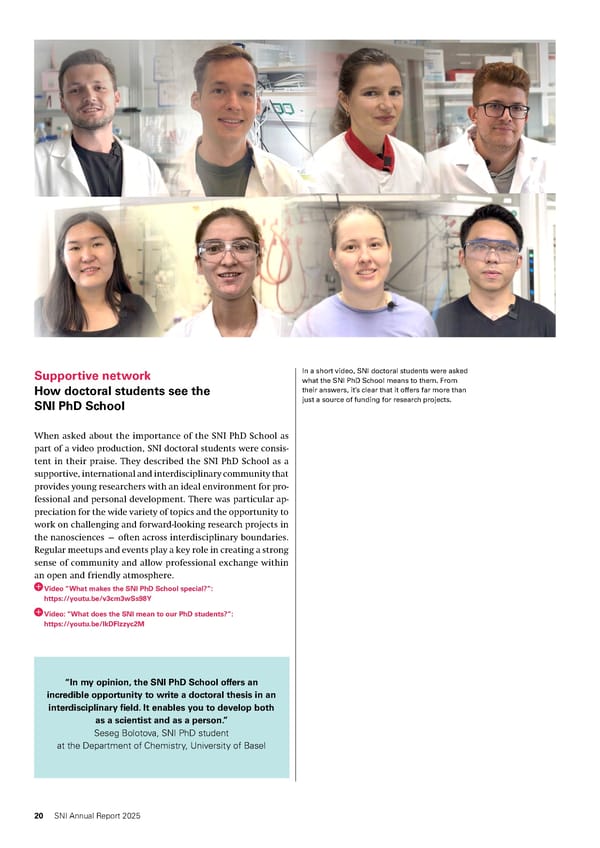
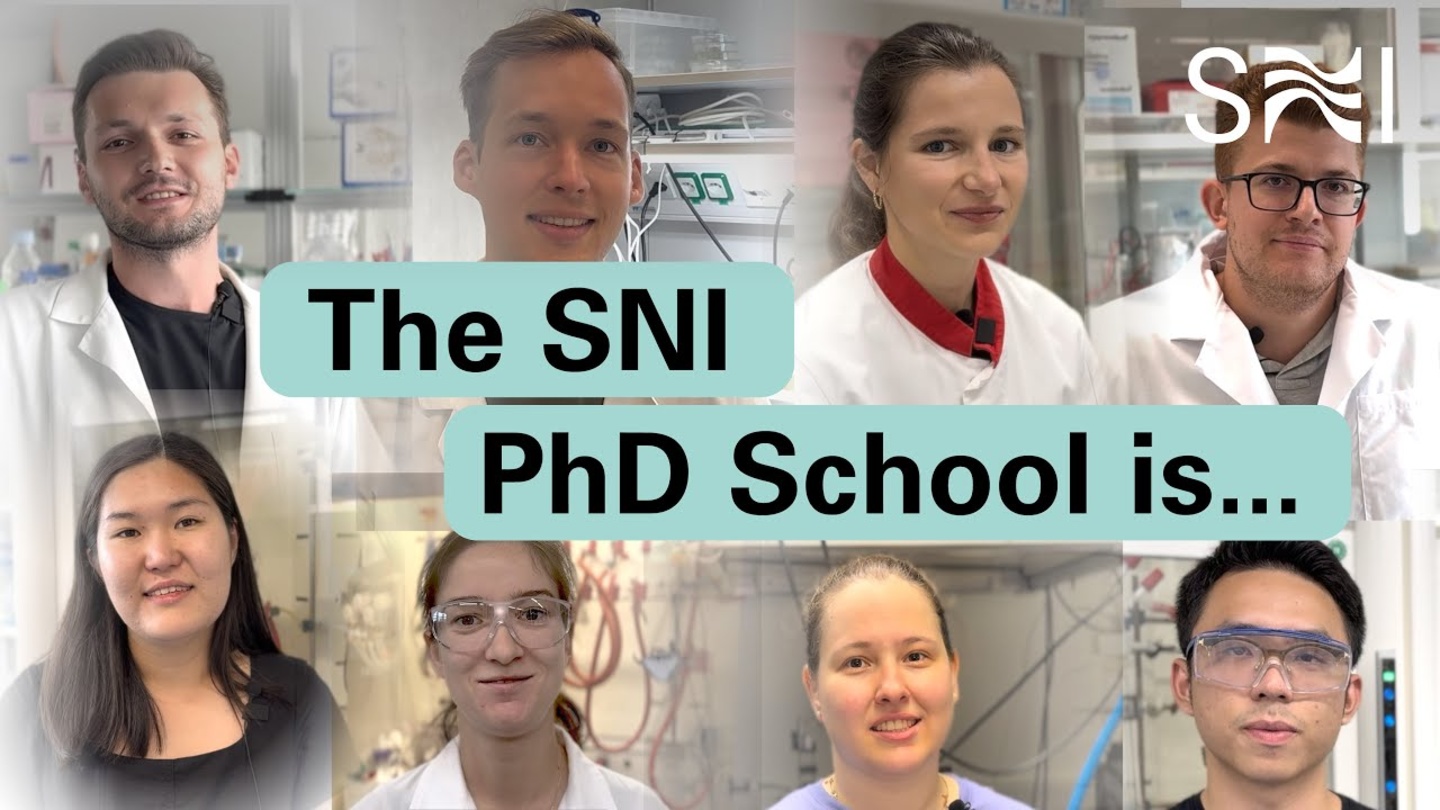
Supportive network How doctoral students see the SNI PhD School When asked about the importance of the SNI PhD School as part of a video production, SNI doctoral students were consis- tent in their praise. They described the SNI PhD School as a supportive, international and interdisciplinary community that provides young researchers with an ideal environment for pro- fessional and personal development. There was particular ap- preciation for the wide variety of topics and the opportunity to work on challenging and forward-looking research projects in the nanosciences — often across interdisciplinary boundaries. Regular meetups and events play a key role in creating a strong sense of community and allow professional exchange within an open and friendly atmosphere. Video “What makes the SNI PhD School special?”: https://youtu.be/v3cm3wSs98Y Video: “What does the SNI mean to our PhD students?”: https://youtu.be/lkDFlzzyc2M In a short video, SNI doctoral students were asked what the SNI PhD School means to them. From their answers, it’s clear that it offers far more than just a source of funding for research projects. “In my opinion, the SNI PhD School offers an incredible opportunity to write a doctoral thesis in an interdisciplinary field. It enables you to develop both as a scientist and as a person.” Seseg Bolotova, SNI PhD student at the Department of Chemistry, University of Basel 20 SNI Annual Report 2025
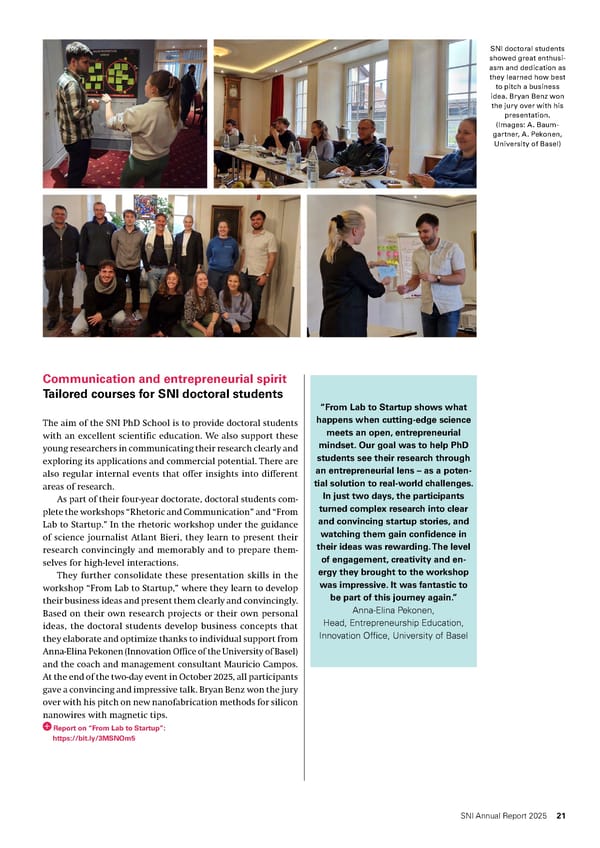
SNI doctoral students showed great enthusi- asm and dedication as they learned how best to pitch a business idea. Bryan Benz won the jury over with his presentation. (Images: A. Baum- gartner, A. Pekonen, University of Basel) Communication and entrepreneurial spirit Tailored courses for SNI doctoral students The aim of the SNI PhD School is to provide doctoral students with an excellent scientific education. We also support these young researchers in communicating their research clearly and exploring its applications and commercial potential. There are also regular internal events that offer insights into different areas of research. As part of their four-year doctorate, doctoral students com- plete the workshops “Rhetoric and Communication” and “From Lab to Startup.” In the rhetoric workshop under the guidance of science journalist Atlant Bieri, they learn to present their research convincingly and memorably and to prepare them- selves for high-level interactions. They further consolidate these presentation skills in the workshop “From Lab to Startup,” where they learn to develop their business ideas and present them clearly and convincingly. Based on their own research projects or their own personal ideas, the doctoral students develop business concepts that they elaborate and optimize thanks to individual support from Anna-Elina Pekonen (Innovation Office of the University of Basel) and the coach and management consultant Mauricio Campos. At the end of the two-day event in October 2025, all participants gave a convincing and impressive talk. Bryan Benz won the jury over with his pitch on new nanofabrication methods for silicon nanowires with magnetic tips. Report on “From Lab to Startup”: https://bit.ly/3MSNOm5 “From Lab to Startup shows what happens when cutting-edge science meets an open, entrepreneurial mindset. Our goal was to help PhD students see their research through an entrepreneurial lens – as a poten- tial solution to real-world challenges. In just two days, the participants turned complex research into clear and convincing startup stories, and watching them gain confidence in their ideas was rewarding. The level of engagement, creativity and en- ergy they brought to the workshop was impressive. It was fantastic to be part of this journey again.” Anna-Elina Pekonen, Head, Entrepreneurship Education, Innovation Office, University of Basel 21 SNI Annual Report 2025
22 SNI Annual Report 2025
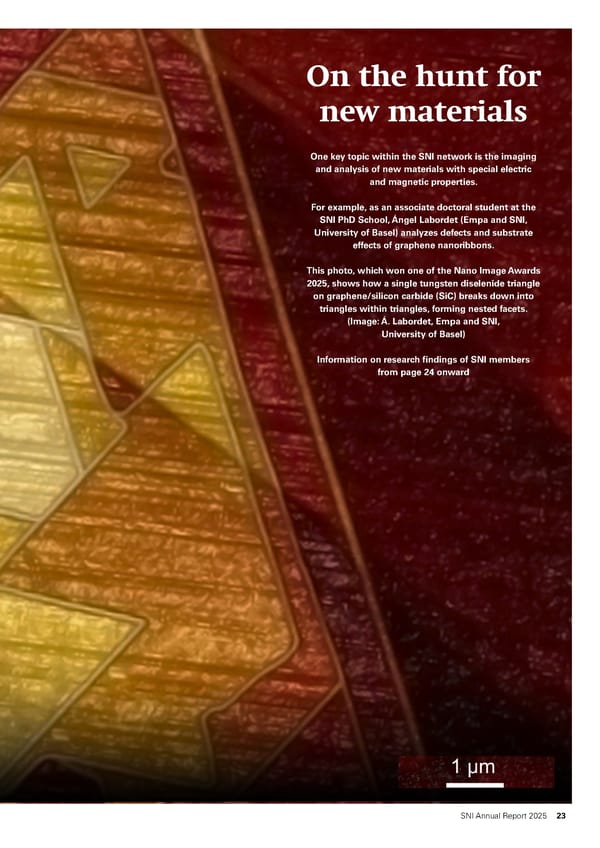
On the hunt for new materials One key topic within the SNI network is the imaging and analysis of new materials with special electric and magnetic properties. For example, as an associate doctoral student at the SNI PhD School, Ángel Labordet (Empa and SNI, University of Basel) analyzes defects and substrate effects of graphene nanoribbons. This photo, which won one of the Nano Image Awards 2025, shows how a single tungsten diselenide triangle on graphene/silicon carbide (SiC) breaks down into triangles within triangles, forming nested facets. (Image: Á. Labordet, Empa and SNI, University of Basel) Information on research findings of SNI members from page 24 onward 23 SNI Annual Report 2025
Research: Focus on nanoimaging and nanofabrication Members of the SNI network conduct research across a wide range of fields, as can be seen from their publications in renowned scientif- ic journals. Examples include topics explored by teams at various re- search institutions from the life sciences as well as from materials, quantum and environmental science. This work often revolves around detailed imaging and analysis of nanoscale structures. The small size of the objects being studied calls for the use and development of highly specialized methods and equipment, which in turn rely on spe- cial manufacturing processes on an extremely small scale. This diversity and the focus on nanoimaging and nanofabrication are reflected by a selection of the 94 publications by researchers from the SNI network in 2025. Publications primarily focused on results of research into basic scientific questions by the various teams. This year, however, some applied Nano-Argovia projects have also pre- sented results in scientific publications. With their research activities in the areas of basic and applied sci- ence, SNI members make a key contribution to our understanding of processes and laws operating on the nanoscale and therefore pave the way for applications for the benefit of society. 24 SNI Annual Report 2025
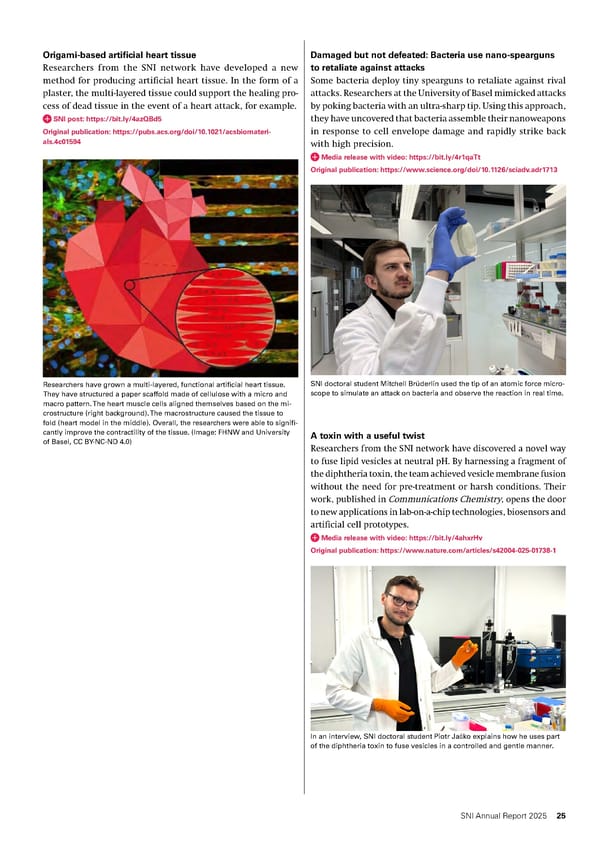
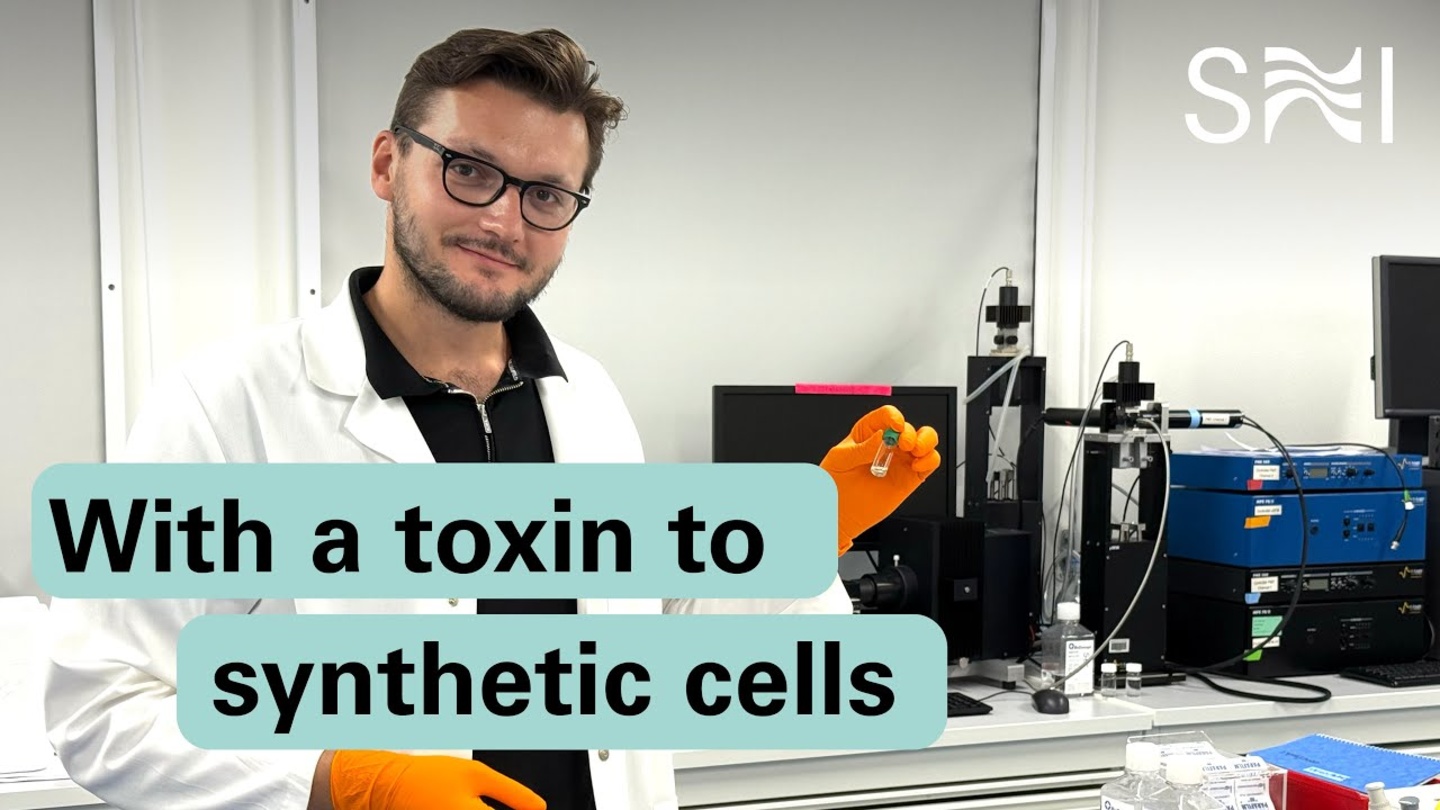
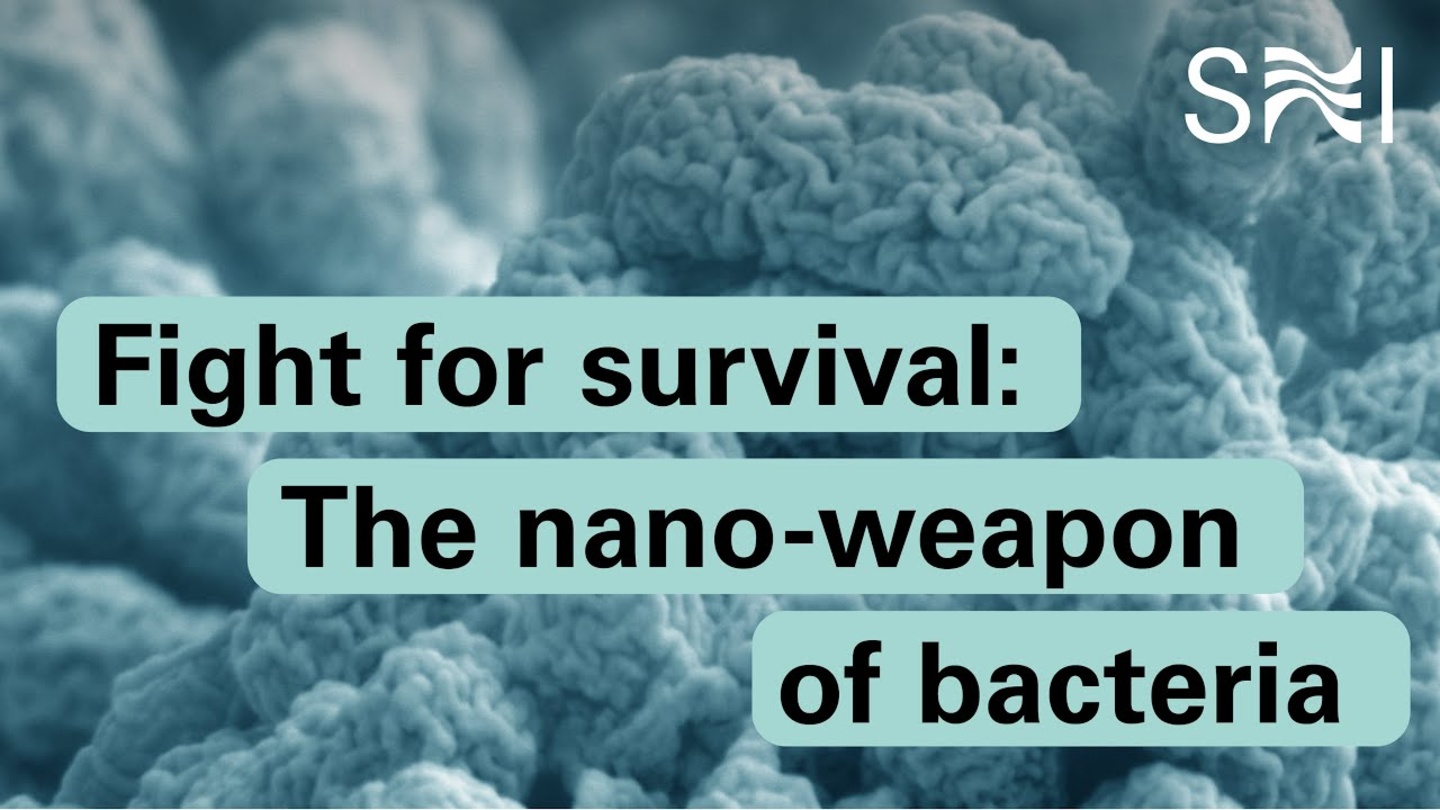
A toxin with a useful twist Researchers from the SNI network have discovered a novel way to fuse lipid vesicles at neutral pH. By harnessing a fragment of the diphtheria toxin, the team achieved vesicle membrane fusion without the need for pre-treatment or harsh conditions. Their work, published in Communications Chemistry, opens the door to new applications in lab-on-a-chip technologies, biosensors and artificial cell prototypes. Media release with video: https://bit.ly/4ahxrHv Original publication: https://www.nature.com/articles/s42004-025-01738-1 In an interview, SNI doctoral student Piotr Ja ś ko explains how he uses part of the diphtheria toxin to fuse vesicles in a controlled and gentle manner. Origami-based artificial heart tissue Researchers from the SNI network have developed a new method for producing artificial heart tissue. In the form of a plaster, the multi-layered tissue could support the healing pro- cess of dead tissue in the event of a heart attack, for example. SNI post: https://bit.ly/4azQBd5 Original publication: https://pubs.acs.org/doi/10.1021/acsbiomateri- als.4c01594 Researchers have grown a multi-layered, functional artificial heart tissue. They have structured a paper scaffold made of cellulose with a micro and macro pattern. The heart muscle cells aligned themselves based on the mi- crostructure (right background). The macrostructure caused the tissue to fold (heart model in the middle). Overall, the researchers were able to signifi- cantly improve the contractility of the tissue. (Image: FHNW and University of Basel, CC BY-NC-ND 4.0) Damaged but not defeated: Bacteria use nano-spearguns to retaliate against attacks Some bacteria deploy tiny spearguns to retaliate against rival attacks. Researchers at the University of Basel mimicked attacks by poking bacteria with an ultra-sharp tip. Using this approach, they have uncovered that bacteria assemble their nanoweapons in response to cell envelope damage and rapidly strike back with high precision. Media release with video: https://bit.ly/4r1qaTt Original publication: https://www.science.org/doi/10.1126/sciadv.adr1713 SNI doctoral student Mitchell Brüderlin used the tip of an atomic force micro- scope to simulate an attack on bacteria and observe the reaction in real time. 25 SNI Annual Report 2025
Polymer-inorganic hybrid nanoparticles can con- vert external stimuli such as light or magnetic field into heat, triggering drug release. (Image: A. Nikolet ić , Department of Chemistry and SNI, University of Basel and FHNW) Reaction due to heat As part of a doctoral dissertation at the SNI PhD School, re- searchers from the FHNW School of Life Sciences and the University of Basel have analyzed a new carrier system for active substances that promises to release drugs in a targeted and controlled manner within the body. This work focused on polymers that undergo changes at slightly elevated tempera- tures, combined with inorganic nanoparticles that convert ex- ternal stimuli such as light or magnetic fields into heat, allow- ing precise control over the spatial and temporal release of active substances. These systems can be used not only for ther- apy but also for imaging. This makes them particularly inter- esting for the treatment of complex diseases, as the researchers conclude in the journal Helvetica. Original publication: https://onlinelibrary.wiley.com/doi/10.1002/ hlca.202400193 26 SNI Annual Report 2025
Help with the insertion of membrane proteins For the first time, researchers have shown how a specific acces- sory protein (chaperone SurA) delivers membrane proteins to a protein factory in the outer membrane of gram-negative bac- teria (a BAM complex) in a targeted manner. The team, which also includes a doctoral student at the SNI PhD School, used high-resolution cryo-electron microscopy to reveal that the chaperone SurA performs a pronounced swinging motion when docking to the BAM complex. This movement apparently guides the controlled entry of proteins into the bacterial membrane. Published in the journal Science Advances, the findings provide new insights into one of the vital functions of bacteria and could open up new starting points for antibiotics. Original publication: https://www.science.org/doi/10.1126/sciadv.ads6094 The swinging motion of the SurA chaperone apparently controls the target- ed transfer of proteins to the BAM complex, which then integrates them into the outer bacterial membrane. (M. Degen, Biozentrum and SNI, University of Basel) Thin membrane for improved release of active substances Researchers from the SNI network have developed special block copolymers in order to produce improved pH-sensitive nanocar- riers with a thin membrane that can release active substances with particularly high efficiency. By targeted adjustment of the polymer structure, they reduced the membrane thickness, thereby improving the speed of release. This was tested using various model drugs, including doxorubicin, in slightly acidic conditions such as those found in tumors. The nanocarriers showed no cellular damage and therefore offer a promising approach to future targeted drug delivery, as the researchers report in the journal Macro Molecular Rapid Communications. Original publication: https://doi.org/10.1002/marc.202500418 The developed vesicles with a thin membrane effectively release their cargo at a specific pH value. (Image: A. Nikoleti ć , Department of Chemistry and SNI, University of Basel and FHNW) Structure determination thanks to electron diffraction In collaboration with ELDICO Scientific, a startup founded within the SNI network, researchers have used 3D electron dif- fraction (3D ED) to analyze the structure of complex molecules — which wasn’t possible using classical X-ray crystallography. Specifically, they analyzed products of an “atroposelective ring-opening reaction,” proving the effectiveness of electron diffraction for 3D structure determination with small crystals. The work was published in the journal Chimia. The basis for establishing ELDICO Scientific emerged from the Nano-Argovia project A3EDPI. The collaboration described above took place at the Electron Diffraction Experience Center, where SNI members can carry out measurements on the elec- tron diffractometer in collaboration with ELDICO Scientific. Report in SNI INSight: https://bit.ly/4tVvR72 Original publication: https://www.chimia.ch/chimia/article/view/2025_255 27 SNI Annual Report 2025
An artificial metalloenzyme (orange-brown structure) anchored to the sur- face of lipid membranes allows lateral phase separation in membranes to be specifically controlled (represented by light blue and pink areas). Targeted genetic optimization of the enzyme can lead to the formation of larger mem- brane domains, which can result in cell budding due to the different curva- tures of the membranes. (Image: R. Hamaguchi, Institute of Science, Tokyo) Controlled phase separation in membranes Cell membranes consist of a mixture of different lipids and proteins. These are not always evenly distributed. Under certain conditions, similar lipids and proteins can accumulate laterally in small areas within the membrane. This phase separation creates functional zones within the membrane that play a key role in many biological processes, including signal transmission and transport. A team of researchers from the SNI network has shown for the first time that such lateral phase separation in membranes can be specifically controlled by a chemical reaction. This is made possible by the use of an artificial metalloenzyme an- chored to the surface of the lipid membrane. SNI post: https://bit.ly/4acl0MW Original publication: https://pubs.acs.org/doi/10.1021/jacs.5c10187 New spectroscopic methods for the quantitative detection of functional groups on the nanoparticles surface The combination of nanoparticles with biologically active mol- ecules such as antibodies offers promising applications in the diagnosis and treatment of various diseases. In order to design these so-called bioconjugated nanoparticles in a precise manner, it is important to obtain quantitative information about the number of functional groups on the nanoparticle surface prior to bioconjugation reaction. Researchers from the SNI network have now developed two new spectroscopy methods to quantify functional surface groups of metal oxide nanoparticles. SNI post: https://bit.ly/4cwHzz5 Original publication: https://onlinelibrary.wiley.com/doi/10.1002/ sstr.202500083 Electron microscopic image of nanoparticles. (Image: Department of Chemistry and Nano Imaging Lab, University of Basel) Manipulating tiny things with sound Researchers from the SNI network recently published their find- ings on using acoustic tweezers — devices that manipulate tiny objects using sound waves without solid contact— in a more efficient and sustainable manner. Rather than using a single chip, the researchers used a combination of a reusable sonic chip and a disposable microfluidic chip. This allowed them to conduct the experiments more cost-effectively and with mini- mized cross-contamination between experiments. SNI post: https://bit.ly/4kdhKpk Original publication: https://ieeexplore.ieee.org/document/11045819 Biological cells can be captured and examined with the help of sound. They deform temporarily under the pressure of the waves. (Image: Scale bars 10 μm, S. Jia, SNI and Paul Scherrer Institute PSI) 28 SNI Annual Report 2025
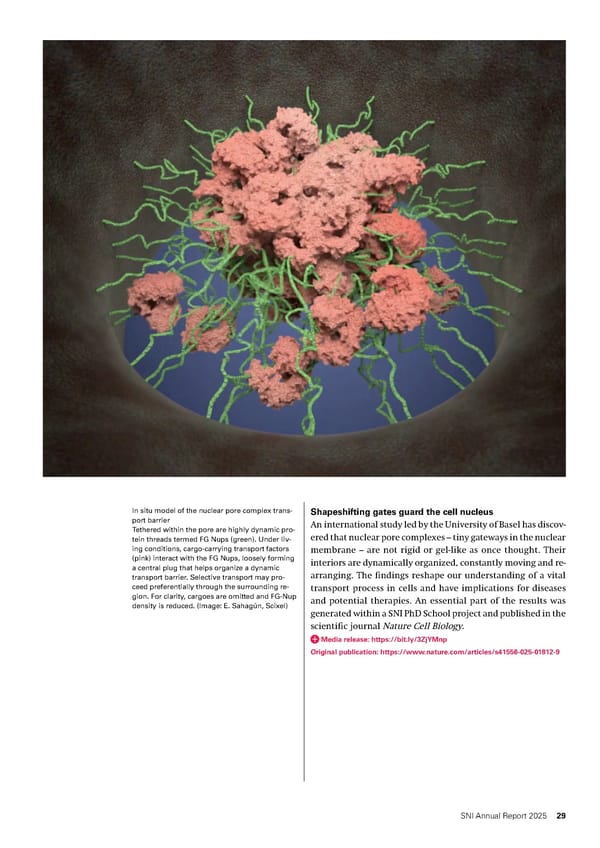
Shapeshifting gates guard the cell nucleus An international study led by the University of Basel has discov- ered that nuclear pore complexes – tiny gateways in the nuclear membrane – are not rigid or gel-like as once thought. Their interiors are dynamically organized, constantly moving and re- arranging. The findings reshape our understanding of a vital transport process in cells and have implications for diseases and potential therapies. An essential part of the results was generated within a SNI PhD School project and published in the scientific journal Nature Cell Biology. Media release: https://bit.ly/3ZjYMnp Original publication: https://www.nature.com/articles/s41556-025-01812-9 In situ model of the nuclear pore complex trans- port barrier Tethered within the pore are highly dynamic pro- tein threads termed FG Nups (green). Under liv- ing conditions, cargo-carrying transport factors (pink) interact with the FG Nups, loosely forming a central plug that helps organize a dynamic transport barrier. Selective transport may pro- ceed preferentially through the surrounding re- gion. For clarity, cargoes are omitted and FG-Nup density is reduced. (Image: E. Sahagún, Scixel) 29 SNI Annual Report 2025
Kagome network from a single molecular building block: Complex structure produced by self-assembly of porphyrin derivate Researchers from the SNI network have shown that copies of a single molecular building block can spontaneously form a com- plex supramolecular structure on surfaces. Writing in the jour- nal Communications Chemistry, the researchers describe how the studied porphyrin derivate arranges itself as individual mol- ecules, in short chains or as a complex Kagome network on a silver surface. In each of these three roles, the molecule adopts a different conformation. The results are an example of how — and in what conditions —self-assembled molecular structures can use a small number of components to form complex struc- tures at interfaces. Even in the primordial atmosphere, adapt- able structures of this kind may have contributed to the origin and development of biochemical processes. SNI post: https://bit.ly/4rxTG2V Original publication: https://doi.org/10.1038/s42004-025-01607-x In the case of self-assembly on a silver surface, the analyzed porphyrin derivate is present in three different forms (represented by the three molecules at the bottom left). The formation of the complex Kagome network involves the or- ange and yellow conformations shown in the im- age. The hydrogen bonds vary depending on how the conformations bond to one another (as seen between two silver-colored hydrogen atoms in the magnified section). In the isolated molecules (pink), the side groups have a different configura- tion.(Image: Department of Physics, University of Basel, and E. Sahagún, Scixel) 30 SNI Annual Report 2025
When quantum light does work Members of the SNI network have developed a new theoretical approach to thermodynamics for quantum systems that interact with light. The researchers from the University of Basel take into account the facts that the light emitted by such a system can contain useful energy, not just waste heat. SNI post: https://bit.ly/3MlHAek Original publication: https://journals.aps.org/prl/abstract/10.1103/zdbv-rksc When laser light passes through a cavity filled with atoms, part of it can do useful work (for instance, charge a quantum battery, top), whereas the oth- er part turns into “heat” (bottom). (Image: Enrique Sahagún, Scixel and Department of Physics, University of Basel) Computer models to support successful molecular synthesis Researchers from the SNI network have used computer simu- lations to investigate a special group of large, symmetrical, cage- like molecular structures (calixarenes bonded via methylene bridges). To date, these molecules are purely hypothetical and have not yet been produced. As part of a doctoral dissertation, researchers have now used computer simulations to analyze which of the postulated structures could realistically be synthe- sized. In the journal Helvetica Chimica Acta, they describe a structure known as methanospherophane as especially stable and therefore a strong candidate for the first successful synthe- sis within this class. If realized experimentally, it would open access to an entirely new family of molecules. Original publication: https://onlinelibrary.wiley.com/doi/10.1002/ hlca.202500177 Computational model of a postulated methanospherophane (K. Tiefenbacher, Department of Chemistry, University of Basel) 31 SNI Annual Report 2025
The complex construction allows the coupling of two oscillators in order to process quantum information. (M. Weegen, former SNI PhD student, Depart- ment of Chemistry, Department of Physics and SNI, University of Basel) Hybrid system to investigate new physical effects In a recent study based on work at the SNI PhD School, research- ers have built a hybrid system that combines different physical platforms, each of which has its own specific advantages. The system is made up of two coupled oscillators: laser-cooled cal- cium ions (Ca + ) in a small ion trap and a charged silver-gallium nanowire (Ag 2 Ga). In a publication in the journal Review of Scientific Instruments, the researchers explain how they de- signed the system and implemented it experimentally. They also show how the nanowire influences the ion trap and how its movement directly causes the ions to resonate. Hybrid sys- tems of this kind offer prospects to study classical and quantum dynamics, take extremely sensitive measurements and investi- gate new physical effects. Original publication: https://bit.ly/49Wa0oc The researchers from the Department of Physics and the Swiss Nanoscience Institute of the University of Basel used these chips to conduct research into more stable and controllable qubits. (Image: A. Kononov, Department of Phys- ics, University of Basel) Rotated magnetic field for more stable qubits Researchers from the SNI network have presented a method that allows them not only to control quantum states more eas- ily but also to keep them stable for longer. To this end, they rotate the magnetic field in a semiconducting nanowire that contains individual electrons acting as quantum bits. The find- ings published in Communications Physics could help to drive forward the development of a reliable and scalable quantum computer. SNI post: https://bit.ly/45LGKhu Original publication: https://www.nature.com/articles/s42005-025-02216-9 A smart accelerator for qubits Researchers at the University of Basel have made a quantum bit faster and more robust at the same time. In the future, this could help in the development of quantum computers. Media release University of Basel: https://bit.ly/4r8OoLi Original publication: https://www.nature.com/articles/s41467-025-62614-z Using electric fields, the Basel researchers drive qubits made of holes in a nanowire. In doing so, they can adjust the accelerator in such a way that the qubits are simultaneously fast and robust against outside influences (yellow) and are not disturbed by the stronger drive (orange). (Illustration: Miguel J. Carballido, Department of Physics, University of Basel | CC BY-NC-ND 4.0) 32 SNI Annual Report 2025
Ultrasensitive SQUID nanoprobes for high-resolution magnetic field images Researchers from the SNI network have developed innovative, extremely small, and robust magnetic field probes that enable high-resolution images of nanoscale magnetic structures. The sensors are based on superconducting quantum interference devices (SQUIDs) – superconducting components that are among the most sensitive magnetometers precisely detecting even very weak magnetic fields. SNI post: https://bit.ly/4qZissY Original publication: https://journals.aps.org/prapplied/ab- stract/10.1103/6s24-vz3k A SQUID fabricated directly at the tip of silicon cantilever is able to achieve magnetic field imag- ing with a resolution of less than 100 nanometers at low temperatures. (Image: Department of Physics, University of Basel) 33 SNI Annual Report 2025
Stable magnetic vortices with potential for future applications As part of an SNI doctoral dissertation, researchers were able to show that a special rare earth ferromagnet can form stable sky- rmion bubbles — tiny vortices in the magnetization that persist even in the absence of an external magnetic field — at room temperature. Using X-ray microscopy and nanoscale magnetic field measurements, the researchers were able to demonstrate the stability of these bubbles and observed that they could be deformed and recovered by varying the magnetic field. Simula- tions confirmed this behavior and showed that certain complex magnetic interactions are not required to generate the bubbles – contrary to previous expectations. Published in the journal Scientific Reports, the findings underline the robustness of skyrmions and their potential for future applications in spin- tronics. Original publication: https://www.nature.com/articles/s41598-024-82114-2 Strained Ge QW 2 nm Germanium is explored as a promising semiconductor for quantum applica- tions due to various factors. The performance of the components can be im- proved by changing the strain of heterostructures. Here we show a scheme of a quantum component (left) and an atomic-resolution scanning transmis- sion electron microscopy image (right) that confirms single-crystal, high- quality layers with atomically sharp interfaces. (Image: A. Nigro, Department of Physics, University of Basel) Strain leads to better charge transport Targeted strain of the crystal lattice can boost the functional properties of extremely thin germanium layers. In a publication in the journal Advanced Materials Interfaces, researchers from the SNI network show how the strain in extremely thin germa- nium layers changes if they are embedded between layers of silicon-germanium. By changing the design of the structure, i.e. layers thickness and chemical composition, the team engi- neered the electronic properties of the system. Using advanced measurement techniques and computer simulations, the team of researchers was able to quantify how much the layers were stretched or compressed in a targeted manner. These findings bring germanium-based quantum chips a significant step closer to practical applications. Original publication: https://advanced.onlinelibrary.wiley.com/doi/ full/10.1002/admi.202500620 Skyrmion bubbles of this kind can be deformed and recovered by varying the magnetic field. (Image: S. Treves, former SNI PhD student, Department of Physics and SNI, University of Basel) 34 SNI Annual Report 2025
Innovative X-ray lens In the Nano-Argovia project ACHROMATIX, researchers have for the first time developed an achromatic X-ray lens — con- sisting of a single component — that can focus X-rays sharply over a wide range of energies. To this end, the interdisciplinary team incorporated two previously separate lens types directly onto the same substrate so that there is no need for a laborious alignment process. The new lens achieves a very high resolution — down to some 200 nanometers — and works across a wide range of en- ergies. Having already proven effective in various X-ray micros- copy and spectroscopy techniques, it has considerable potential for applications across X-ray imaging, as the researchers report in the journals Optics Express and Photonics Research. Original publications: https://opg.optica.org/oe/fulltext. cfm?uri=oe-33-12-26578 https://www.researching.cn/Articles/OJb3d672085c7e2a4e Tiny magnetic sensors As part of a Nano-Argovia project, researchers from the FHNW School of Life Sciences have developed magnetic sensors on the nanoscale. These sensors can measure magnetic fields quickly, accurately and with very little energy, and their simple elec- tronics mean they are suitable for mass production at a later stage. The experiments, published in the IEEE Sensors Journal, show that these sensors are some of the smallest of their kind and have potential applications in industry and the life sciences — for example, for the detection of magnetic particles. Original publication: https://doi.org/10.1109/jsen.2025.3537700 In the Nano-Argovia project NanoHighSens, researchers have developed magnetic sensors in the nanometer range. (Image: J. Pascal and H. Nicolas, FHNW) Structural Elucidation of Membrane Proteins Using Electron Diffraction An interdisciplinary team from the SNI network has made sig- nificant advances in the application of 3D microcrystal electron diffraction (3D ED/MicroED) in a project within the Nano-Argovia program. The results, recently published in the Biophysical Journal, highlight the method’s potential for structural eluci- dation of membrane proteins – a class of proteins that are cen- tral to drug development but often challenging to analyze. Original publication: https://doi.org/10.1016/j.bpj.2025.10.027 Electron diffraction offers great potential for elucidating the structure of membrane proteins. (Image: V. Panneels, Paul Scherrer Institute PSI) Scanning electron microscope image of the monolithic achromatic X-ray lens. (Image: J. Vila-Comamala, Paul Scherrer Institute PSI) 35 SNI Annual Report 2025
36 SNI Annual Report 2025
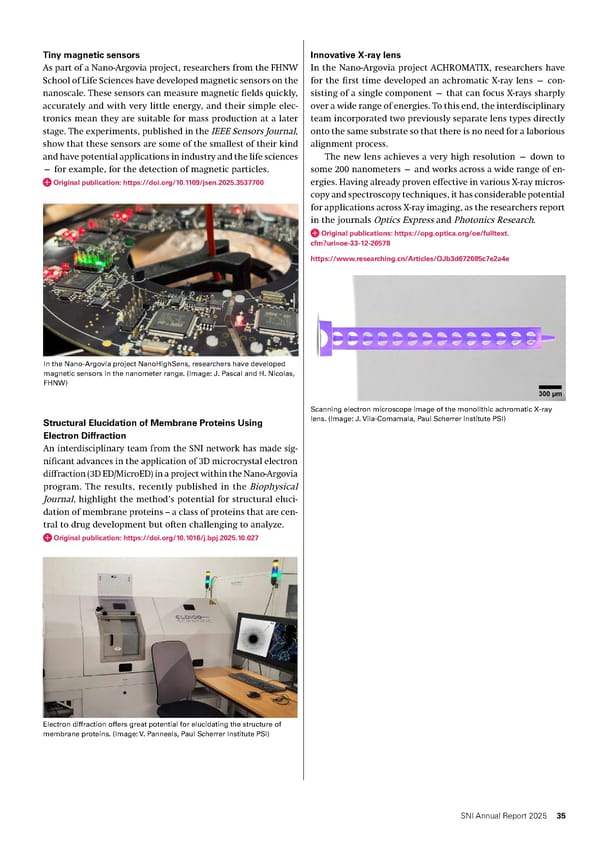
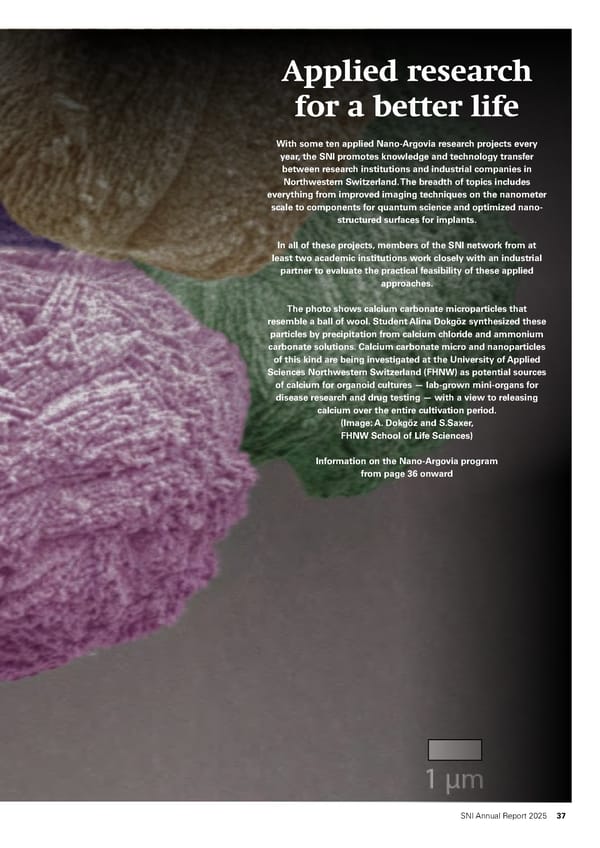
Applied research for a better life With some ten applied Nano-Argovia research projects every year, the SNI promotes knowledge and technology transfer between research institutions and industrial companies in Northwestern Switzerland. The breadth of topics includes everything from improved imaging techniques on the nanometer scale to components for quantum science and optimized nano- structured surfaces for implants. In all of these projects, members of the SNI network from at least two academic institutions work closely with an industrial partner to evaluate the practical feasibility of these applied approaches. The photo shows calcium carbonate microparticles that resemble a ball of wool. Student Alina Dokgöz synthesized these particles by precipitation from calcium chloride and ammonium carbonate solutions. Calcium carbonate micro and nanoparticles of this kind are being investigated at the University of Applied Sciences Northwestern Switzerland (FHNW) as potential sources of calcium for organoid cultures — lab-grown mini-organs for disease research and drug testing — with a view to releasing calcium over the entire cultivation period. (Image: A. Dokgöz and S.Saxer, FHNW School of Life Sciences) Information on the Nano-Argovia program from page 36 onward 37 SNI Annual Report 2025
Nano-Argovia program: Networking between research and industry Close, research-oriented collaboration with companies from North- western Switzerland has been a key strategic approach of the Swiss Nanoscience Institute (SNI) since the time of its founding. With the Nano-Argovia program, we enable researchers to test and validate their applied lines of research even at early stages of development – in direct collaboration with companies with a concrete interest in the respective applications. In addition, Nano-Argovia projects can provide students and doctoral students with insights into industry and have already allowed some of them to join participating companies. To date, the SNI has supported over 100 projects with around 70 com- panies from Northwestern Switzerland – paving the way for numerous innovations in nanotechnology. In 2025,ten Nano-Argovia projects received financial support, five of which started in 2025 and five of which had been underway since 2024. Six of the industrial partners are from the Canton of Aargau, while two came from the Basel half-cantons and two from the Canton of Solothurn. Researchers from the University of Applied Sciences Northwestern Switzerland in Muttenz and Windisch, the Paul Scherrer Institute PSI and the University of Basel also contributed their exper- tise to the projects as academic partners. Nano-Argovia program: www.nano-argovia.swiss 38 SNI Annual Report 2025
Degradable implants with optimized properties In the Nano-Argovia project NanoPed, researchers are develop- ing resorbable metallic implants for neurosurgery. These novel implants are intended to reduce the number of required surger- ies, thereby improving the healing process. For this, the team led by Dr. Romy Marek (FHNW) is using a degradable magnesium alloy whose strength and formability can be tailored using nanoscale magnesium-calcium particles. Given that neurosurgical procedures often involve very delicate implants, it is vital to ensure that these implants dissolve slowly and in a controlled manner inside the body and have reliable mechanical properties. The interdisciplinary team began by de- veloping three variants of the alloy with different strengths and formabilities. They then used these materials to produce cylin- ders, plates and screws. The various samples were also given a protective coating that is intended to prevent the implants from degrading too quickly inside the body. Tests on plates showed that the adjustments to the magne- sium alloy had successfully delivered the desired mechanical properties, allowing the plates to be readily formed to the skull during surgery. The researchers were also able to prove the ef- fectiveness of the protective coating — when the samples were immersed in a physiological saline solution, the coating slowed down the degradation rate, thereby confirming its protective effect. Collaboration between: FHNW School of Life Sciences // ANAXAM // Kairos Medical AG (Bettlach) // Cantonal Hospital Winterthur Project description: https://bit.ly/4toMgAT Master’s student Anita Bitterli prepares a physio- logical saline solution in which she tests whether the protective layer protects the magnesium alloy from rapid degradation. “Neurosurgical procedures are often particularly stressful for patients. Avoiding follow-up surgery would therefore relieve the burden not only on the healthcare system, but also on patients in particular. NanoPed is a strategically important project for us, driving the devel- opment of next-generation me- tallic, resorbable implants and significantly strengthening our position when it comes to de- livering safer and more adap- tive treatments for patients.” Dr. Leopold Berger, Kairos Medical AG 39 SNI Annual Report 2025
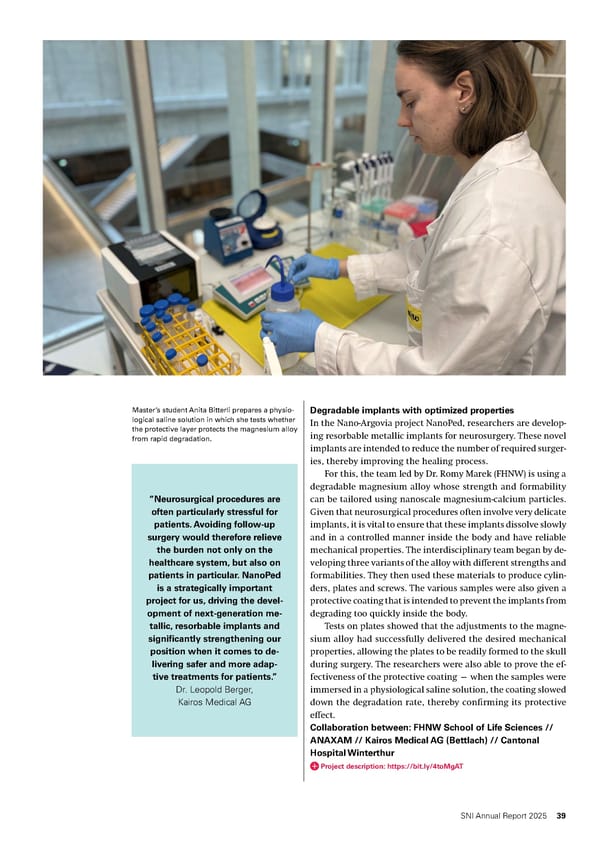
Wound healing without stitches or clips In the Nano-Argovia project Na-LTS, researchers are developing a tissue plaster that can be used in the mouth to support rapid wound closure using lasers — thereby reducing complications in the healing process. The work of the interdisciplinary team led by Dr. Franziska Koch (Thommen Medical AG) is focusing on the production of a biologically degradable polymer plaster. Equipped with a pro- tein “glue” and tiny, heat-generating gold nanorods, the plaster is heated in a targeted manner inside the mouth with the help of a diode laser. This controlled heating causes the plaster to bond firmly to the tissue without damaging it. In the first year of the project, the researchers developed a flexible and tissue-compatible polymer material whose porous structure delivers excellent adhesion. They also integrated gold nanorods and a dye with existing medical authorization. To- gether, the nanorods and the dye emit heat when excited with a laser. Initial tests on porcine tissue have shown that the plas- ter can be bonded reliably to the tissue at moderate tempera- tures. The next steps will seek to optimize the robustness of the system in everyday clinical practice. Collaboration between: FHNW School of Life Sciences // FHNW School of Engineering and Environment // Thom- men Medical AG (Grenchen) Project description: https://bit.ly/46sHoRv “It’s almost impossible for an SME to cover the necessary skills for a project like Na-LTS alone. The Nano-Argovia pro- gram brings together relevant experts, creates synergies and allows joint learning and refine- ment of the idea.” Dr. Franziska Koch, Thommen Medical AG The interdisciplinary team of the Nano-Argovia project Na-LTS meets at regular intervals to dis- cuss progress in the development of a biodegrad- able polymer patch. 40 SNI Annual Report 2025
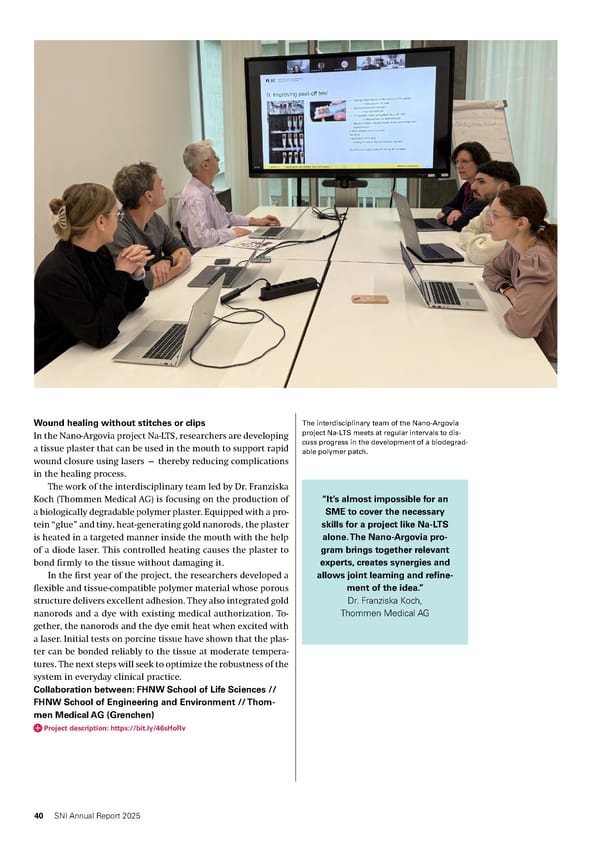
Nanoparticles for the detection of water pollution In the Nano-Argovia project SENAMAG, an interdisciplinary team is developing a cost-effective sensor system for the long- term detection of water pollution using magnetic nanoparticles. These particles are designed to bind selectively to specific pol- lutants. They are then concentrated using magnets, and their concentration is measured by sensitive sensors. In the first year of the project, the team led by Professor Joris Pascal (FHNW) focused on the detection of glyphosate. For this, they used nanoparticles functionalized with antibodies that were specific to the pollutant. This specificity will need to be further optimized in the second year. In addition, the re- searchers have identified a specially coated glass surface that can store the particles prior to use. They have developed a spe- cial source of power for magnetic manipulation of the particles, as well as promising sensor technologies. Initial tests have suc- cessfully demonstrated the detection of small quantities of nanoparticles and proved that the proposed concept is not only technically feasible but also offers considerable potential for an efficient new form of water quality monitoring. Collaboration between: FHNW School of Life Sciences // FHNW School of Engineering and Environment // Mems AG (Birmenstorf) Project description: https://bit.ly/3P2bHZ6 Macroscopic representation of the measurement principle for water pollution based on function- nalized magnetic nanoparticle. (Image: J. Pascal, FHNW) “The new measuring technique proposed in the SENAMAG project is a promising approach as it combines miniaturization, low manufacturing costs and high performance.” Dr. Daniel Matter, Mems AG 41 SNI Annual Report 2025
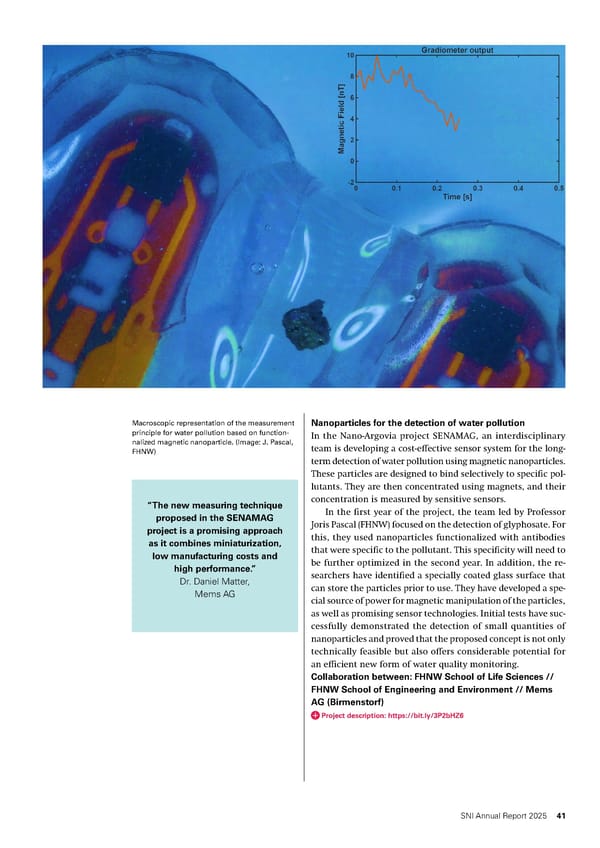
Low-noise amplification of quantum signals In the Nano-Argovia project QAmp, researchers are developing an extremely low-noise amplifier that converts quantum signals into classical electrical signals as losslessly as possible. The work centers around a “traveling-wave parametric am- plifier” (TWPA), which is based on superconducting Josephson junctions (JJs) and planar capacitors. This amplifier will initially be used to read spin qubits and superconducting qubits in quan- tum processors but will also have future applications in quan- tum sensors and imaging. The team led by Professor Andrea Hofmann and Professor Christian Schönenberger (both of the University of Basel) is de- veloping the TWPA with a completely planar, two-dimensional geometry and a small number of manufacturing steps. For the substrate, the researchers use highly pure, undoped silicon with a superconducting coating of tantalum metal. Tests with reso- nators reveal excellent agreement with designs as well as high quality factors, which indicate low losses. In addition, the sci- entists have established a reliable process for superconducting bridges with a view to clean grounding. In the next step, they plan to further optimize Josephson junctions and incorporate them into a complete TWPA. Collaboration between: University of Basel // Paul Scherrer Institute PSI // YQuantum (Villigen) Project description: https://bit.ly/4qQPSsJ “With support from the Nano-Argovia project, we’ve been able to achieve significant advances in the development of a novel quantum amplifier by working hand in hand with strong partners from the University of Basel and PSI. This promising system is well on the way to becoming a vital product in our portfolio.” Dr. Christian Jünger, YQuantum In the Nano-Argovia project QAmp, researchers are developing an extremely low-noise amplifier that converts quantum signals into classical elec- trical signals as losslessly as possible. Here, Deepankar Sarmah from YQuantum inspects a nanostructure on a wafer. 42 SNI Annual Report 2025
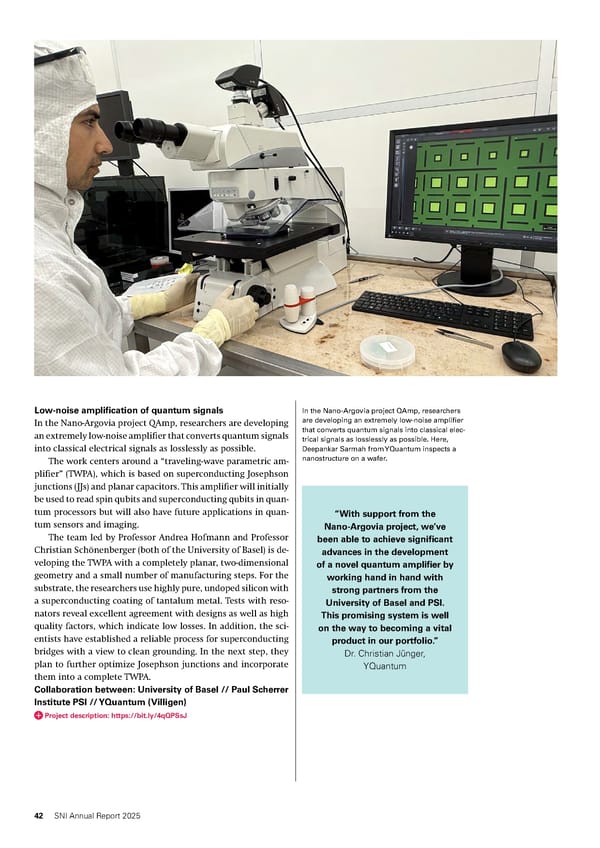
New nanostructured lenses for 3D imaging In the Nano-Argovia project Nano Diffractive Optics, an inter- disciplinary team is developing optical elements on the nano- meter scale that can be used for three-dimensional imaging in an optical coherence tomography (OCT) system. As part of this work, the researchers are focusing on the design and production of “fraxicon lenses.” With their tiny tip, these conical lenses are made up of numerous thin, concentric rings that deflect laser light into a narrow beam (a Bessel beam) that remains the same over a long distance. In the first year of the project, the researchers led by Pro- fessor Bojan Resan (FHNW) were able to produce fraxicon lenses with a diameter of 2 millimeters and an extremely fine tip using direct laser lithography. Initial tests showed that the lens pro- duces a very narrow Bessel beam with a diameter of less than 2 micrometers that propagated over a distance of several milli- meters without becoming significantly wider. Further work is now focusing on producing bigger lenses in order to increase the range of the Bessel beam. In the next months, the fraxicon lenses will be integrated into an existing OCT 3D imaging system, leading to better image resolution and enabling deeper imaging. Collaboration between: FHNW School of Engineering and Environment // Paul Scherrer Institute PSI // XRnanotech AG (Villigen) Project description: https://bit.ly/4tMXlf8 “The Nano-Argovia program provides a strong acceleration of our R&D and product proto- typing efforts, positioning XRnanotech to bring innovative solutions to market and expand into new application areas within the next year.” Dr. Gérard Perren, XRnanotech AG In the Nano-Argovia project Nano Diffractive Optics, the interdisciplinary team is focusing on the production of fraxicon lenses. These consist of numerous thin, concentric rings which, thanks to their jagged or stepped structures, deflect la- ser light into a narrow beam that remains the same over a long distance. (Image: FHNW and XRnanotech) 43 SNI Annual Report 2025
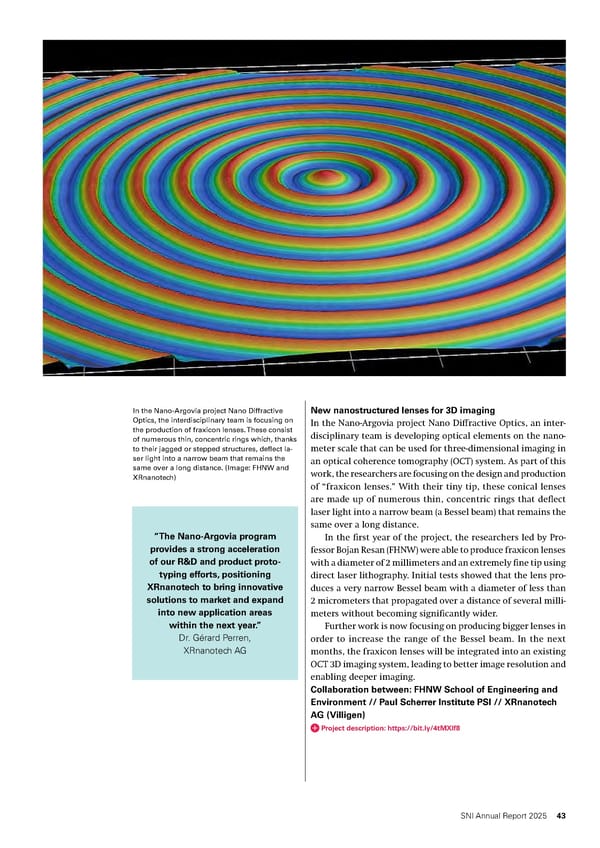
Coatings create better batteries In the Nano-Argovia project BatCoat, researchers are investigat- ing a new generation of batteries known as anode-less sol- id-state lithium batteries. As well as storing a particularly large amount of energy, these batteries are cheaper to manufacture and safer than today’s lithium-ion batteries — and they could make a key contribution to efficient, safe and sustainable elec- tromobility. In the new type of battery, there is no classical anode — rather, lithium is deposited directly onto a copper current col- lector during charging. Until now, issues have related to uneven lithium distribution, mechanical stress and damage to the solid electrolyte leading to an earlier loss of battery capacity and short circuits. Now, the team led by Dr. Mario El Kazzi (PSI) has shown that extremely thin coatings on the current collector can significantly alleviate some of these problems. For example, a silver layer ensures that lithium is deposited more evenly, while an additional protection layer prevents harmful reactions with the current collector— allowing a large number of charging cycles. Computer simulations have confirmed that the coatings also reduce mechanical stress inside the battery and prevent crack formation. Overall, the BatCoat project shows that specific surface coatings can significantly improve the stability and ser- vice life of anode-less solid-state batteries. Collaboration between: Paul Scherrer Institute PSI // FHNW School of Engineering and Environment // Oerlikon Metco AG (Wohlen) Publication: https://doi.org/10.1002/advs.202521791 Project description: https://bit.ly/4s3xD4g “The BatCoat project shows that ultra thin functional coat- ings can significantly enhance the performance and durability of anode less solid state batter- ies, offering a scalable pathway to safer and more reliable next generation energy storage. Building on these results, Oerlikon is now in active dis- cussions with leading manufac- turers to validate the technol- ogy for industrial adoption.” Dr. Phani Kumar Yalamanchili, Oerlikon Metco AG Doctoral student Robin Wullich uses an X-ray pho- toelectron spectrometer to examine the chemical composition on the surface of the electrodes. 44 SNI Annual Report 2025
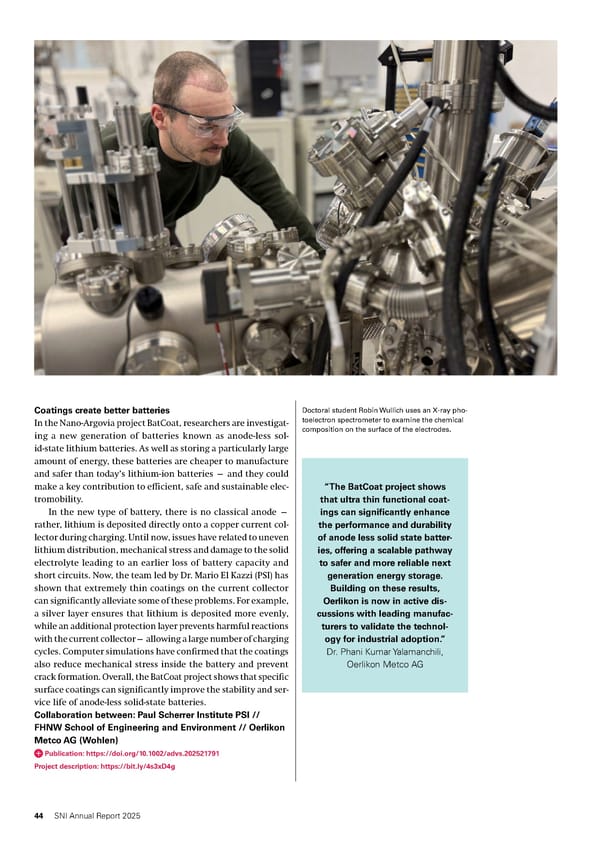
The team from the Nano-Argovia project HiZfEM prepares the new hybrid pixel detector and then inserts it into the electron microscope for test measurements. New detector with higher resolution Researchers working on the Nano-Argovia project HiZfEM have developed a new hybrid pixel detector with improved image quality for transmission electron microscopy. Hybrid pixel detectors (HPDs) are becoming increasingly popular in electron microscopy as they are very fast, have a large measurement range, and are more resistant to radiation damage than other detector technologies. Their spatial resolu- tion is limited, however, by the multiple scattering of the high-energy electrons in the thick, but comparably light silicon sensors of the detector layer. Now, the team led by Dr. Dominic Greiffenberg (PSI) has significantly improved the image sharpness using a sensor ma- terial with a higher electron density — as demonstrated by simulations and experimental studies. For their investigations, the researchers used gallium arsenide doped with chromium (GaAs:Cr) as sensor material. As this material reduces the free mean path of incident electrons, the lateral spread of their signal is reduced, and the entry point of an electron can be determined more precisely. The results show that GaAs:Cr sensors deliver significantly less blurring, hence better image resolution, than silicon sen- sors, particularly at high electron energies. This resolution can be further increased by simple position interpolation. Collaboration between: Paul Scherrer Institute PSI // Biozentrum, University of Basel // DECTRIS AG (Baden) Project description: https://bit.ly/4rK0dIu “We are proud to see our state-of-the-art GaAs:Cr sensor material at the core of the HiZfEM project, which is signifi- cantly advancing the field of electron microscopy. The collab- oration with the Paul Scherrer Institute and the University of Basel is not only accelerating the scientific progress but also strengthens our leading role and expertise in hybrid pixel detector technology.” Dr. Sonia Fernandez, DECTRIS AG 45 SNI Annual Report 2025
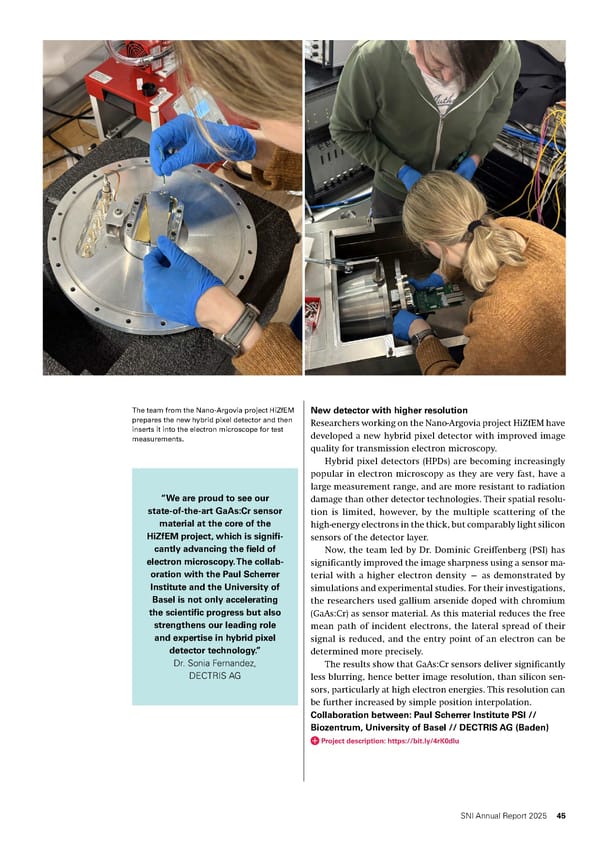
Sustainable alternative for breaking down PET As part of the Nano-Argovia project NANOdePET, an interdisci- plinary team has developed a sustainable method that allows enzymatic degradation of the plastic polyethylene terephthal- ate (PET). To this end, the researchers led by Professor Patrick Shahgaldian (FHNW) developed particularly robust enzymes by embedding PET-degrading enzymes in a thin, porous orga- nosilica shield. This approach allowed them to stabilize se- lected enzymes, improve contact with the plastic, and ensure that they could be used multiple times. In their analyses, the researchers showed that the stabilized enzymes degrade PET much more efficiently than freely dis- solved variants. The selected nanobiocatalysts were able to break PET down almost entirely into its basic building blocks — and particularly into terephthalic acid (TPA), a key starting material for the production of new plastics. Moreover, the en- zymes remained active over several degradation cycles and even worked at high temperatures, at which conventional enzymes quickly lose their activity. Overall, the project shows that en- zymatic PET recycling with long-lived, reusable nanobiocata- lysts can serve as a realistic and more sustainable alternative to modern recycling processes. Collaboration between FHNW School of Life Sciences // FHNW School of Engineering and Environment // INOFEA AG (Muttenz) Project description: https://bit.ly/4b0r8Zs “Converting PET entirely back into its basic building blocks with reusable nanobiocatalysts would mark a major step toward a truly circular, sustain- able plastics economy. Through the Nano-Argovia project NANOdePET, we advanced INOFEA’s core technology toward a robust enzymatic approach for PET depolymer- ization – enabled by the strong, multidisciplinary contributions of the FHNW School of Life Sciences and the FHNW School of Engineering and Environment. ” Dr. Rita Correro, INOFEA AG Amir Nazemi, Patrick Shahgaldian and Rita Correro discuss the stabilized PET-degrading enzymes at the electron microscope. 46 SNI Annual Report 2025
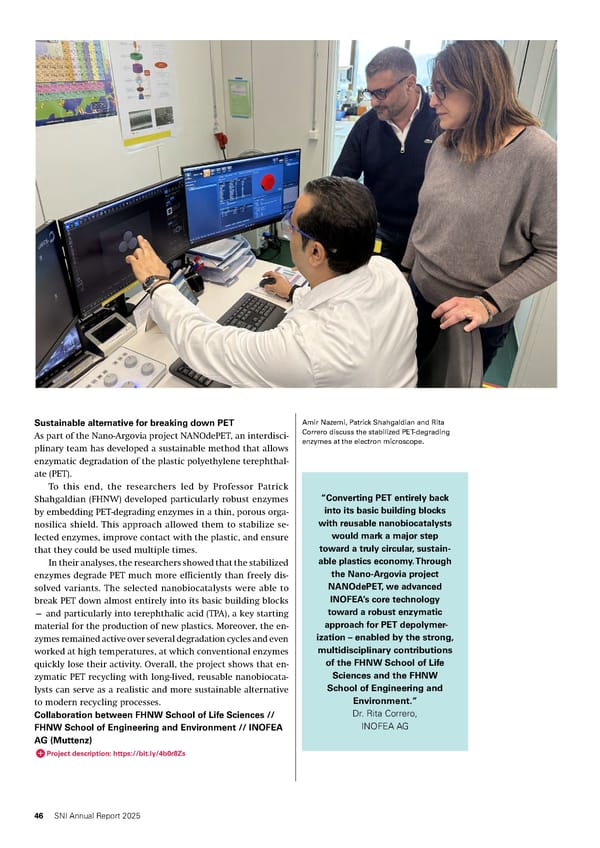
To investigate the immune response on various surfaces, researchers cultivated immune cell lines on zirconium dioxide disks with different nanostructures. This fluorescence image shows a macrophage (actin scaffold in green, cell nu- cleus in blue) on one of the surfaces. (Image: L. Krattiger, UZB, University of Basel) Simplified surface structuring technique for ceramic implants In the Nano-Argovia project ZIRYT, researchers have investigated how zirconium dioxide dental implants can be manufactured in a stable, cost-efficient and biocompatible manner using targeted nanostructuring. Zirconium dioxide is a ceramic that can be used as an aesthetically pleasing alternative to titanium. The aim was to design a material surface that promotes cell and bone growth, prevents inflammation and can simultaneously withstand high mechanical, chemical and thermal loads. The interdisciplinary team led by Professor Nadja Rohr (UZB) used a new, cost-effective and safe approach to create implant surfaces that met all the requirements. The zirconium dioxide surfaces were first polished until they were very smooth, before undergoing targeted heat treatment in order to produce nano- meter- to micrometer-sized crystal structures. It emerged that as the proportion of yttrium oxide in the material increased, so too did the grain size on the surface, while there was a slight decrease in mechanical strength. All of the tested materials delivered ex- cellent biological properties: bone maturation and a controlled immune response without signs of chronic inflammation. The results achieved underline the potential of this simplified man- ufacturing technique for long-lasting, biocompatible and cost-ef- ficient dental implants made of ceramics. Collaboration between: University Center for Dental Medicine Basel (UZB) // FHNW School of Life Sciences // Institut Straumann AG (Basel) Publication: https://bit.ly/4agXgaE Project description: https://bit.ly/46urCWa “The results of the ZIRYT project make an important contribution to our efforts to continuously improve our prod- ucts for the benefit of patients.” Dr. Raphael Wagner, Institut Straumann AG 47 SNI Annual Report 2025
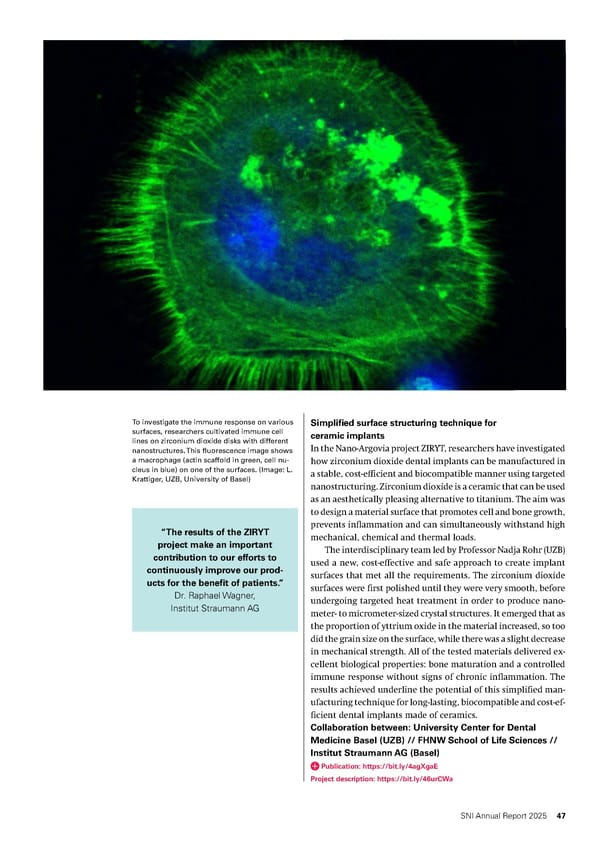
Electron diffraction for structural analysis of proteins In the Nano-Argovia project ProtEDinNanoxtals, researchers sought to establish a complete workflow for analyses with elec- tron diffraction and to use the technique in a targeted manner to investigate the role of hydrogen atoms in protein-ligand in- teractions — for both soluble and membrane proteins. To this end, the team led by Dr. Valérie Panneels (PSI) took measurements both with a conventional electron microscope and with an electron diffractometer specifically designed for electron diffraction. In their investigations, the researchers suc- ceeded for the first time in determining protein structures from nanocrystals with a resolution down to 2.1 Å. The team also established a method based on a focused ion beam (FIB) for cutting thick crystals into analyzable thin sheets — resulting in usable structural data even starting from thicker crystals. Overall, the results show that electron diffraction can also be used reliably for the structural determination of proteins, paving the way for numerous future applications. Collaboration between: Paul Scherrer Institute PSI // Biozentrum, University of Basel // leadXpro AG (Villigen) // ELDICO Scientific AG (Allschwil) Publication: https://doi.org/10.1016/j.bpj.2025.10.027 Project description: https://bit.ly/4kWSfcl Researchers in the Nano-Argovia project ProtEDinNanoxtals have established a complete workflow for using electron diffraction to specifi- cally investigate the role of hydrogen in protein- ligand interactions. 48 SNI Annual Report 2025
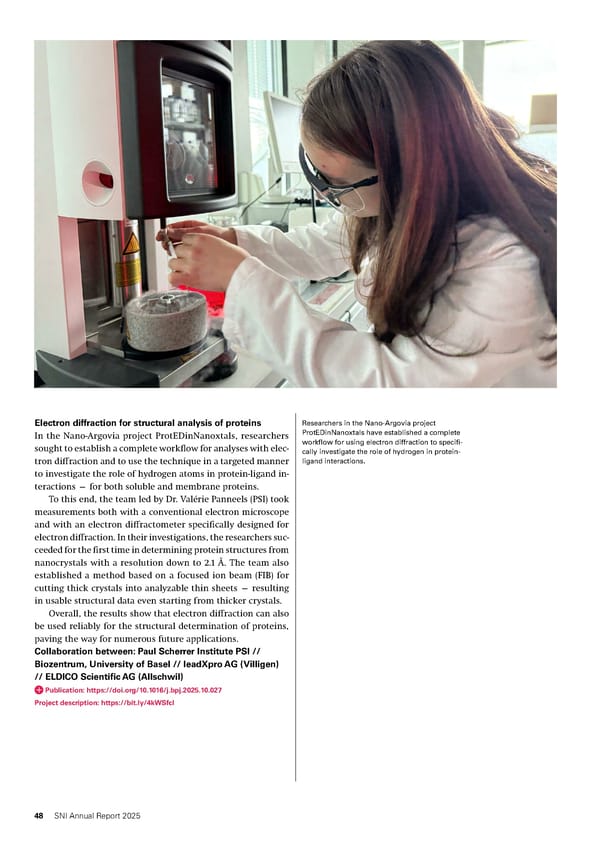
“LeadXpro specializes in mem- brane protein structure-based drug discovery, integrating cryo-EM, conventional/serial/ time-resolved X-ray crystallog- raphy, and a strong biophysics platform to advance novel medicine for our research part- ners. Electron diffraction is an emerging complementary tech- nology, particularly valuable for nano-sized crystals and for the detailed analysis of hydrogen atoms, which are not possible with conventional X-ray crys- tallography and cryo-EM.” Dr. Robert Cheng, leadXpro AG “ELDICO Scientific develops dedicated electron diffractome- ters and advances electron dif- fraction methodology through its Basel Application Center. The company combines commercial instrument expertise with ongo- ing method development, en- abling structural determination across diverse crystalline mate- rials. Through this collaboration, ELDICO contributes its electron diffraction capabilities to expanding methodological reach into challenging protein targets.” Dr. Gunther Steinfeld, ELDICO Scientific AG The researchers performed the elect- ron diffraction measu- rements using the ED-1 electron diffrac- tometer, which was developed specifically for such investigations by project partner ELDICO Scientific. (Image: V. Panneels, Paul Scherrer Institute PSI) 49 SNI Annual Report 2025
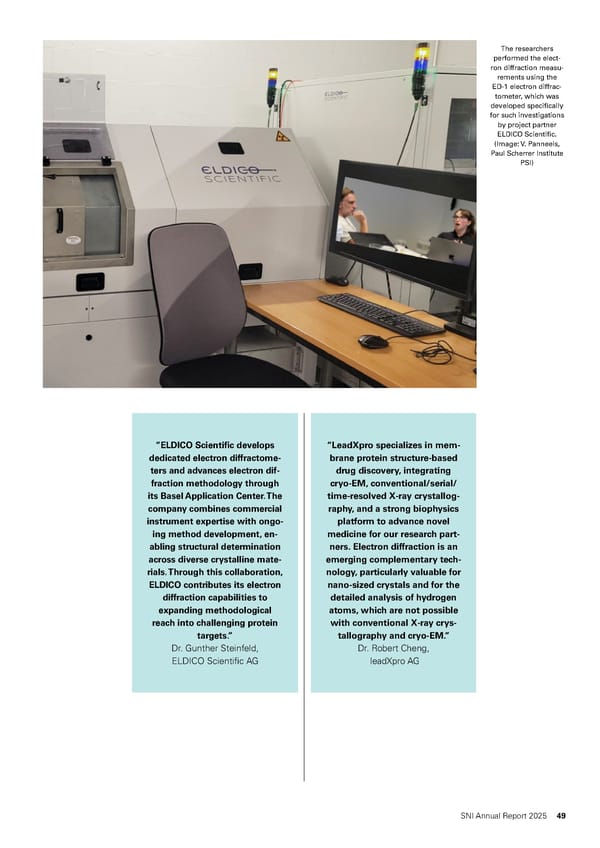
Key role in imaging and manufacturing The Nano Imaging Lab and Nano Fabrication Lab are important contacts for researchers within and outside the SNI network. Together, these two groups form the SNI’s Nano Technology Center and are playing a key role in the SNI’s focus on nanoimaging and nanofabrication. The NI Lab has been involved in projects dealing with sustainable viticulture under changing climatic condi- tions for many years. Here, the team used scanning electron microscopy to visualize the infestation of grapes by fungi. (Image: E. Bieler, NI Lab, SNI, University of Basel) 50 SNI Annual Report 2025
51 SNI Annual Report 2025
The Swiss Nanoscience Institute (SNI) is increasingly consolidating its expertise in the fields of nanoimaging and nanofabrication – two key dis- ciplines in quantum, materials and environmental science, as well as the life sciences. This strategic focus centers around the Nano Technology Center, which is led by Professor Ilaria Zardo and was established in 2022 as a central platform for services and research. With the Nano Imaging Lab (NI Lab), led by Dr. Marcus Wyss, and the Nano Fabrication Lab (NF Lab), led by Dr. Gerard Gadea, the Nano Technology Center provides both internal partners from the SNI net- work and external clients with access to highly specialized infrastruc- ture and expert support. To meet growing demands, the teams rely on continuous adaptation and modernization. Infrastructure is steadily expanded, new methods are integrated, and organizational processes are optimized. Close col- laboration with the scientific community remains a key priority – whether through services, teaching, outreach activities or close sup- port for research projects. The Nano Imaging Lab handled a total of 200 assignments from 140 clients in 2025. Approximately 85% came from the SNI network, nearly 10% involved collaborations with industry (Bruker Nano Surface, Artidis AG, DeltaMem AG, SenTec AG, Solvias AG), and around 5% originated from research institutions outside the SNI network. In 2025, 76 different users availed themselves of the Nano Fabrication Lab’s infrastructure. These users came from 13 different research groups – 10 from the Department of Physics, two from the Depart- ment of Chemistry and one from the Biozentrum. In addition, there were also researchers from two startups working at the NF Lab. Nano Technology Center: https://nanoscience.unibas.ch/en/services/ Nano Technology Center: Expertise, collaboration, and continuous development 52 SNI Annual Report 2025
Nano Imaging Lab Improving analyses, developing contacts, sharing knowledge In recent years, the Nano Imaging Lab (NI Lab) has developed into a center of excellence for high-resolution imaging and ma- terial analyses. With state-of-the-art equipment and a dedicated, interdisciplinary team, the NI Lab makes a key contribution to basic research and applied projects in physics, chemistry and the life sciences — bringing together research, teaching and dialog with the general public. The team from the Nano Imaging Lab doesn’t rest on its laurels and is always striving to further expand its range of services. Evi Bie- ler, Monica Schönenberger (front, from left to right), Susanne Erpel, Marcus Wyss and Alex- ander Vogel (back, from left to right) comple- ment one another perfectly. 53 SNI Annual Report 2025
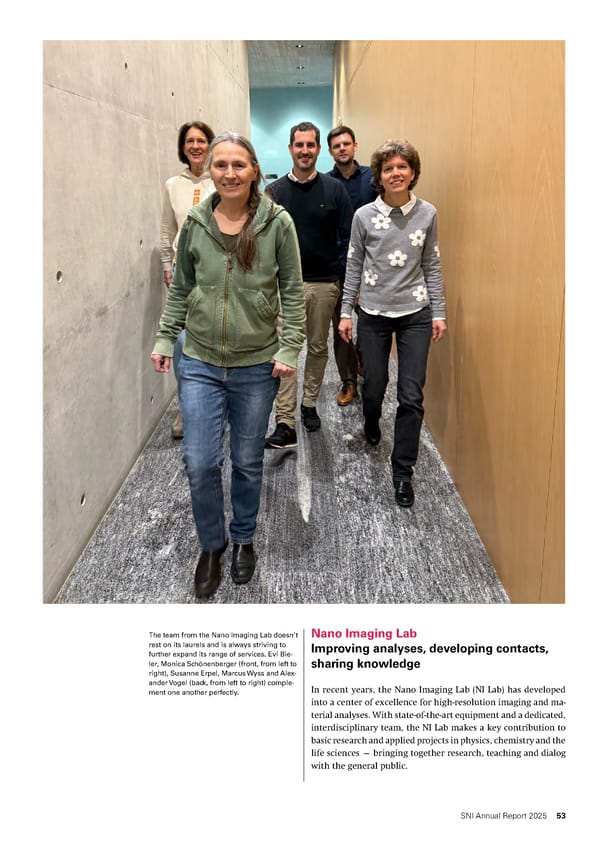
Scanning electron microscope image of the cross- section of a membrane that acts as a water filter. (Image: S. Erpel, NI Lab, SNI, University of Basel) The head of the NI Lab, Dr. Marcus Wyss, is keen to further boost the lab’s visibility at both the national and international level. One key objective for him is participation in demanding research projects and the continuing education of staff and students. One example of these efforts is the newly designed block course “Structural Biology and Biophysics,” which was held in 2025. Here, over 60 biology students not only gained theoretical in- sights into scanning electron microscopy but also had the chance to image cell nuclei and nuclear pore complexes themselves — offering a practical insight into the overarching subject matter of the course. Participation in research projects In 2025, the staff from the NI Lab made great efforts to learn about the latest developments in electron and scanning probe microscopy at various conferences. Through active contributions in the form of posters and talks, they succeeded in developing new contacts that have already given rise to promising research collaborations. For example, the team took advantage of its participation in the Microscopy Conference 2025 Dreiländertagung in Karlsruhe to visit the group led by Prof. Andrea Schäfer from the Institute for Advanced Membrane Technology at KIT in Karlsruhe, with whom they have an interesting collaboration. As part of this proj- ect, NI Lab staff member Susanne Erpel is analyzing nanofiltration membranes for water. These analyses involve energy-dispersive X-ray spectroscopy (EDX) and cross-sections through the mem- branes, which help researchers develop effective water filters for wide-ranging applications. There was also a fruitful collaboration with the Technical University of Denmark (DTU) in Copenhagen after Marcus Wyss presented the NI Lab’s wide-ranging projects at a nanotechnology seminar in Copenhagen. In this project in collaboration with Dr. Dennis Valbjørn Christensen and Dr. Mohamad Koshkalam (both from the Department of Energy Conversion and Storage at DTU), the aim was to consider batteries from a new perspective and gain a better understanding of degeneration mechanisms. The NI Lab contributed to this work with structural and chemical “The excellent collaboration with the Nano Imaging Lab and the startup Qnami played an essential role in clarifying degradation mechanisms in next-generation energy storage devices by linking functional, structural and chemical imag- ing on the nanoscale.” Dr. Dennis Valbjørn Christensen, DTU, Copenhagen “We’re delighted with the close collaboration and excellent research enabled by the Nano Imaging Lab.” Prof. Andrea Schäfer, KIT, Karlsruhe 54 SNI Annual Report 2025
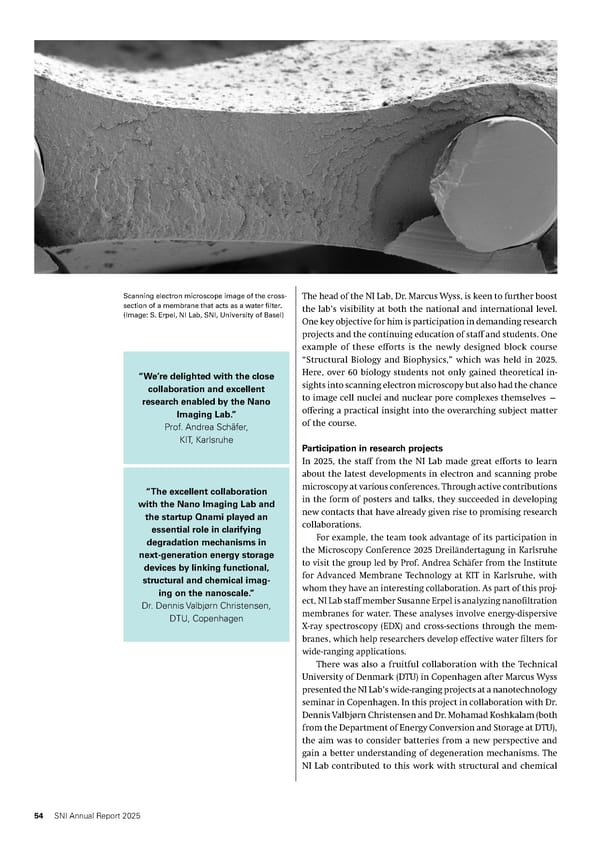
imaging of the cathode material. This project also involved Qnami, a startup that was founded within the SNI network. Since 2023, the NI Lab has been an active partner in the tri- national project WiVitis, which develops strategies for cultivating climate-resistant grape varieties. The NI Lab’s contribution stems primarily from Evi Bieler in the form of valuable data on grape health, which she obtains using cryo-electron microscopy. The team recently further developed the technique of electrochem- ical impedance spectroscopy with a view to delivering key infor- mation on the physical barrier of grape skin. Due to the promis- ing results, the partners involved are expected to apply for a follow-up project, as WiVitis will expire in April 2026 and the successful collaboration should to be continued. In 2025, many analyses by NI Lab staff were again carried out in collaboration with research groups from the SNI network. For example, Dr. Alexander Vogel was involved in a project with Professor Ilaria Zardo’s group at the Department of Physics of the University of Basel. The results, which the researchers pub- lished jointly, showed that it is possible to control the electronic properties of thin germanium layers by stretching their crystal lattice in a targeted manner. This represents a key step toward practical applications of germanium-based quantum chips. Expanded range of services In order to boost the range of services and opportunities for new research collaborations, the NI Lab team is always open to new technologies — such as three-dimensional electron diffraction for analyzing nanostructures. The ED-1 electron diffractometer was developed by the startup ELDICO Scientific, which has been working with the SNI since being founded from a Nano-Argovia project. In 2025, Marcus Wyss and Alexander Vogel learned to use the ED-1 at ELDICO Scientific and are now in a position to carry out measurements for SNI members. In an initial pilot project, they are investigating the various axes of growth for nanowires from Ilaria Zardo’s lab. For SNI members who are curious about the possibilities of electron diffraction, the NI Lab also acts as a point of contact for measurements on the ED-1 from ELDICO Scientific Marcus Wyss and Alexander Vogel from the NI Lab can now also provide SNI members with measurements using the electron diffrac- tometer from ELDICO Scientific for three-di- mensional structural determination of small crystals. (Images: NI Lab, SNI, University of Basel) 55 SNI Annual Report 2025
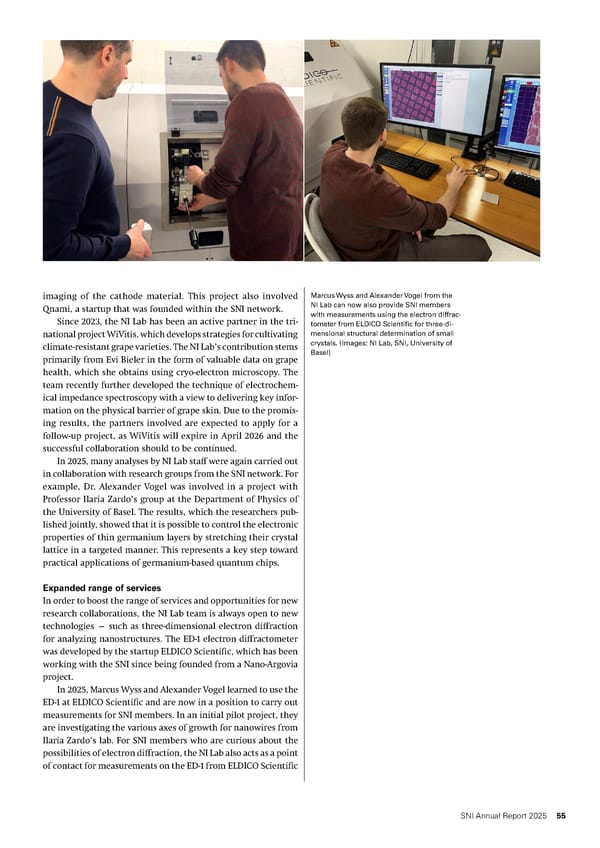
— facilitating access to this state-of-the-art technology, which promises to be particularly useful for structural determination. The services offered by the NI Lab now also include analyses using a new atomic force microscope (DriveAFM, Nanosurf ) that allows fast and precise measurements of wide-ranging samples thanks to excitation with an additional laser. The NI Lab staff member responsible for AFM, Monica Schönenberger, has already used the instrument to analyze two-dimensional materials as part of a collaboration with Professor Ernst Meyer’s team and is looking forward to other exciting applications. Commitment to public relations work The fascinating images from the nano and microcosmos that are produced at the NI Lab are ideal for getting a wider audience excited about tiny structures. In 2025, the team therefore taught evening classes on electron microscopy, gave a talk to the me- chanical engineering team of the general vocational school (All- gemeine Gewerbeschule, AGS) of Basel, invited people to attend the NI Lab User Event, and welcomed numerous visitor groups for tours of its laboratories. The aim was to give people insights into the work and functionality of the microscopes, as well as to generate enthusiasm for the nanosciences. Layers of graphene in an image captured with the new DriveAFM and an optical microscope. (Images: M. Schönenberger, NI Lab, SNI, Uni- versity of Basel) 56 SNI Annual Report 2025
Nano Fabrication Lab Safe and clean conditions for micro and nanofabrication Founded in 2022 and led by Dr. Gerard Gadea, the Nano Fabri- cation Lab (NF Lab) provides researchers from the University of Basel and companies within the SNI network with comprehen- sive infrastructure for micro and nanofabrication — from pat- terning and material deposition to process control. The avail- able facilities allow lithographic techniques on the micro and nanometer scale, thin-film deposition, and wet and dry chem- ical etching processes. These capabilities are complemented by facilities for substrate and surface preparation and by methods for the characterization and quality control of the fabricated structures. The extensive pool of equipment and the NF Lab’s two clean rooms are primarily used by master’s students, doctoral stu- dents, postdocs and several scientists from companies within the SNI network. The NF Lab’s four-person team manages instruments and in- frastructure, enabling trained users to carry out their projects independently. It also ensures that all users can conduct their work safely and efficiently, regardless of the diversity of projects. The team’s responsibilities include providing training on the different instruments, procuring, installing, maintaining and repairing equipment, providing consumables, and monitoring compliance with safety and cleanliness requirements. In 2025, the team introduced new guidelines for the use of clothing and materials in order to further improve conditions in the clean rooms — making work safer, more efficient and cleaner for ev- eryone involved. Expanding the equipment pool It is also a priority for NF Lab head Gerard Gadea to continuously improve the laboratory’s equipment and respond to the needs of research groups that rely on its facilities. “At the NF lab, we fabricate nanoscale devices that we use to measure quantum effects at temperatures close to absolute zero.” Prof. Andrea Hofmann, Department of Physics, University of Basel Through supervision, training and technical support, Xavier Wildermuth, Juri Herzog, Arnold Lücke and Gerard Gadea (from left to right) provide access to state-of-the-art fabrication technologies at the Nano Fabrication Lab. “We use the new electron beam lithography machine (EBPG) of the NF Lab to fabricate electrical gates within 10nm to semiconduct- ing nanowires to form quan- tum bits, with a precision and reproducibility that was not possible on the older machines.” Dr. Andreas Baumgartner, Department of Physics, University of Basel 57 SNI Annual Report 2025
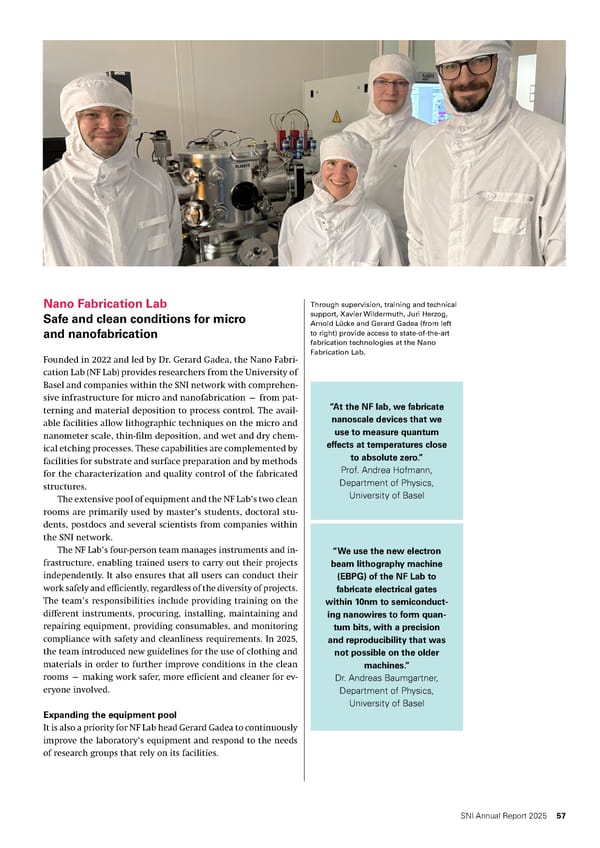
In 2025, Gadea acquired an additional compact plasma ashing system for the clean room. This device allows researchers to remove carbon contaminants before depositing layers onto a sample. Likewise, a new CO 2 snow-jet cleaning gun enables ef- fective and comparatively gentle removal of contaminations by using high pressure to eliminate even the smallest particles. The NF Lab also acquired a new semiautomatic wire bonder. This serves as a backup device, as numerous groups depend on a functioning wire bonder in order to connect microstructures with macroscopic measurement components that are used to investigate the properties of functional nanomaterials. In another improvement, the NF Lab modernized its existing annealing furnace, further enhancing the lab’s capabilities. The new setup is safer and allows components to be heated at a low and controlled pressure (vacuum annealing), thereby expanding the range of possible applications. New acquisitions also include a 3D microscope equipped with various light sources, lenses and tilt axes that ensure excellent imaging for the quality control of samples with complex, three-di- mensional microscopic features. Satisfied users The research groups active at the NF Lab value both the service provided and the lab’s continually improving equipment, as these allow them to carry out sophisticated fabrication processes on site. As well as providing infrastructure, the NF Lab now also offers complete fabrication service packages. For example, in 2025, the team developed specialized test structures on behalf of the Nano Imaging Lab to evaluate the focused ion/electron beam deposition techniques used at the NI Lab. Micro and nanofabrication for teaching and the public Students working at the Nano Fabrication Lab receive individual instruction and supervision on how to use the various instru- ments from the NF Lab team. Together with Marcus Wyss from the Nano Imaging Lab, Gerard Gadea also gives a lecture for master’s students of the nanosciences, biology and physics, pro- viding an overview of the different techniques. Several school groups and individual interns who visited the SNI in 2025 were also given guided tours that offered an insight into work in clean rooms — environments that require particu- larly stringent cleanliness and safety measures, which are en- sured by the NF Lab team. The new CO 2 snow-jet cleaning gun removes even the tiniest particles with high pressure while remaining relatively gentle. Xavier Wildermuth inspects the fabricated structures using the new 3D microscope. Gerard Gadea operates the modernized annealing furnace, which now allows sample preparation at controlled pressures. 58 SNI Annual Report 2025
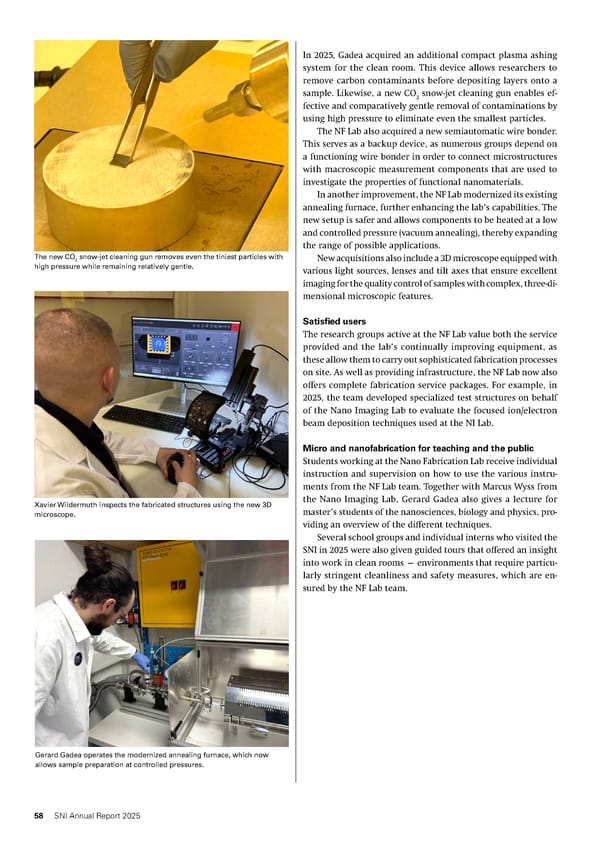
The micro and nanostructures produced at the NF Lab are not only visually striking but also allow the investigation of quantum phenomena. (Image: F . Volante, A. Hofmann group, Department of Physics, University of Basel) At the Nano Fabrication Lab, researchers produce tiny, intricate chips to study quantum effects at temperatures close to absolute zero. (Image: L. Ruggiero, A. Hofmann group, Department of Physics, University of Basel) 59 SNI Annual Report 2025
Networks on a small and large scale The success of the SNI is underpinned by a dynamic network in which researchers from different disciplines and institutions work hand in hand on questions of basic science and applied research. It is not only in our macroworld that networks exist, however. Network-like structures also form at the nano- meter level — as seen in this image submitted by Dr. Martin Heinrich to the Nano Image Awards 2025. The former SNI PhD student produced the image by using a scanning tunneling microscope to visualize how the two materials, indium telluride and manganese telluride, arrange themselves at the atomic level when they meet. The network pattern is formed due to the different lattice structures of the two materials. (Image: M. Heinrich, PSI and SNI, University of Basel) 60 SNI Annual Report 2025
61 SNI Annual Report 2025
Network: A basis for innovative research and education The Swiss Nanoscience Institute is underpinned by its strong, inter- disciplinary network, in which members from different fields and insti- tutions contribute jointly to driving excellence in research and educa- tion at the SNI. Their commitment, expertise and readiness to work together pave the way not only for innovative projects in basic and ap- plied research but also for ongoing support of early career researchers in the nanosciences. The make-up of the SNI network is deliberately dynamic, as member- ship is mostly based on active participation in research projects. From year to year, new researchers join the network and others leave it again. This steady turnover provides opportunities for new perspec- tives and ideas, but also calls for regular events to promote interdisci- plinary dialog, to create space for developing joint projects, and to provide information about service offerings from the SNI. For exam- ple, all members of the network are invited to the Annual Meeting and the NanoTec Apéro, which are held on an annual basis. Moreover, the Nano Imaging Lab organizes an annual User Event that is open not only to the network but also to external partners. As well as creating opportunities for people to meet one another, the various events promote interdisciplinary dialog, reinforce the sense of community and provide the Nano Technology Center with a plat- form to present itself to the network – all of which are key require- ments for successful collaboration and the steady further develop- ment of the SNI. 62 SNI Annual Report 2025
Nano community in Northwestern Switzerland Partners in the network Interdisciplinary and interinstitutional collaboration is a top priority in the SNI network. The partner institutions belonging to the network include the University of Basel, with its Nano Technology Center, Departments of Biomedicine, Biomedical Engineering, Chemistry, Physics, Pharmaceutical Sciences and Environmental Sciences, and the Biozentrum; the FHNW School of Life Sciences in Muttenz and FHNW School of Engineering and Environment in Windisch; the Paul Scherrer Institute PSI; the Department of Biosystems Science and Engineering of ETH Zurich in Basel; the Centre Suisse d’Electronique et de Micro- technique (CSEM) in Allschwil ; and the technology transfer cen- ters ANAXAM and Swiss PIC. The broader network also includes the Hightech Zentrum Aargau (HTZ) in Brugg and Basel Area Business & Innovation, through which the SNI team jointly pro- motes knowledge and technology transfer. The appointment of the new outreach manager, Dr. Battist Utinger, who joined the SNI management team in mid-2024 and acts as industry contact, brought new momentum to the col- laboration with HTZ in 2025. Various projects, such as feasibil- ity studies and fellowships for doctoral students in industry, are being discussed. Over the course of 2026, the relevant legal aspects will need to be clarified so that we can further support collaboration and dialog with industrial companies in North- western Switzerland through new platforms. Information and networks Events for specific target groups In spring, the Nano Imaging Lab’s User Event marked the first networking event within the SNI in 2025. The program show- cased the wide variety of research questions that the Nano Im- aging Lab (NI Lab) helps to address through images and analyses. Around 60 participants gained insights into various aspects of the preparation and analysis of tiny structures in different areas of application. Researchers also presented industrial perspec- tives based on the example of Delta Mem AG and the technology transfer center ANAXAM — because analyses with high-resolu- tion electron microscopy also provide a valuable basis for prod- uct optimization at companies when it comes to issues of du- rability, stability and resilience. In September 2025, the third installment of the SNI Annual Meeting was held in Meisterschwanden on Lake Hallwil — with two days full of science, networking, exchanging ideas and get- ting to know one another. Numerous fascinating talks gave the over 80 participants a chance to learn about current research findings from ongoing Nano-Argovia and doctoral dissertation projects. At social activities and as part of a lively poster session, there were also ample opportunities to discuss the latest devel- opments in nanoresearch. While both basic science and applied topics are presented and discussed at the Annual Meeting, the NanoTec Apéro focuses on the Nano-Argovia program, with its applied research projects in collaboration with industry. In October 2025, the event was Several times a year, events are held that bring together members of the SNI network to discuss the various lines of research. Here are some pic- tures from the Nano Imaging Lab’s User Event, the Annual Meeting and the NanoTec Apéro. 63 SNI Annual Report 2025
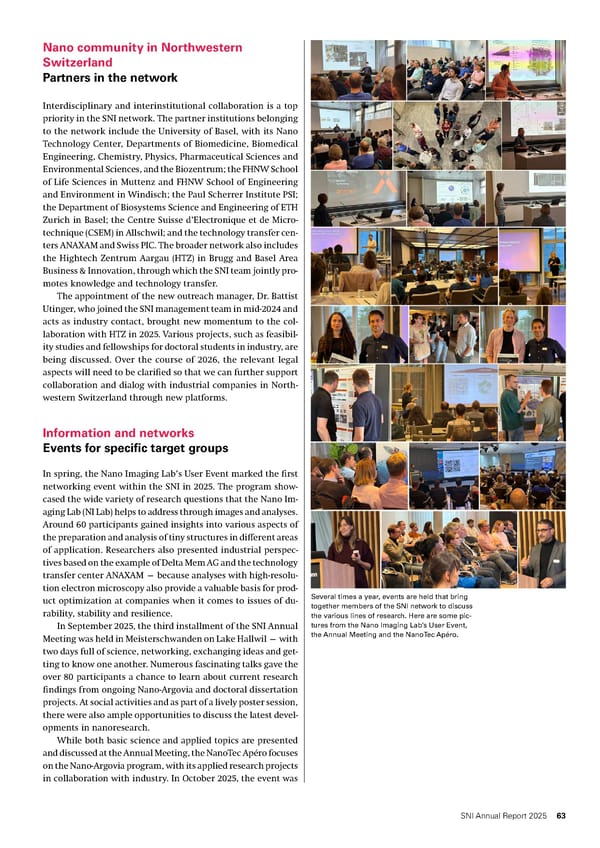
held at the premises of long-standing industry part- ner Straumann Institut AG in Basel. Those present enjoyed fascinating insights into the company’s work as well as current Nano-Argovia projects on ceramic dental implants, enzyme-based PET degra- dation and self-degrading implants. In addition, a poster session provided an opportunity to discuss further research projects. The lively network also benefits from the Alumni- Nano organization, which appointed a new board in 2025. The five-person executive team has already be- gun to boost activity within the alumni network. Working hand in hand with the SNI team, they are intensifying contact between alumni and students as well as creating formats for dialog — which also generates added value for the whole network. As well as benefiting from contact with alumni, nanoscience students also get to know various com- panies and research institutions from the extended SNI network, even in the first semesters, thereby gaining an insight into applied nanoscience and nanotechnology topics. For example, one highlight in 2025 was the visit to the technology transfer center ANAXAM, which allowed students to experience state-of-the-art mea- suring technology up close. They also gained insights into the interface between research and industrial applications and benefited from personal exchange with the Chief Technical Officer, Matthias Wagner, who took plenty of time for questions, including about his own studies and professional career. Students also benefit from the SNI‘s inter- disciplinary network – for example, during an excursion to the ANAXAM technology transfer center. (Image: N. Stebler, SNI, University of Basel) “I was particularly impressed by how well the content of our studies is connected to the world of work. Even as early as the second semester, you get a clear a sense of what’s important in practice.” Kasimir Heeb, Nanoscience student, University of Basel Further informationen: NI Lab User Event: https://bit.ly/4rEVSpZ NanoTec Apéro: https://bit.ly/4tWNcg3 Campus Stories about ANAXAM visit: https://bit.ly/49HcDca 64 SNI Annual Report 2025
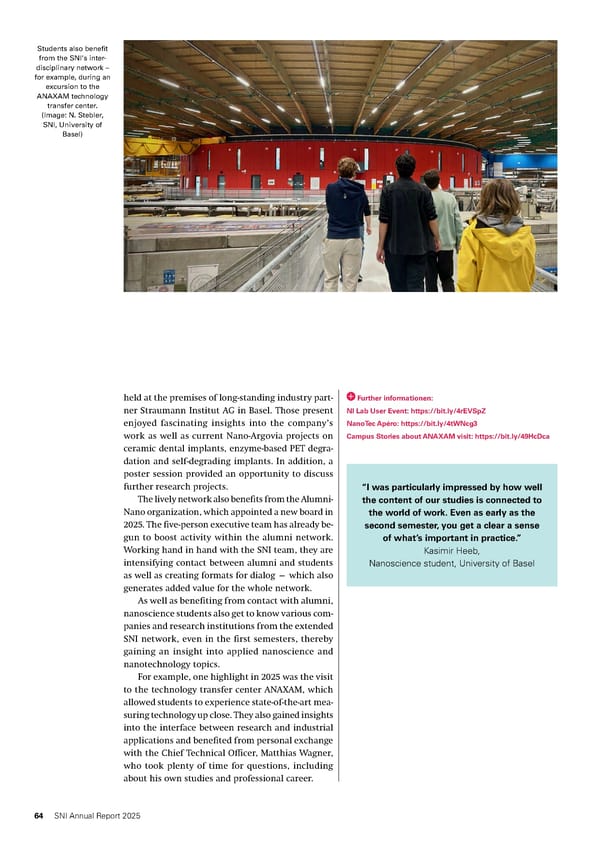
Research funding for nanoresearch Successful SNI members In 2025, researchers from the Swiss Nanoscience Institute once again successfully procured funding from national and inter- national funding programs such as the European Research Council (ERC) or the Swiss National Science Foundation (SNSF). These externally funded research projects also benefit research supported by the SNI. In the online magazine SNI INSight, we regularly report on newly launched projects and, by doing so, hope to contribute to the active and lively exchange of ideas within the network. Article in SNI INSight June 2025: https://bit.ly/40BCFcx Article in SNI INSight December 2025: https://bit.ly/46rSmqn Professors Tomasz Smole ń ski, Tom Ward and Oliver Wenger were awarded ERC Grants in 2025. In addition to these three researchers, other SNI members were also awarded funding from national and interna- tional funding programs, as we reported in SNI INSight. (Photos: Photo Vision Neuchâtel and SNI) 65 SNI Annual Report 2025
Communication and outreach: Successful formats for different target groups One of the key objectives for the communication and outreach team is to make the nanosciences – as well as the diverse news emerging from the SNI – accessible to different target groups and to actively promote dialog between research and society. To that end, the team keeps researchers inside and outside the SNI network up to speed on the latest scientific developments and activities while also sharing its enthusiasm for the natural sciences and the distinctive features of the nanosciences with children and young people. To reach the various target groups, the SNI relies on a wide range of different formats. Among others, these include established science fairs, school visits, and participation in student fairs (Maturandenmes- sen) across Switzerland. Appearances at markets also allow the SNI team to reach large numbers of people directly, with small-scale ex- periments offering an attractive and accessible way for members of the public to engage with the natural sciences and the nanosciences. Every year, a balanced mix of tried-and-tested events and new formats are used to reach the widest possible audience. In addition to face-to-face communication, the SNI’s social media channels and comprehensive website also play a vital role. As well as channels that have existed for several years (on LinkedIn, YouTube, Instagram and Bluesky) , 2025 saw the addition of new channels on Instagram, TikTok and YouTube. Under the title “Nano.Neugier” (“Nano.Curiosity”), the SNI team regularly publishes short videos of experiments and handicraft ideas for children, encouraging people to engage in a wide range of activities at home. Including individuals and organizations, the SNI’s channels on social media had a total of more than 8,500 followers in 2025. Thanks to this multifaceted approach, the SNI is able to communicate scientific content in a clear and entertaining manner and therefore help people to appreciate the relevance of the nanosciences in re- search and everyday life on a lasting basis. 66 SNI Annual Report 2025
In a workshop at Cartoonmuseum Basel, Kerstin Beyer-Hans introduced pu- pils to the world of the nanosciences. Local and international Broad range of activities The SNI’s outreach team has developed a wide range of exper- iments with a view to getting children, young people and the wider public excited about various aspects of the nanosciences as well as appealing to potential students. The team primarily offers these activities in Northwestern Switzerland, tailoring them to the respective event, age group and thematic focal area. This flexible program has become well established at schools and organizations in recent years, resulting in a steadily grow- ing number of inquiries. In 2025, numerous pupils from the two Basel half-cantons and the Canton of Aargau encountered the nanosciences for the first time through SNI activities — including workshops as part of the IBSA Foundation’s “Let’s Science” initiative at Cartoonmuseum Basel as well as experiment parcours allow- ing school classes to discover the various aspects of the nanoworld. Once again, “MINT on the move” was a particular highlight of 2025. Featuring experiments and handicrafts aboard a train in collaboration with Schweizerische Südost- bahn, the activity was also attended by a team from Swiss tele- vision SRF, who reported on this unusual format for STEM pro- motion from the SNI as part of the news program Schweiz Aktuell. It was with great enthusiasm that the SNI team took part, for the first time, in the Gurten Spring Festival in Bern, the Basel Holiday Pass, the open day at phaenovum in Lörrach, and a collaboration with the VHS Bremgarten, as well as the events “Aarau wird zum Bauernhof” (“Aarau becomes a farm”) and “Ad- vent i de Altstadt” (“Advent in the old town”) in Aarau. Our presence at these various markets added to our well-established stand at the Rüeblimärt and offered a chance to engage in many conversations with a wide audience. Focusing on accessible ex- periments and handicrafts, the stands attracted numerous vis- itors — and the SNI team also brought many of these experi- ments together on its three new social media channels by the name of “Nano.Neugier” in 2025. On Instagram, TikTok and YouTube, Dr. Kerstin Beyer-Hans published new ideas for creative activities on a weekly basis, helping to boost the SNI’s visibility. The SNI principally engages with potential students at stu- dent fairs, which the Study Coordination team attends regu- larly, as well as through advertisements and the “Schnupper School“ of the University of Basel. In addition, numerous nano- science students visited their former schools to talk about their personal experiences of this demanding degree program. When communicating research findings, the SNI follows a broad-based approach and sets its sights on an international audience. Via social media, the SNI regularly posts short articles on the excellent research supported by the SNI and thereby reaches a growing academic readership. In addition, the twice- yearly online magazine “SNI INSight” provides information aimed at the SNI network. Further informationen: SNI website: https://nanoscience.unibas.ch/en/ LinkedIn: https://bit.ly/3rbYP4s YouTube: https://bit.ly/4q9V1Mh + https://bit.ly/3NPKXdN SNI INSight: https://bit.ly/4cJUn52 At the Future Day, Battist Utinger explained to an interested audience how colors can be produced by different structures. On visits to the SNI, pupils make various stops to learn about different as- pects of the nanosciences. SRF reported on “MINT on the move” aboard a train operated by Südostbahn. Kerstin Beyer-Hans 67 SNI Annual Report 2025
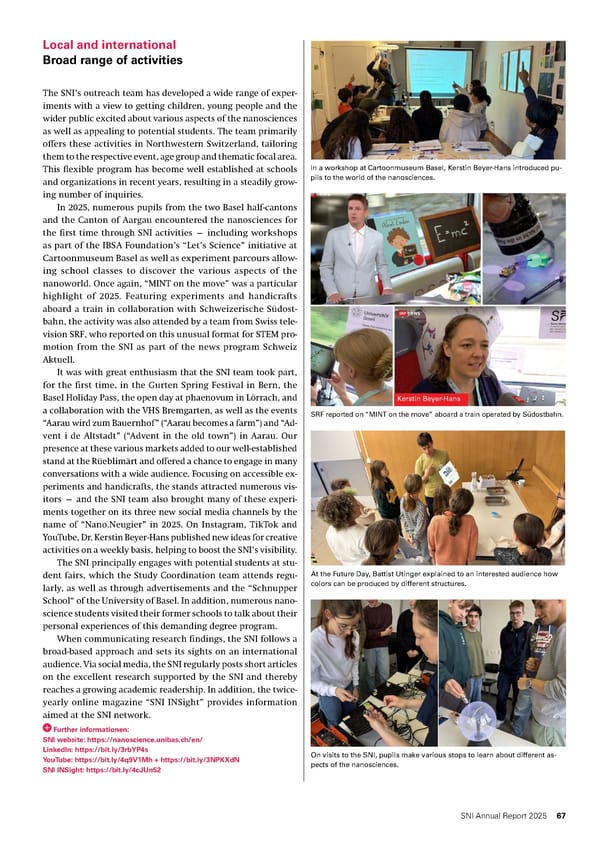
Financial report The Swiss Nanoscience Institute (SNI) was jointly founded by the University of Basel and the Canton of Aargau in 2006. Twenty years later, the SNI is firmly established as the leading center of excellence for nanoscience and nanotechnology in Northwestern Switzerland. It brings together cutting-edge research with services and knowledge and technology transfer as well as the promotion of early career researchers. The SNI focuses on the core areas of nanoimaging and nano- fabrication — from basic research and applied projects to the service units of the Nano Technology Center (the Nano Imaging Lab and Nano Fabrication Lab) and the educational program. One key factor in the SNI’s success is its interdisciplinary net- work, which includes researchers from the leading academic in- stitutions of Northwestern Switzerland. Together, SNI members work to put the nanosciences and nanotechnology to use for the benefit of society. These efforts rely on constant adaptation in order to meet increasing technological requirements. Founded on basic research At the SNI, the basic research that forms the starting point for innovation is, to a large extent, supported by funding the two Argovia Professors Rodrick Lim and Martino Poggio. With their outstanding scientific work, the two professors make a key con- tribution to the SNI’s international visibility and recognition. Through participation in national and international research col- laborations, they were awarded over CHF 1.5 million in external funding for their research, as well as the funding from the SNI. The SNI also supports the research of the three titular pro- fessors at the Paul Scherrer Institute: Thomas Jung, Michel Kenzelmann and Frithjof Nolting. All the professors together received around CHF 1.8 million from the SNI budget. Most doctoral students at the SNI PhD School, which was founded in 2012, also focus on questions of basic science. There were 41 doctoral students in the PhD School in 2025. Although they were working at various institutions within the SNI network, they will all receive their doctorates from the Faculty of Science at the University of Basel. The total expenditure for the PhD School — which covers salaries, consumables and events — ran to some CHF 1.8 million in 2025. Collaboration with industry The Nano-Argovia program, which has existed since the SNI was founded, lays the foundation for knowledge and technology trans- fer between research and industry. In 2025, the SNI supported ten Nano-Argovia projects with total funding of over CHF 1.5 million. The project partners supplemented this funding with addi- tional resources from public research funding programs such as Innosuisse, the Swiss National Science Foundation and EU pro- grams, in addition to a total of over CHF 1.2 million in funding from the participating research institutions themselves. The in- dustrial partners also made contributions in kind worth some CHF 1.3 million to support the implementation of the research projects. Nano Technology Center as a service and research unit Founded in 2022, the Nano Technology Center is made up of two service units — the Nano Imaging Lab and the Nano Fabrication Lab — and provides industry and academia with state-of-the-art infrastructure and comprehensive services in the areas of imag- ing, analysis, and micro and nanofabrication. Expenditure 2025 in CHF The following table shows the outgoings by 2025 by item of expenditure according to the financial report of the University of Basel of 26 February, 2026: Management Infrastructure Know-how and Techtransfer Outreach & PR Support Nano Curriculum Nano Technology Center SNI PhD School Personnel and operational costs Overhead Infrastructure equipment Personnel and operational costs Nano-Argovia projects Personnel and operational costs Professors Univ. Basel PSI professors Bachelor and master programs Nano Imaging/Nano Fabrication Personnel and operational costs Univ. Basel 412’506 50’203 79’087 795’854 262’361 743’374 735’194 3’078’579 Canton AG 445’584 650‘000 311’366 155’060 1’557’715 98’528 938’185 94’639 175’560 357’238 1’102’791 5’886’666 Total 858’090 650‘000 361’569 155’060 1’557’715 177’615 1’734’039 94’639 437’921 1’100’612 1’837’985 8’965’245 Total expenditure 2025 in CHF 68 SNI Annual Report 2025
In keeping with the SNI’s strategic orientation toward nano- imaging and nanofabrication, the focus here is on the center’s continual expansion and sustainable operation in an internation- ally competitive manner. In 2025, the SNI facilitated not only the modernization of the Nano Technology Center’s technical facili- ties but also the timely realization of necessary maintenance and repair work through targeted investments drawn from the exist- ing reserves. The total budget of the Nano Technology Center was around CHF 1.1 million in 2025. Education and information as another focal area In 2025, there were 78 students enrolled on the bachelor’s and master’s program in nanosciences at the University of Basel, and the SNI supported the program with over CHF 0.4 million. Students on the bachelor’s degree program first gain a compre- hensive grounding in the natural sciences and then supplement this with individual specializations. This structure enables grad- uates of the program to work at the interfaces between differ- ent scientific disciplines. As well as providing financial support for the degree pro- gram, the SNI is actively engaged in public relations with a view to raising awareness of the nanoscience degree program and informing people about the SNI’s activities and current research findings. The team achieves this using various formats, includ- ing direct dialog with the public and a presence on social media. Digital channels also play a key role in internal communication within the interdisciplinary network. Moreover, the SNI orga- nizes regular events such as the Annual Meeting or the NanoTec Apéro, which promote technical dialog as well as networking. Expenditure on public relations and internal events ran to less than CHF 0.2 million in 2025. Expansion of infrastructure Given its accumulated reserves, the SNI was also able to support the renewal of infrastructure with over CHF 0.35 million in 2025. This funding primarily went to the expansion of the Nano Tech- nology Center. In order to maintain an internationally compet- itive level in terms of the technical equipment of the Nano Imaging Lab and the Nano Fabrication Lab, it will also be nec- essary to expand the two service units in the coming years. The assets of around CHF 4.2 million set out in the 2025 annual financial statement are already partially earmarked, as orders have been placed that will not be supplied and invoiced until 2026. For example, the planned acquisition of a new FIB-SEM in 2025 has been postponed to 2026 due to a lengthy tendering pro- cedure. There is also a proportion of Nano-Argovia project funding that had not yet been spent by the end of 2025. Some of the assets also serve as a reserve for ongoing PhD projects. This is necessary in order to safeguard the payment of doctoral students, who begin their dissertations in the course of the year and are each funded for a period of 48 months. Many thanks for the support We are very grateful to the Finances of the University of Basel for its excellent and constructive collaboration and assistance with financial reporting. Particular thanks also go to the Cantons of Aargau, Basel-Stadt and Basel-Landschaft, whose ongoing commitment allows the SNI to train outstanding early career researchers, gain new scientific insights into the nanosciences, and support companies from Northwestern Switzerland with innovative projects as we work toward building a sustainable future. The following table shows the income statement of SNI funds as of 31 December 2025: SNI annual statment 2025 in CHF Grants Investment income Income Expenditure Annual balance 2025 SNI assets per 01/01/2025 Annual balance Univ. Basel 2’847’470 18’648 2’866’118 3’078’579 (212’461) 1’665’383 (212’461) 1’452’922 Canton AG 5 ‘247‘940 249’562 5’497’502 5’886’666 (389’164) 3’198’742 (389’163 ) 2’809’579 Total 8’095’410 268’210 8’363’620 8’965’245 (601’625) 4’864’125 (601’624 ) 4’262’501 SNI assets per 31/12/2025 in CHF 69 SNI Annual Report 2025
Organization Argovia Board Regierungsrätin M. Bircher, Head Department of Education, Culture and Sport, Canton of Aargau Prof. Dr. A. Schenker-Wicki, President University of Basel Prof. Dr. M. Poggio, Director SNI Prof. Dr. C. Bergamaschi, President FHNW Prof. Dr. G.-L. Bona, former Director Empa Prof. Dr. C. Rüegg, Director Paul Scherrer Institute PSI SNI Executive Committee Prof. Dr. M. Poggio, Director SNI (PhD School) Prof. Dr. P. Maletinsky, Vice Director (Nano-Argovia program) Prof. Dr. T. Maier (Biozentrum, Dean Phil.-Nat.) Prof. Dr. J. Huwyler (Curriculum Nanosciences, Department of Pharmaceutical Sciences) Prof. Dr. R. Y. H. Lim (Biozentrum) Prof. Dr. K. Moselund (Paul Scherrer Institute PSI), bis 30.9.2025 Prof. Dr. F. Nolting (Paul Scherrer Institute PSI), ab 1.10.2025 Prof. Dr. O. Tagit (University of Applied Sciences and Arts Northwestern Switzerland) Prof. Dr. O. Wenger (Department of Chemistry) C. Wirth, General Manager SNI Prof. Dr. I. Zardo ( Nano Technology Center and Department of Physics) SNI Management Prof. Dr. M. Poggio, Director C. Wirth, General Manager Dr. A. Baumgartner (PhD School) Dr. K. Beyer-Hans (Outreach, communications, social media) Dr. A. Car (Curriculum Nanosciences) Dr. G. Gadea (Nano Fabrication Lab) S. Hüni (Outreach, communications) Dr. C. Möller (Communications, media contact, social media) Dr. B. Utinger (Outreach, communications, industry contact) Dr. M. Wyss (Nano Imaging Lab) Curriculum Nanosciences Dr. A. Car, (Study coordinator) S. Chambers (Administration) Nano Imaging Lab Dr. M. Wyss (Head, TEM, FIB-SEM) E. Bieler (SEM) S. Erpel (SEM, TEM) Dr. M. Schönenberger (AFM, LSM) Dr. A. Vogel (TEM, FIB-SEM) Nano Fabrication Lab Dr. G. Gadea (Head) J. Herzog A. Lücke X. Wildermuth Lists of members and projects 2025 Principal Investigators and associated members https://bit.ly/4bbgMXJ PhD students https://bit.ly/4aMRRII Projects PhD School https://bit.ly/4aTNKKO Projects Nano-Argovia program https://bit.ly/4kT482S Further information If you would like to know more about the Swiss Nanoscience Institute, please visit our website (www.nanoscience.ch) or fol- low us on LinkedIn, Bluesky, Instagram or YouTube. There we regularly post news from the network. Scientific supplement Scientific reports from all the Nano-Argovia and SNI PhD School projects from 2025 can be found on our website or by scanning the QR code. https://bit.ly/3N5YePz 70 SNI Annual Report 2025
About this publication : Design concept: STUDIO NEO Text and layout: C. Möller and M. Poggio with support of PIs, doctoral students and Chat GPT Translation and proofreading: UNIWORKS (Erlangen, Germany) Images: If not referenced, C. Möller © Swiss Nanoscience Institute, March 2026 Cover image: Protein foam The open-pored structure consists of natural albumin and forms a stable, biocompatible protein network. Its highly cross-linked pore structure provides an optimal microenvironment for cell adhesion and tissue integration, making it a promising scaffold for bone and cartilage re- generation. (Image: S. Zaugg, University of Applied Sciences and Arts Northwestern Switzerland and University of Basel)
University of Basel Petersplatz 1 P .O. Box 2148 4001 Basel Switzerland www.unibas.ch Swiss Nanoscience Institute University of Basel Klingelbergstrasse 82 4056 Basel Switzerland www.nanoscience.ch Educating Talents since 1460. Scientific supplement