
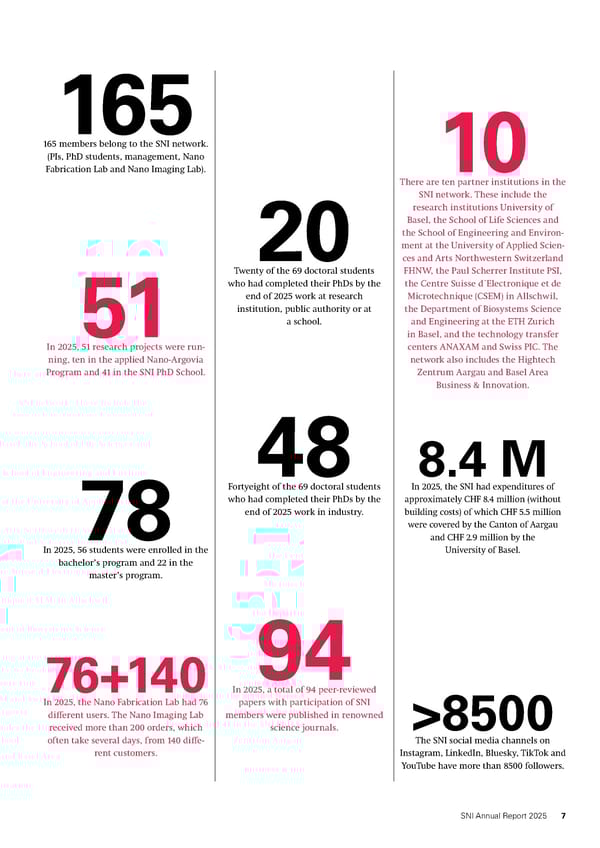
165 165 members belong to the SNI network. (PIs, PhD students, management, Nano Fabrication Lab and Nano Imaging Lab). 78 In 2025, 56 students were enrolled in the bachelor’s program and 22 in the master’s program. 8.4 M In 2025, the SNI had expenditures of approximately CHF 8.4 million (without building costs) of which CHF 5.5 million were covered by the Canton of Aargau and CHF 2.9 million by the University of Basel. 51 In 2025, 51 research projects were run- ning, ten in the applied Nano-Argovia Program and 41 in the SNI PhD School. 10 There are ten partner institutions in the SNI network. These include the research institutions University of Basel, the School of Life Sciences and the School of Engineering and Environ- ment at the University of Applied Scien- ces and Arts Northwestern Switzerland FHNW, the Paul Scherrer Institute PSI, the Centre Suisse d`Electronique et de Microtechnique (CSEM) in Allschwil, the Department of Biosystems Science and Engineering at the ETH Zurich in Basel, and the technology transfer centers ANAXAM and Swiss PIC. The network also includes the Hightech Zentrum Aargau and Basel Area Business & Innovation. 94 In 2025, a total of 94 peer-reviewed papers with participation of SNI members were published in renowned science journals. 48 Fortyeight of the 69 doctoral students who had completed their PhDs by the end of 2025 work in industry. 20 Twenty of the 69 doctoral students who had completed their PhDs by the end of 2025 work at research institution, public authority or at a school. >8500 The SNI social media channels on Instagram, LinkedIn, Bluesky, TikTok and YouTube have more than 8500 followers. 76+140 In 2025, the Nano Fabrication Lab had 76 different users. The Nano Imaging Lab received more than 200 orders, which often take several days, from 140 diffe- rent customers. 7 SNI Annual Report 2025
 Annual Report 2025 - Swiss Nanoscience Institute Page 6 Page 8