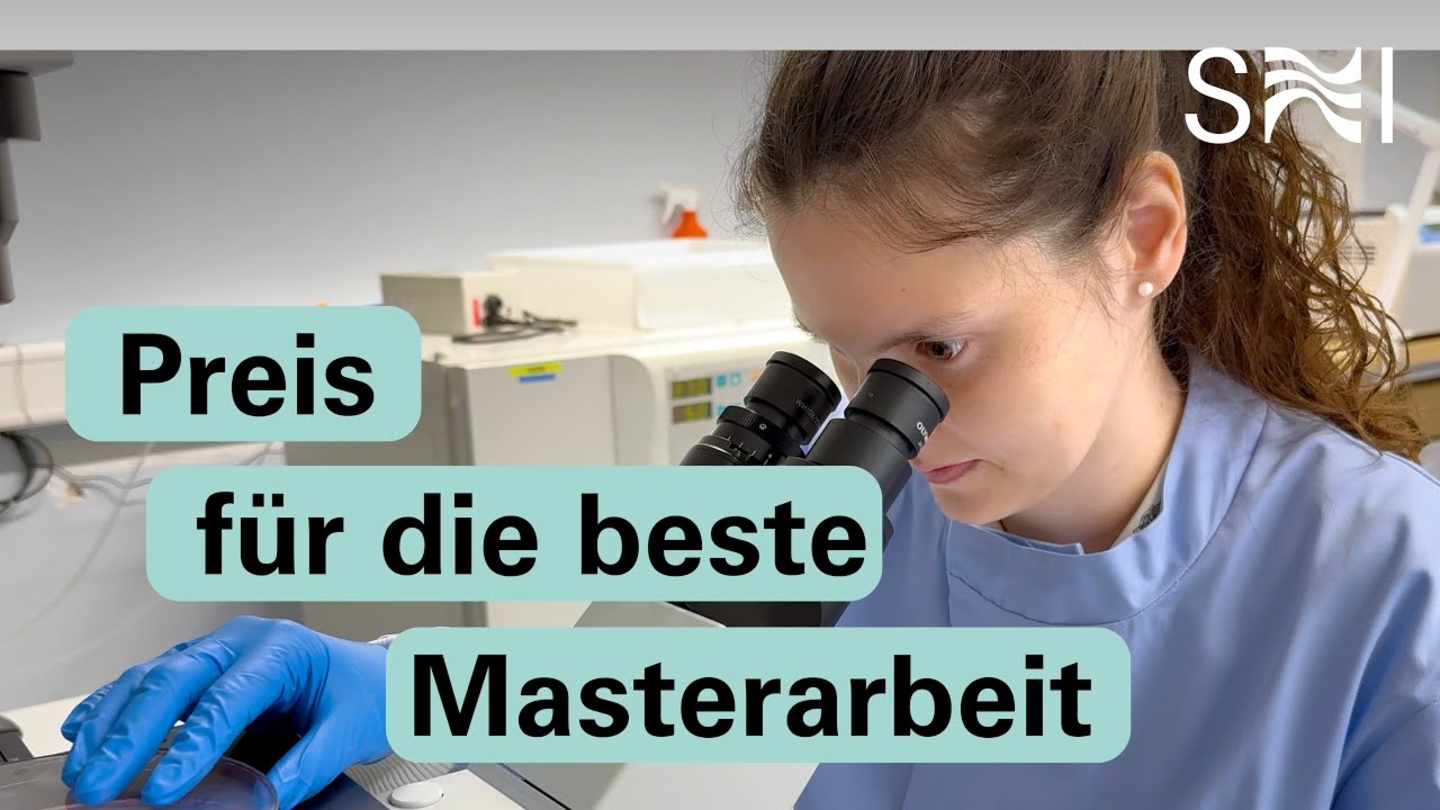
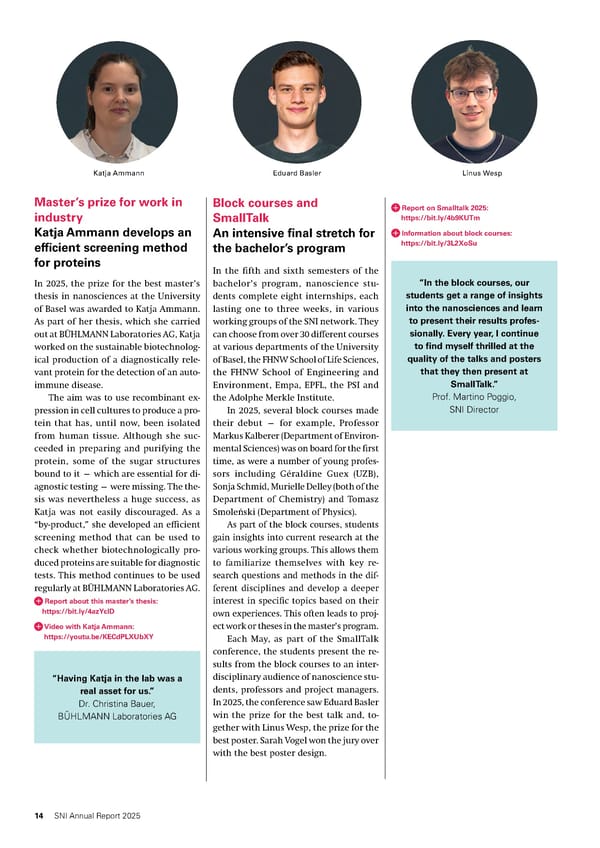
Master’s prize for work in industry Katja Ammann develops an efficient screening method for proteins In 2025, the prize for the best master’s thesis in nanosciences at the University of Basel was awarded to Katja Ammann. As part of her thesis, which she carried out at BÜHLMANN Laboratories AG, Katja worked on the sustainable biotechnolog- ical production of a diagnostically rele- vant protein for the detection of an auto- immune disease. The aim was to use recombinant ex- pression in cell cultures to produce a pro- tein that has, until now, been isolated from human tissue. Although she suc- ceeded in preparing and purifying the protein, some of the sugar structures bound to it — which are essential for di- agnostic testing — were missing. The the- sis was nevertheless a huge success, as Katja was not easily discouraged. As a “by-product,” she developed an efficient screening method that can be used to check whether biotechnologically pro- duced proteins are suitable for diagnostic tests. This method continues to be used regularly at BÜHLMANN Laboratories AG. Report about this master’s thesis: https://bit.ly/4azYcID Video with Katja Ammann: https://youtu.be/KECdPLXUbXY “Having Katja in the lab was a real asset for us.” Dr. Christina Bauer, BÜHLMANN Laboratories AG Block courses and SmallTalk An intensive final stretch for the bachelor’s program In the fifth and sixth semesters of the bachelor’s program, nanoscience stu- dents complete eight internships, each lasting one to three weeks, in various working groups of the SNI network. They can choose from over 30 different courses at various departments of the University of Basel, the FHNW School of Life Sciences , the FHNW School of Engineering and Environment , Empa, EPFL, the PSI and the Adolphe Merkle Institute. In 2025, several block courses made their debut — for example, Professor Markus Kalberer (Department of Environ- mental Sciences) was on board for the first time, as were a number of young profes- sors including Géraldine Guex (UZB), Sonja Schmid, Murielle Delley (both of the Department of Chemistry) and Tomasz Smoleński (Department of Physics). As part of the block courses, students gain insights into current research at the various working groups. This allows them to familiarize themselves with key re- search questions and methods in the dif- ferent disciplines and develop a deeper interest in specific topics based on their own experiences. This often leads to proj- ect work or theses in the master’s program. Each May, as part of the SmallTalk conference, the students present the re- sults from the block courses to an inter- disciplinary audience of nanoscience stu- dents, professors and project managers. In 2025, the conference saw Eduard Basler win the prize for the best talk and, to- gether with Linus Wesp, the prize for the best poster. Sarah Vogel won the jury over with the best poster design. Report on Smalltalk 2025: https://bit.ly/4b9KUTm Information about block courses: https://bit.ly/3L2XoSu “In the block courses, our students get a range of insights into the nanosciences and learn to present their results profes- sionally. Every year, I continue to find myself thrilled at the quality of the talks and posters that they then present at SmallTalk.” Prof. Martino Poggio, SNI Director Katja Ammann Eduard Basler Linus Wesp 14 SNI Annual Report 2025
 Annual Report 2025 - Swiss Nanoscience Institute Page 13 Page 15