
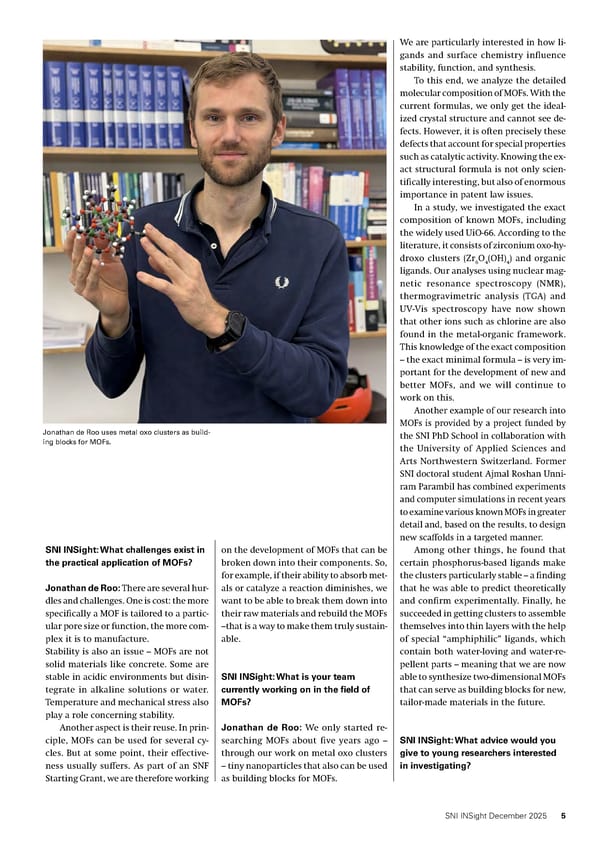
on the development of MOFs that can be broken down into their components. So, for example, if their ability to absorb met- als or catalyze a reaction diminishes, we want to be able to break them down into their raw materials and rebuild the MOFs –that is a way to make them truly sustain- able. SNI INSight: What is your team currently working on in the field of MOFs? Jonathan de Roo: We only started re- searching MOFs about five years ago – through our work on metal oxo clusters – tiny nanoparticles that also can be used as building blocks for MOFs. We are particularly interested in how li- gands and surface chemistry influence stability, function, and synthesis. To this end, we analyze the detailed molecular composition of MOFs. With the current formulas, we only get the ideal- ized crystal structure and cannot see de- fects. However, it is often precisely these defects that account for special properties such as catalytic activity. Knowing the ex- act structural formula is not only scien- tifically interesting, but also of enormous importance in patent law issues. In a study, we investigated the exact composition of known MOFs, including the widely used UiO-66. According to the literature, it consists of zirconium oxo-hy- droxo clusters (Zr6O4(OH)4) and organic ligands. Our analyses using nuclear mag- netic resonance spectroscopy (NMR), thermogravimetric analysis (TGA) and UV-Vis spectroscopy have now shown that other ions such as chlorine are also found in the metal-organic framework. This knowledge of the exact composition – the exact minimal formula – is very im- portant for the development of new and better MOFs, and we will continue to work on this. Another example of our research into MOFs is provided by a project funded by the SNI PhD School in collaboration with the University of Applied Sciences and Arts Northwestern Switzerland. Former SNI doctoral student Ajmal Roshan Unni- ram Parambil has combined experiments and computer simulations in recent years to examine various known MOFs in greater detail and, based on the results, to design new scaffolds in a targeted manner. Among other things, he found that certain phosphorus-based ligands make the clusters particularly stable – a finding that he was able to predict theoretically and confirm experimentally. Finally, he succeeded in getting clusters to assemble themselves into thin layers with the help of special “amphiphilic” ligands, which contain both water-loving and water-re- pellent parts – meaning that we are now able to synthesize two-dimensional MOFs that can serve as building blocks for new, tailor-made materials in the future. SNI INSight: What advice would you give to young researchers interested in investigating? SNI INSight: What challenges exist in the practical application of MOFs? Jonathan de Roo: There are several hur- dles and challenges. One is cost: the more specifically a MOF is tailored to a partic- ular pore size or function, the more com- plex it is to manufacture. Stability is also an issue – MOFs are not solid materials like concrete. Some are stable in acidic environments but disin- tegrate in alkaline solutions or water. Temperature and mechanical stress also play a role concerning stability. Another aspect is their reuse. In prin- ciple, MOFs can be used for several cy- cles. But at some point, their effective- ness usually suffers. As part of an SNF Starting Grant, we are therefore working Jonathan de Roo uses metal oxo clusters as build- ing blocks for MOFs. 5 SNI INSight December 2025
 SNI Insight December 2025 Page 4 Page 6