
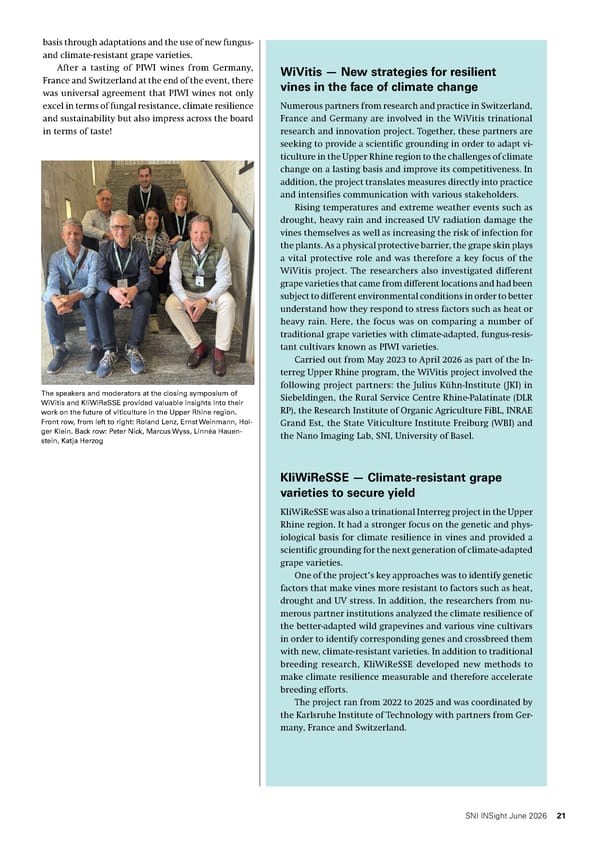
basis through adaptations and the use of new fungus- and climate-resistant grape varieties. After a tasting of PIWI wines from Germany, France and Switzerland at the end of the event, there was universal agreement that PIWI wines not only excel in terms of fungal resistance, climate resilience and sustainability but also impress across the board in terms of taste! WiVitis — New strategies for resilient vines in the face of climate change Numerous partners from research and practice in Switzerland, France and Germany are involved in the WiVitis trinational research and innovation project. Together, these partners are seeking to provide a scientific grounding in order to adapt vi- ticulture in the Upper Rhine region to the challenges of climate change on a lasting basis and improve its competitiveness. In addition, the project translates measures directly into practice and intensifies communication with various stakeholders. Rising temperatures and extreme weather events such as drought, heavy rain and increased UV radiation damage the vines themselves as well as increasing the risk of infection for the plants. As a physical protective barrier, the grape skin plays a vital protective role and was therefore a key focus of the WiVitis project. The researchers also investigated different grape varieties that came from different locations and had been subject to different environmental conditions in order to better understand how they respond to stress factors such as heat or heavy rain. Here, the focus was on comparing a number of traditional grape varieties with climate-adapted, fungus-resis- tant cultivars known as PIWI varieties. Carried out from May 2023 to April 2026 as part of the In- terreg Upper Rhine program, the WiVitis project involved the following project partners: the Julius Kühn-Institute (JKI) in Siebeldingen, the Rural Service Centre Rhine-Palatinate (DLR RP), the Research Institute of Organic Agriculture FiBL, INRAE Grand Est, the State Viticulture Institute Freiburg (WBI) and the Nano Imaging Lab, SNI, University of Basel. KliWiReSSE — Climate-resistant grape varieties to secure yield KliWiReSSE was also a trinational Interreg project in the Upper Rhine region. It had a stronger focus on the genetic and phys- iological basis for climate resilience in vines and provided a scientific grounding for the next generation of climate-adapted grape varieties. One of the project’s key approaches was to identify genetic factors that make vines more resistant to factors such as heat, drought and UV stress. In addition, the researchers from nu- merous partner institutions analyzed the climate resilience of the better-adapted wild grapevines and various vine cultivars in order to identify corresponding genes and crossbreed them with new, climate-resistant varieties. In addition to traditional breeding research, KliWiReSSE developed new methods to make climate resilience measurable and therefore accelerate breeding efforts. The project ran from 2022 to 2025 and was coordinated by the Karlsruhe Institute of Technology with partners from Ger- many, France and Switzerland. The speakers and moderators at the closing symposium of WiVitis and KliWiReSSE provided valuable insights into their work on the future of viticulture in the Upper Rhine region. Front row, from left to right: Roland Lenz, Ernst Weinmann, Hol- ger Klein. Back row: Peter Nick, Marcus Wyss, Linnéa Hauen- stein, Katja Herzog 21 SNI INSight June 2026
 SNI INSight - June 2026 Page 20 Page 22