
SNI INSight - June 2026
SNI INSight highlights research and activities of the Swiss Nanoscience Institute.
In Northwestern Switzerland Five new Nano-Argovia projects In the Upper Rhine region Future of viticulture In administration Short portraits of management team members In industry Best Master’s thesis prize SNI INS ight June 2026 Showcasing research and activities of the Swiss Nanoscience Institute
3 Editorial 4 Exploring alternatives to cancer diagnostics Master’s prize for Raphael Pauli 7 In memoriam: Andreas Engel 10 Nano-Argovia program – Understanding antifouling systems and calcium carbonate microstructures – On the trail of liver disease with AFM – Preventing clumping – New method for producing X-ray diffraction gratings – Clock generator for digital systems 18 The future of viticulture in focus Final meeting of WiVitis and KliWiReSSE 24 n³: Nano – Now & Next Guest article by Timon Flathmann 26 Successfully defended 28 Launch of the National Centre of Competence in Research “Precision” 29 Tool of the Month: DriveAFM 30 Who is who? A management team with diverse expertise 40 News from the SNI network www.nanoscience.ch Follow us on: SNI INSight Twice a year, SNI INSight informs you about the Swiss Nanoscience Institute’s activities and results in research, education, technology, knowledge transfer and public relations. Previous issues are available on our website under SNI INSight. 2 SNI INSight June 2026
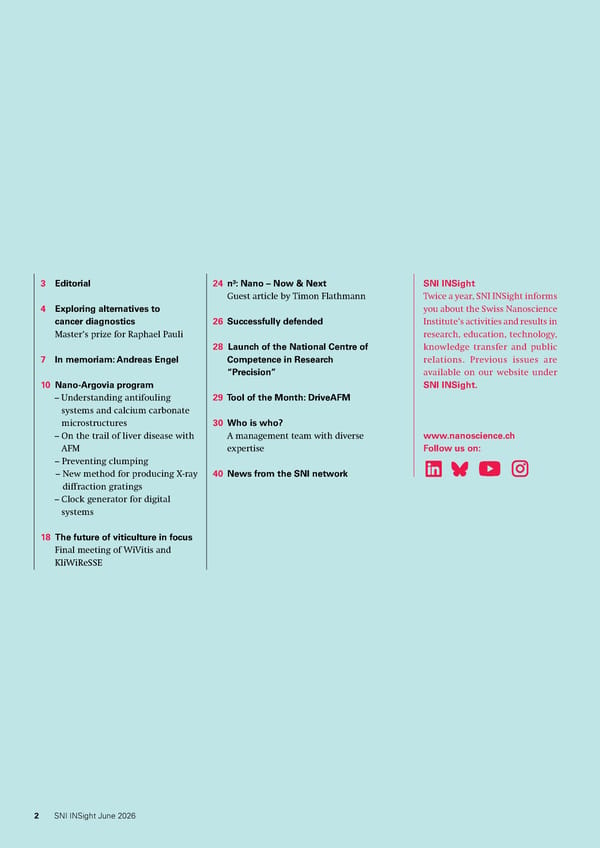
Dear colleagues and nanoenthusiasts, For our network, the first months of 2026 have been dominated by good news and a series of exciting events. Five new Na- no-Argovia projects have made a good start and are briefly presented in this edi- tion of SNI INSight. At the last NanoTec Apéro, which was held in May at the FHNW School of Engineering and Envi- ronment, we had the chance to learn more about these new projects in collab- oration with industrial companies from the region. Three doctoral students from the SNI PhD School have successfully defended their dissertations over the last six months, and we’ve chosen Raphael Pauli as winner of the prize for the best mas- ter’s thesis of last year. In this edition, we briefly report on the topics explored by these early career researchers. In recent weeks, there have also been moments where it was necessary to pause, reflect and bid farewell. Our long-standing honorary member Andreas Engel passed away in April – and in this edition, we once again pay tribute to his dedication to the SNI and the nanoscience degree program. The trinational project WiVitis, which addressed the topic of sustainable viticul- ture in the face of climate change, also came to a successful conclusion in the past few months. The SNI’s Nano Imaging Lab primarily contributed to this project with informative electron microscope im- ages of the grapes – and hosted the well-attended closing symposium. Many other areas of research also ben- efit from the valuable information found in electron microscope images of differ- ent surfaces. With a view to not only ex- ploring the fascinating world of tiny structures but also making it accessible to a wide audience, the SNI outreach and communication team has for several years maintained a successful collabora- tion with the Museum Burghalde in Lenz- burg. In May, five “NanoCubes” were in- augurated at the museum following two years of preparatory work. Integrated into the permanent exhibition, these cubes provide insights into the world of microscopically small structures – offer- ing a new perspective on objects from the permanent exhibition. We’re very grate- ful to Markus Dürrenberger, the former head of the Nano Imaging Lab, who showed great attention to detail in han- dling the technical implementation of the concepts from the SNI outreach team. At the SNI, a small but excellent team is tasked with implementing and driving forward projects of this kind, as well as organizing SNI events and running the SNI PhD School, the study program and the institute as a whole. These people of- ten work in the background – but in this and the next edition of SNI INSight, we want to put them in the spotlight. With this in mind, we briefly introduce the members of the management team, who keep the SNI running smoothly and effi- ciently through their administrative work. I hope you all enjoy reading this edi- tion and have a great summer. I look for- ward to seeing many of you at the Annual Event in September. Prof. Martino Poggio, SNI director 3 SNI INSight June 2026
Raphael Pauli found out about the degree in nanosciences at the University of Basel via an internet search in 2019. After his time at the cantonal school in Baden, he knew he wanted to do a degree in the areas of physics, chemistry and biology. “The nanoscience degree offered the broadest possible grounding and only be- came more specialized at a later stage — that’s why I chose it,” Raphael recalls. During his studies, the wide-ranging practical activities were a real highlight for him. “I particularly enjoyed the hands-on courses and above all the re- search work in the various groups as part of the block courses, as well as the project and master’s work,” he says. Leaning toward biotechnology and medical subjects Thanks to the sheer diversity of the bach- elor’s, it became increasingly clear to him over the course of the program that, in order to go down a biological/medical route in the future, the best option was to take the medical nanosciences special- ization as part of the master’s program. In keeping with this, Raphael chose proj- ects at the university hospital and at the Department of Pharmaceutical Sciences. It was also clear to him from an early stage that he wanted to go straight into employment after completing his studies and that a doctoral dissertation was out Exploring alternatives to cancer diagnostics Master’s prize for Raphael Pauli This year, the prize for the best master’s thesis goes to Raphael Pauli. In his project at BÜHLMANN Laboratories, Raphael investigated synthetic proteins that could one day play a role in colorectal cancer diagnostics. A promising synthetic alternative Until now, tests of this kind have relied on antibodies from the blood of rabbits, but BÜHLMANN Laboratories is inter- ested in a synthetic alternative — which is where Raphael’s work comes in. “One promising option are a form of small, artificially produced proteins known as sybodies, which can be de- signed in the lab and produced in cell cultures in order to bind to specific mol- ecules in a targeted manner,” Raphael explains. The problem with the hemoglo- bin-detecting sybodies tested so far, how- ever, is that they are too quick to break away from their target molecule again and are therefore unsuitable for reliable tests. Raphael’s approach in his master’s project was to make the system more sta- ble by combining multiple sybodies into larger complexes — similar to natural antibodies, which are also each made up of four subunits. Hailing from the Canton of Aargau, the young researcher therefore used cell cultures to produce various sy- body variants with different numbers of sybodies. Based on ELISA tests, he simul- taneously tested the expression of the constructs and their binding to hemoglo- bin. Using a technique known as bio-layer interferometry, Raphael was then also able to show not only that all of the ana- lyzed complexes bind to hemoglobin suc- of the question. In order to gain valuable experience for his job search, he there- fore aimed to do his master’s thesis in industry. Through contacts within the nano network, he got in touch with for- mer nanoscience student Dr. Michael Ger- spach at BÜHLMANN Laboratories, who forwarded Raphael’s request internally at the company. Master’s thesis all about colorectal cancer diagnostics This led Raphael to the team of Dr. Sara Bantleon, Lead Manager Industrial Engi- neering & Business Excellence at BÜHL- MANN Laboratories. As part of this six- month master’s thesis, Raphael worked with small synthetic proteins known as sybodies, which may one day play a role in colorectal cancer diagnostics. “Colorectal cancer is one of the most common forms of cancer worldwide and can only be treated effectively if it is di- agnosed early,” explains Bantleon, who supervised Raphael’s work. “With this in mind, we’re developing a sensitive immu- nochemical laboratory test that can quan- titatively detect even the smallest amounts of hemoglobin — in other words, blood — in stool samples. This al- lows us to pick up a key warning signal for colorectal cancer or its precursors, known as colorectal polyps.” 4 SNI INSight June 2026
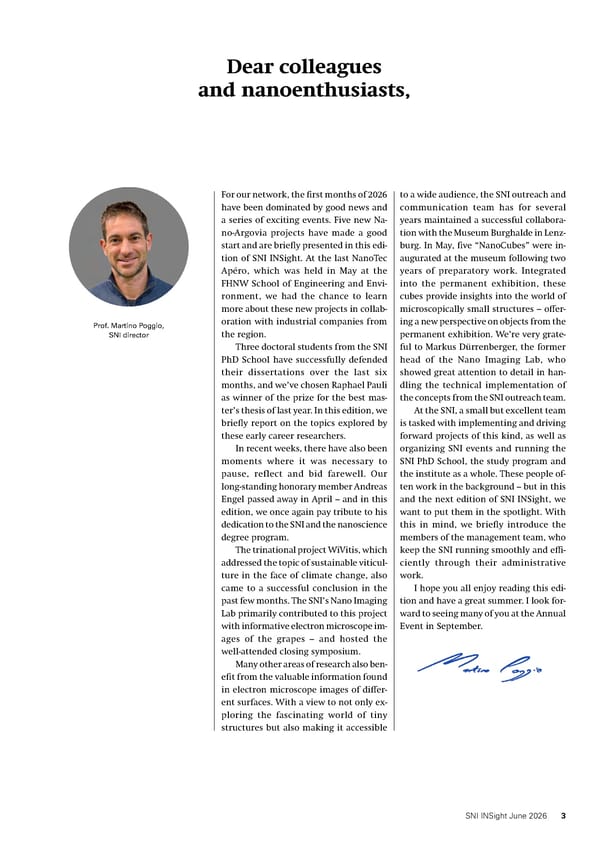
complete all steps of the work himself — from producing the sybodies to their analysis and testing — with support pro- vided by the team in a very approachable manner. This practical experience, with all the methods he learned, was instrumental in helping him quickly find a job as a re- search assistant at the Botnar Institute of Immune Engineering (BIIE) after complet- ing his master’s degree — although he explains that there weren’t that many entry-level positions advertised. “The in- terview at the BIIE was primarily about the areas of practical work where I’ve al- ready gained experience. I was lucky to get to know bio-layer interferometry very well through my work at BÜHLMANN,” he says in our interview. cessfully but also that some variants do so up to 1,000 times stronger than indi- vidual sybodies. Amazingly, the sybodies bind to the natural hemoglobin better than to a recombinant hemoglobin pro- duced in the lab. “We’ve taken the first step toward a replacement for natural antibodies, although there’s still a need for many further experiments and adap- tations,” says Raphael, summarizing his work. Changes after a great time at university For Raphael, the prize for the best mas- ter’s thesis is another great thing to emerge from his thoroughly enjoyable time at BÜHLMANN Laboratories. He particularly liked that he could For his master‘s thesis, Raphael Pauli worked at BÜHLMANN Laboratories, where he received excellent guidance from Sara Bantleon. 5 SNI INSight June 2026
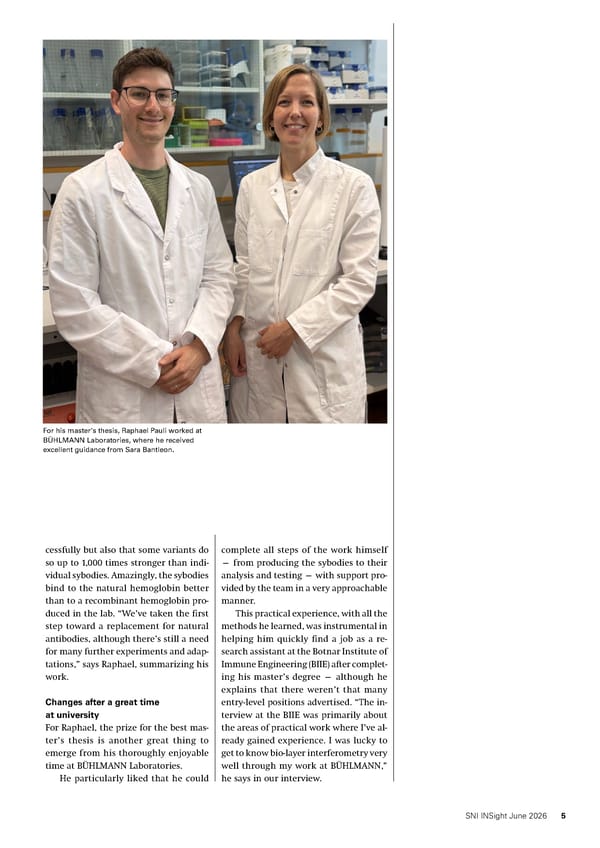
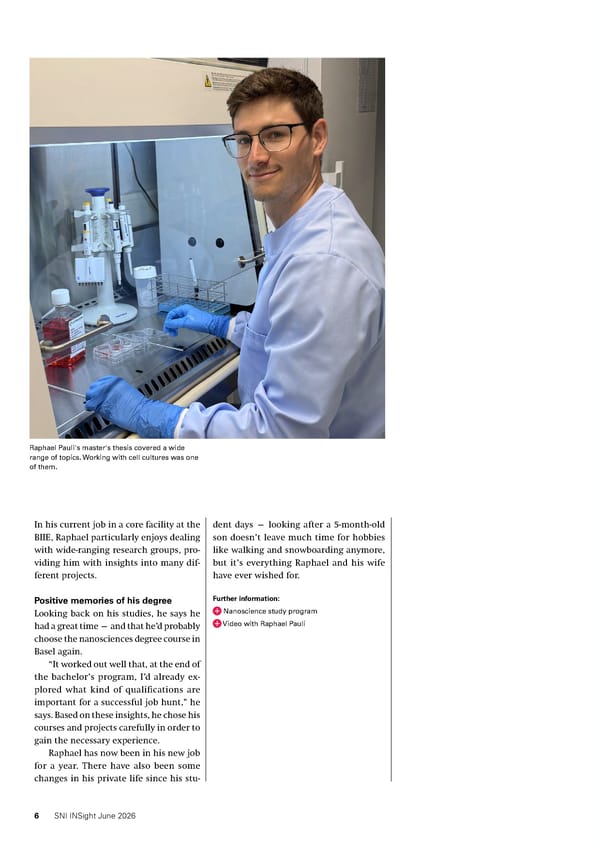
In his current job in a core facility at the BIIE, Raphael particularly enjoys dealing with wide-ranging research groups, pro- viding him with insights into many dif- ferent projects. Positive memories of his degree Looking back on his studies, he says he had a great time — and that he’d probably choose the nanosciences degree course in Basel again. “It worked out well that, at the end of the bachelor’s program, I’d already ex- plored what kind of qualifications are important for a successful job hunt,” he says. Based on these insights, he chose his courses and projects carefully in order to gain the necessary experience. Raphael has now been in his new job for a year. There have also been some changes in his private life since his stu- dent days — looking after a 5-month-old son doesn’t leave much time for hobbies like walking and snowboarding anymore, but it’s everything Raphael and his wife have ever wished for. Further information: Nanoscience study program Video with Raphael Pauli Raphael Pauli's master's thesis covered a wide range of topics. Working with cell cultures was one of them. 6 SNI INSight June 2026
In memoriam: Andreas Engel We mourn the loss of Prof. em. Andreas Engel, who passed away on April 1, 2026, at the age of 82. Andreas Engel was not only an outstanding scientist and a pioneer in nano- and structural biology, but also one of the founding fathers of the nanoscience degree pro- gram at the University of Basel nearly 25 years ago. Through his dedication and visionary leadership within the then newly established National Centre of Compe- tence in Research in Nanosciences (NCCR Nano), he played a key role in creating the interdisciplinary bach- elor’s and master’s programs that continue to inspire young talents to this day. At the time, educating students in an interdisciplinary way across the natural sciences from the very beginning was a true innovation – thanks to Andreas Engel, the first students successfully gradu- ated in nanosciences as early as 2005. Andreas Engel also remained closely connected to the successor organization of the NCCR Nano, the Swiss Na- noscience Institute (SNI). In recognition of his excep- tional commitment to the study program, he was awarded honorary membership of the SNI in 2016. In addition, his distinguished research in the fields of atomic force mi- croscopy and cryo-electron microscopy contributed to numerous projects. Above all, we have lost a warm, enthusiastic and highly valued colleague. He cared deeply about the edu- cation of young scientists, personal interaction and in- terdisciplinary thinking – something many of us experi- enced once again at the anniversary celebration of the nanoscience program last year. We will always remember Andreas Engel with great gratitude. More information about Andreas Engel’s career and research: Obituary for Prof. Andreas Engel (1943–2026), Biozentrum Interview with Prof. Andreas Engel about the foundation of the nanoscience program (2014) 7 SNI INSight June 2026
8 SNI INSight June 2026
Five new applied research projects in the Nano-Argovia program In 2026, the SNI is supporting five new applied research projects in close collaboration with industrial companies. In three of these projects, the industrial partner is based in the canton of Aargau, while one project each involves partners from the cantons of Solothurn and Basel-Stadt. The academic partners come from the FHNW School of Life Sciences in Muttenz, the FHNW School of Engi- neering and Environmental Sciences in Windisch, the Paul Scherrer Institute and the University of Basel. 9 SNI INSight June 2026
Positive and negative effects of calcium On the one hand, hard water delivers valuable min- erals such as magnesium and calcium that are essen- tial for human beings. On the other hand, calcium carbonate deposits in water pipes for tap or cooling water lead to problems including blocked pipes, greater biofilm formation and corrosion. Removing these layers of deposits is a mechanically intensive process and requires limescale removal products. The water can be preventively treated using chemi- cals or ion exchangers, but these are harmful to the environment and must also be properly disposed of. Moreover, they completely strip drinking water of essential calcium ions, which must then be re-added. Electric antifouling (EAF) systems offer a sustain- able alternative. These devices emit electric pulses into water pipes in order to reduce limescale depos- its without removing water-borne minerals. Al- though EAF systems are already widespread and have been the subject of numerous studies, their mecha- nism of action is yet to be fully explored. New calcium carbonate microstructure discovered The interdisciplinary team led by Dr. Sina Saxer (FHNW School of Life Sciences) has demonstrated a reduction in limescale deposits in a feasibility study with EAF devices from project partner Hydro Service Schweiz AG. The researchers have also identified a previously unknown, almond-shaped microstruc- ture of calcium carbonate, which they call μAl- monds. In the Nano-Argovia project of the same name, μAlmond, the team will now use X-ray absorption microspectroscopy to analyze this new microstruc- ture in detail and to investigate, in real time, how it forms under the influence of electric fields when EAF systems are used. The researchers are also ex- amining how various forms of calcium carbonate (calcite, aragonite, μAlmonds) can be absorbed by human intestinal cells. Should μAlmonds exhibit higher bioavailability, they could also be of interest as dietary supplements or biomaterials. With a planned duration of two years, the proj- ect aims to clarify the mechanism of action of EAF systems and, by doing so, to drive the development of tailor-made solutions for homes and industry. At the same time, the findings in relation to μAlmonds could pave the way for innovative approaches in nutrition science and materials research. Understanding antifouling systems and calcium carbon- ate microstructures In the Nano-Argovia project μAlmond, researchers are exploring funda- mental questions regarding the formation of calcium carbonate (CaCO 3 ) crystals in water systems. As part of this work, they are studying the mechanism of action of an electric antifouling system and analyzing the significance of various crystal shapes for water quality and health. Collaboration between: FHNW School of Life Sciences Paul Scherrer Institute PSI Hydro Service Schweiz AG (Wohlen) Further information: Nano-Argovia program FHNW School of Life Sciences Paul Scherrer Institute PSI Hydro Service Schweiz AG 10 SNI INSight June 2026 Nano-Argovia program
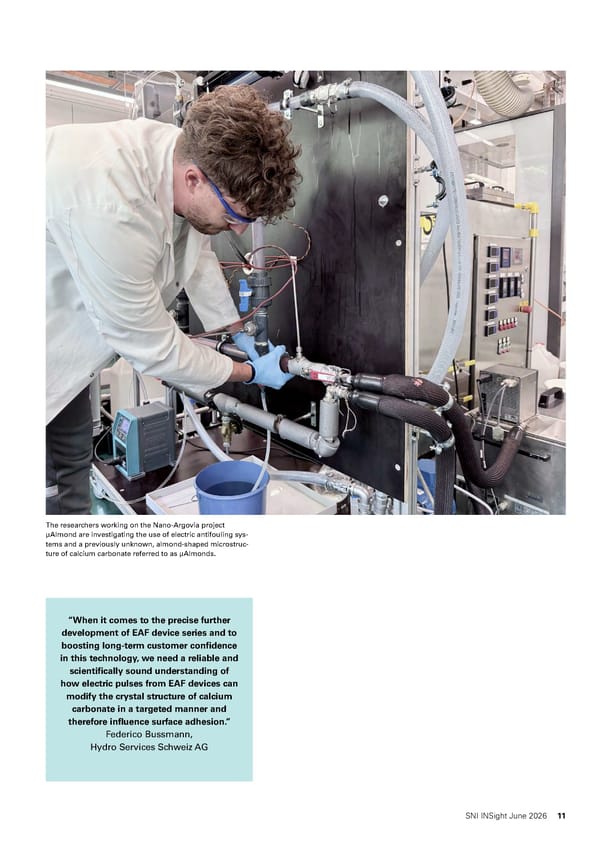
The researchers working on the Nano-Argovia project μAlmond are investigating the use of electric antifouling sys- tems and a previously unknown, almond-shaped microstruc- ture of calcium carbonate referred to as μAlmonds. “When it comes to the precise further development of EAF device series and to boosting long-term customer confidence in this technology, we need a reliable and scientifically sound understanding of how electric pulses from EAF devices can modify the crystal structure of calcium carbonate in a targeted manner and therefore influence surface adhesion.” Federico Bussmann, Hydro Services Schweiz AG 11 SNI INSight June 2026
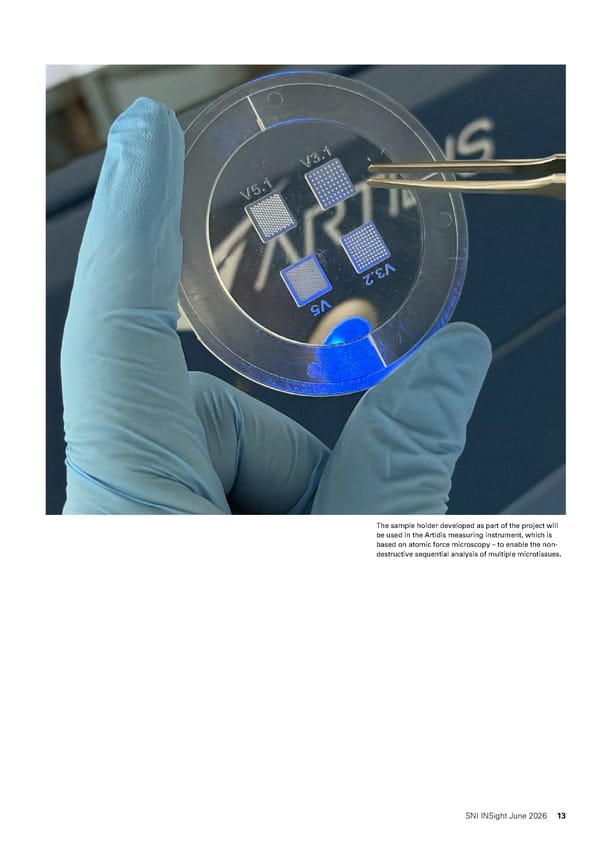
Chronic liver disease is a global health problem. Af- fecting some 1.5 billion people worldwide, it is re- sponsible for some 4% of all deaths annually. The disease often develops gradually — it can start with a fatty liver before progressing to scarring and ulti- mately cirrhosis. Various interactions play a role Existing models, such as two-dimensional cell cul- tures, are unable to sufficiently map the complex interactions between the various participating liver cells. These interactions are, however, key to under- standing how the disease progresses and to develop- ing methods to treat it. Modern 3D cell cultures could provide a better solution, as they mimic natural liver biology. Now, researchers working on the Nano-Argovia project NanoDiLi under the leadership of Dr. Joachim Köser (FHNW School of Life Sciences) have set them- selves the goal of developing an innovative platform for the nanomechanical analysis of liver microtis- sues. To this end, the researchers combine a special measuring instrument based on atomic force micros- copy with a novel sample holder developed within the project that allows nondestructive and sequen- tial examination of multiple microtissues. Comparison with known biomarkers As part of the project, the researchers compare the nanomechanical measurements of healthy and dis- eased liver tissue with classical biochemical markers. They also produce the mixed cellular microtissue in order to study disease development in depth and test known active substances for the treatment of fibro- sis and fatty liver. By providing user-friendly hardware and robust protocols, the aim is to make nanomechanical anal- yses accessible to research laboratories and industry. In the long term, the project could help to reduce animal experimentation in liver research and to pro- mote new applications in tumor biology and tissue engineering. On the trail of liver disease with AFM In the Nano-Argovia project NanoDiLi, an interdisciplinary team is developing an innovative platform based on atomic force microscopy in order to carry out nanomechanical analyses of three-dimensional liver microtissues. The researchers hope to use this platform to study the development of chronic liver diseases and to test known active sub- stances for the treatment of scarring and fatty liver disease in the lab. Cooperation between: FHNW School of Life Sciences FHNW School of Engineering and Environment Artidis AG (Basel- Stadt) Further information: Nano-Argovia program FHNW School of Life Sciences FHNW School of Engineering and Environment Artidis “NanoDiLi will support ARTIDIS in evaluating AFM-based nanomechanical measurements as complementary readouts for advanced in vitro liver models. By comparing mechanical signals with established biological markers, the project will assess their relevance for disease modelling and preclinical testing, while supporting future translational development with liver-model experts and selected industry stakeholders.” Dr. Marko Loparic, ARTIDIS AG 12 SNI INSight June 2026 Nano-Argovia program
The sample holder developed as part of the project will be used in the Artidis measuring instrument, which is based on atomic force microscopy – to enable the non- destructive sequential analysis of multiple microtissues. 13 SNI INSight June 2026
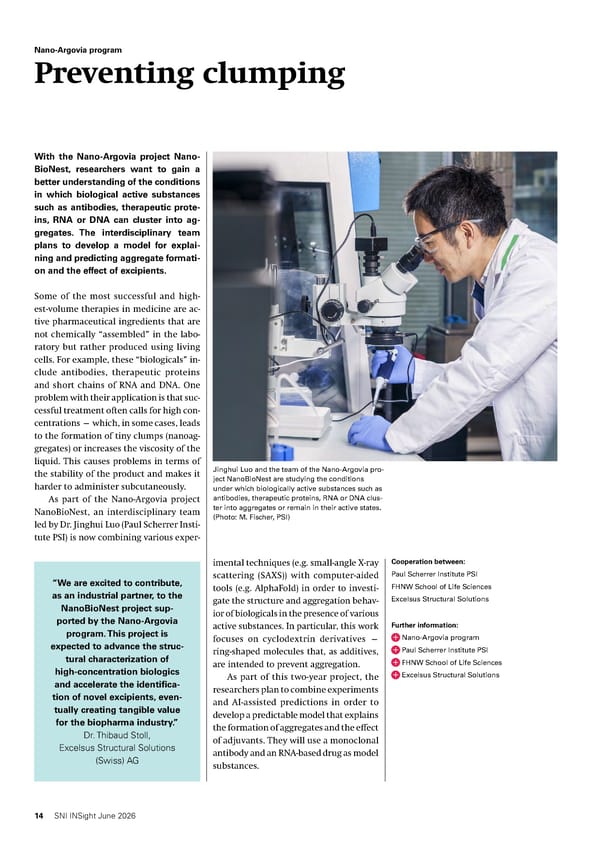
Nano-Argovia program Preventing clumping With the Nano-Argovia project Nano- BioNest, researchers want to gain a better understanding of the conditions in which biological active substances such as antibodies, therapeutic prote- ins, RNA or DNA can cluster into ag- gregates. The interdisciplinary team plans to develop a model for explai- ning and predicting aggregate formati- on and the effect of excipients. Some of the most successful and high- est-volume therapies in medicine are ac- tive pharmaceutical ingredients that are not chemically “assembled” in the labo- ratory but rather produced using living cells. For example, these “biologicals” in- clude antibodies, therapeutic proteins and short chains of RNA and DNA. One problem with their application is that suc- cessful treatment often calls for high con- centrations — which, in some cases, leads to the formation of tiny clumps (nanoag- gregates) or increases the viscosity of the liquid. This causes problems in terms of the stability of the product and makes it harder to administer subcutaneously. As part of the Nano-Argovia project NanoBioNest, an interdisciplinary team led by Dr. Jinghui Luo (Paul Scherrer Insti- tute PSI) is now combining various exper- imental techniques (e.g. small-angle X-ray scattering (SAXS)) with computer-aided tools (e.g. AlphaFold) in order to investi- gate the structure and aggregation behav- ior of biologicals in the presence of various active substances. In particular, this work focuses on cyclodextrin derivatives — ring-shaped molecules that, as additives, are intended to prevent aggregation. As part of this two-year project, the researchers plan to combine experiments and AI-assisted predictions in order to develop a predictable model that explains the formation of aggregates and the effect of adjuvants. They will use a monoclonal antibody and an RNA-based drug as model substances. Jinghui Luo and the team of the Nano-Argovia pro- ject NanoBioNest are studying the conditions under which biologically active substances such as antibodies, therapeutic proteins, RNA or DNA clus- ter into aggregates or remain in their active states. (Photo: M. Fischer, PSI) “We are excited to contribute, as an industrial partner, to the NanoBioNest project sup- ported by the Nano-Argovia program. This project is expected to advance the struc- tural characterization of high-concentration biologics and accelerate the identifica- tion of novel excipients, even- tually creating tangible value for the biopharma industry.” Dr. Thibaud Stoll, Excelsus Structural Solutions (Swiss) AG Cooperation between: Paul Scherrer Institute PSI FHNW School of Life Sciences Excelsus Structural Solutions Further information: Nano-Argovia program Paul Scherrer Institute PSI FHNW School of Life Sciences Excelsus Structural Solutions 14 SNI INSight June 2026
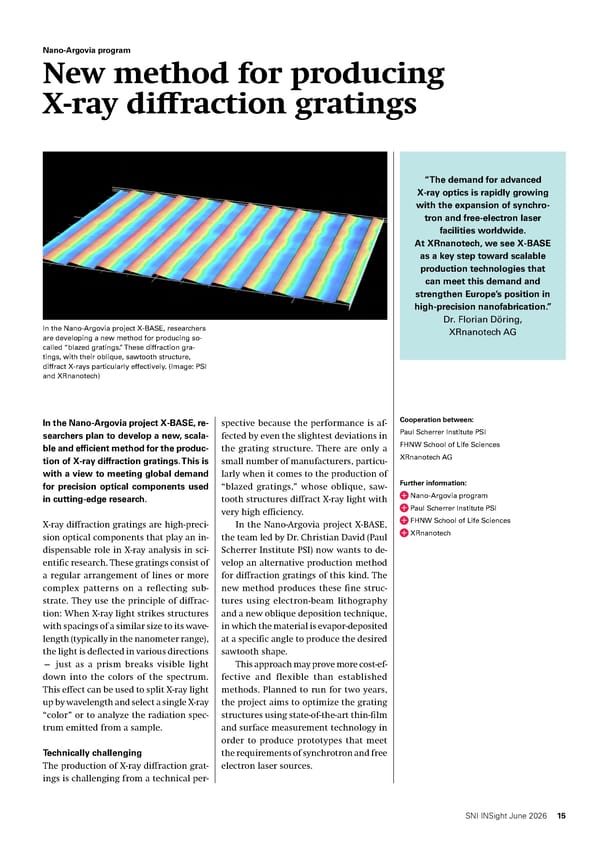
In the Nano-Argovia project X-BASE, researchers are developing a new method for producing so- called “blazed gratings. ” These diffraction gra- tings, with their oblique, sawtooth structure, diffract X-rays particularly effectively. (Image: PSI and XRnanotech) Nano-Argovia program New method for producing X-ray diffraction gratings In the Nano-Argovia project X-BASE, re- searchers plan to develop a new, scala- ble and efficient method for the produc- tion of X-ray diffraction gratings. This is with a view to meeting global demand for precision optical components used in cutting-edge research. X-ray diffraction gratings are high-preci- sion optical components that play an in- dispensable role in X-ray analysis in sci- entific research. These gratings consist of a regular arrangement of lines or more complex patterns on a reflecting sub- strate. They use the principle of diffrac- tion: When X-ray light strikes structures with spacings of a similar size to its wave- length (typically in the nanometer range), the light is deflected in various directions — just as a prism breaks visible light down into the colors of the spectrum. This effect can be used to split X-ray light up by wavelength and select a single X-ray “color” or to analyze the radiation spec- trum emitted from a sample. Technically challenging The production of X-ray diffraction grat- ings is challenging from a technical per- spective because the performance is af- fected by even the slightest deviations in the grating structure. There are only a small number of manufacturers, particu- larly when it comes to the production of “blazed gratings,” whose oblique, saw- tooth structures diffract X-ray light with very high efficiency. In the Nano-Argovia project X-BASE, the team led by Dr. Christian David (Paul Scherrer Institute PSI) now wants to de- velop an alternative production method for diffraction gratings of this kind. The new method produces these fine struc- tures using electron-beam lithography and a new oblique deposition technique, in which the material is evapor-deposited at a specific angle to produce the desired sawtooth shape. This approach may prove more cost-ef- fective and flexible than established methods. Planned to run for two years, the project aims to optimize the grating structures using state-of-the-art thin-film and surface measurement technology in order to produce prototypes that meet the requirements of synchrotron and free electron laser sources. Cooperation between: Paul Scherrer Institute PSI FHNW School of Life Sciences XRnanotech AG Further information: Nano-Argovia program Paul Scherrer Institute PSI FHNW School of Life Sciences XRnanotech “The demand for advanced X-ray optics is rapidly growing with the expansion of synchro- tron and free-electron laser facilities worldwide. At XRnanotech, we see X-BASE as a key step toward scalable production technologies that can meet this demand and strengthen Europe’s position in high-precision nanofabrication.” Dr. Florian Döring, XRnanotech AG 15 SNI INSight June 2026
Synchronization is vital High-precision oscillators are at the heart of modern electronics. They provide accurate timing and syn- chronization in computer centers, AI systems, net- works and many other applications where precise clock signals are vital — for example, in order to transfer data without errors, synchronize calcula- tions or use energy efficiently. The oscillator that the interdisciplinary team plans to build in the Nano-Argovia project NANO- SAW will serve as a proof of concept for a new way of generating vibrations based on “Rayleigh waves” — surface acoustic waves (SAWs) that travel along the surface of a material. These waves are produced in a thin layer of aluminum nitride (AlN), a piezo- electric material that is particularly good at convert- ing mechanical stresses into electrical signals and vice versa. This aluminum nitride layer is applied to a substrate using a special coating technique known as high- power impulse magnetron sputtering (HiPIMS). The substrate can then be integrated directly into exist- ing microchips — which is vital for miniaturization and applications in modern electronic devices. Fine, comblike electrode structures are attached to the aluminum nitride surface in order to apply electrical voltages that stimulate mechanical Rayleigh waves, which then spread across the sur- face. A second electrode structure detects the incom- ing waves and converts them back into electrical signals. These signals are then amplified and re- turned by a feedback circuit in order to produce con- tinuous oscillation — in other words, the oscillator “vibrates” in a stable manner at a specific frequency. Fast, energy-saving and stable When it comes to manufacturing, one priority for the interdisciplinary team led by Professor Mathieu Coustans (FHNW School of Engineering and Environ- ment) is for the aluminum nitride layers to have a thickness of less than 500 nanometers. The research- ers are also keen to achieve optimum crystallo- graphic alignment in order to improve the acoustic characteristics. The oscillator should start very quickly (under 100 milliseconds), consume very little energy and produce an extremely stable clock signal. This project will help to drive advances in ener- gy-efficient information and communication tech- nology with nanoscale materials and nanofabricated components as well as integration at system level. Clock generator for digital systems In the Nano-Argovia project NANO-SAW, researchers are developing a tiny, high-precision oscillator based on nanoscale surface waves. This is intended to serve as a frequency reference for digital high- speed systems. Cooperation between: FHNW School of Engi- neering and Environ- ment Paul Scherrer Institute PSI Micro Crystal AG Further information: Nano-Argovia program FHNW School of Engineering and Environment Paul Scherrer Institute PSI Micro Crystal AG “For Micro Crystal AG, NANO-SAW is an opportunity to bring our industrial exper- tise in high-precision timing components into a strong research collaboration. The project addresses key requirements for future oscillator technologies: accuracy, stability, compactness, low power con- sumption, and compatibility with modern microelectronics. We also expect valuable collateral insights for our broader technology development.” Dr. Thierry Hessler, Micro Crystal AG Nano-Argovia program 16 SNI INSight June 2026
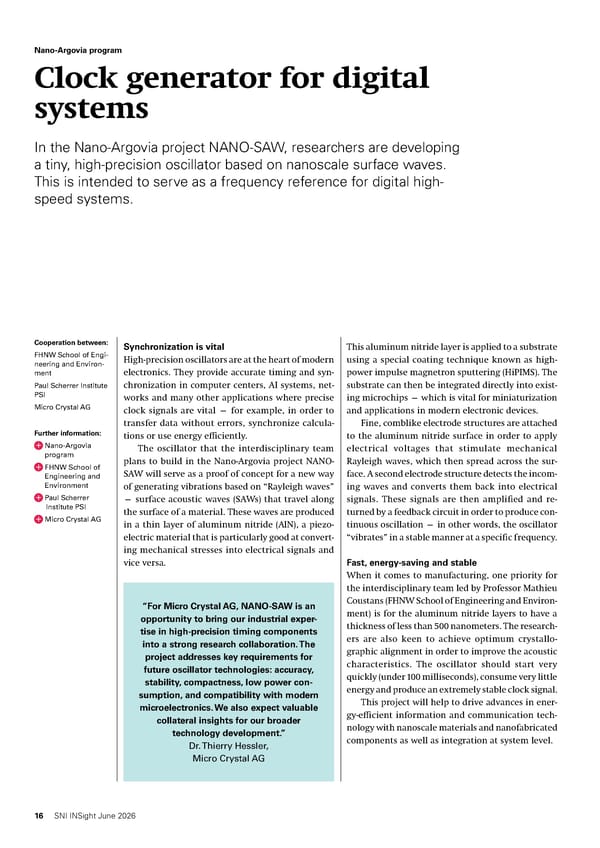
Mathieu Coustans‘ team is working in a cleanroom to develop the novel oscillator based on nanoscale surface waves. (Photo: M. Coustans, FHNW) 17 SNI INSight June 2026
The future of viticulture in focus Final meeting of WiVitis and KliWiReSSE Climate change poses fundamental questions for viticulture in the region — but can simultaneously be a driver of innovation and lasting changes. At the recent closing meeting of the trinational Interreg projects WiVitis and KliWiReSSE, held at the University of Basel, experts from the participating institutions met to present the results of the projects and discuss opportunities for sustainable, economi- cally successful viticulture in the Upper Rhine region. The Nano Imaging Lab of the Swiss Nanoscience Institute (SNI) was actively involved in the WiVitis project and played host to this fascinating and informative event. The repercussions of climate change are manifold — including for viticulture in the Upper Rhine region. Rising tempera- tures and extreme weather events such as late frost, drought, heavy rain and in- creased UV radiation all constitute stress factors for the vines. As well as having to respond to these factors, the plants are also exposed to considerable pressure from diseases. This calls for strategies to help tackle the looming challenges from an ecologi- cal and economic perspective. One option could be to make greater use of fungus-re- sistant grape varieties known as PIWIs. At the start of the closing meeting, WiVitis project coordinator Dr. Katja Her- zog — from the Julius Kühn-Institute in Siebeldingen (Germany) — presented re- search findings clearly showing that PI- WIs are superior to several traditional varieties in terms of resistance to climate change and pressure from diseases. Healthy grape skin is a key indicator Of course, when it comes to protection against fungal infections such as the gray mold caused by the fungus Botrytis cine- rea, key factors include mechanical/phys- ical protective barriers. Accordingly, grapevine cluster architecture also plays a role in terms of susceptibility to infec- tion, as do the composition and structure of the grape skin. “A loose grapevine clus- ter structure minimizes the risk of infec- tion,” explains Herzog. “And a thick coat of wax on the grape skin also results in fewer infections. On the other hand, if the wax coat is too thin or damaged, wa- ter that’s not repelled causes cracks in the skin — which can then provide a pathway for infection.” Over the last three years, the research- ers have used standardized, objective measurements to analyze grapes from various locations and that were subject to different environmental conditions. Among other things, the researchers used 3D scanners to identify the grapevine cluster architecture and impedance mea- surements to determine the electrical properties. They also determined the Nano Technology Center Cryo-SEM images of the grape skin of Pinot Noir following treatment with different pestici- des: untreated, copper, copper plus Armi- carb®. (Photos: Evi Bieler, NI Lab) Copper Untreated Copper + Armicarb ® 18 SNI INSight June 2026
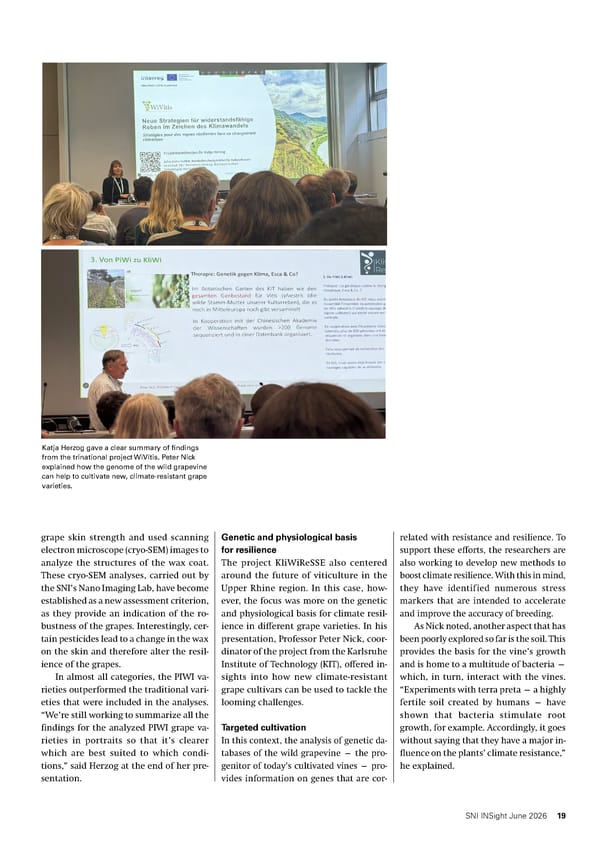
grape skin strength and used scanning electron microscope (cryo-SEM) images to analyze the structures of the wax coat. These cryo-SEM analyses, carried out by the SNI’s Nano Imaging Lab, have become established as a new assessment criterion, as they provide an indication of the ro- bustness of the grapes. Interestingly, cer- tain pesticides lead to a change in the wax on the skin and therefore alter the resil- ience of the grapes. In almost all categories, the PIWI va- rieties outperformed the traditional vari- eties that were included in the analyses. “We’re still working to summarize all the findings for the analyzed PIWI grape va- rieties in portraits so that it’s clearer which are best suited to which condi- tions,” said Herzog at the end of her pre- sentation. Genetic and physiological basis for resilience The project KliWiReSSE also centered around the future of viticulture in the Upper Rhine region. In this case, how- ever, the focus was more on the genetic and physiological basis for climate resil- ience in different grape varieties. In his presentation, Professor Peter Nick, coor- dinator of the project from the Karlsruhe Institute of Technology (KIT), offered in- sights into how new climate-resistant grape cultivars can be used to tackle the looming challenges. Targeted cultivation In this context, the analysis of genetic da- tabases of the wild grapevine — the pro- genitor of today’s cultivated vines — pro- vides information on genes that are cor- related with resistance and resilience. To support these efforts, the researchers are also working to develop new methods to boost climate resilience. With this in mind, they have identified numerous stress markers that are intended to accelerate and improve the accuracy of breeding. As Nick noted, another aspect that has been poorly explored so far is the soil. This provides the basis for the vine’s growth and is home to a multitude of bacteria — which, in turn, interact with the vines. “Experiments with terra preta — a highly fertile soil created by humans — have shown that bacteria stimulate root growth, for example. Accordingly, it goes without saying that they have a major in- fluence on the plants’ climate resistance,” he explained. Katja Herzog gave a clear summary of findings from the trinational project WiVitis. Peter Nick explained how the genome of the wild grapevine can help to cultivate new, climate-resistant grape varieties. 19 SNI INSight June 2026
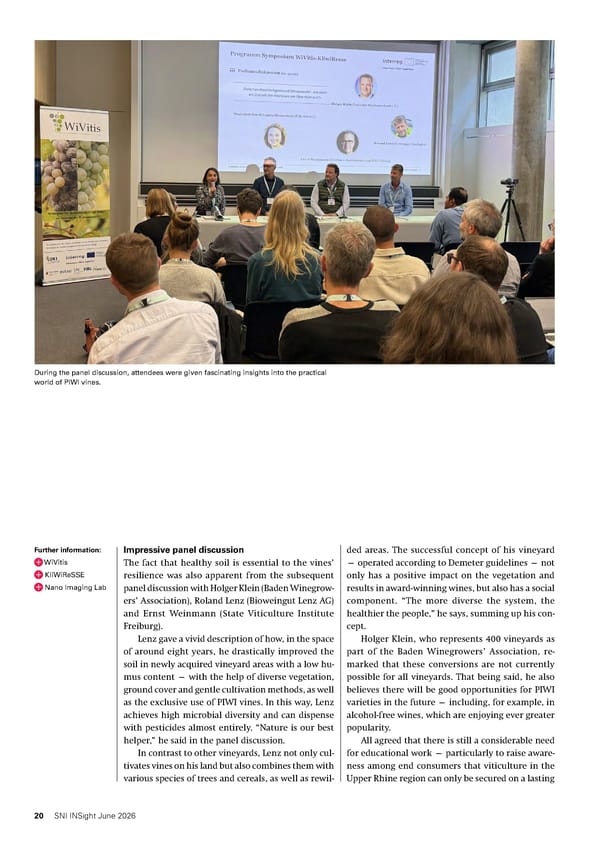
Further information: WiVitis KliWiReSSE Nano Imaging Lab During the panel discussion, attendees were given fascinating insights into the practical world of PIWI vines. Impressive panel discussion The fact that healthy soil is essential to the vines’ resilience was also apparent from the subsequent panel discussion with Holger Klein (Baden Winegrow- ers’ Association), Roland Lenz (Bioweingut Lenz AG) and Ernst Weinmann (State Viticulture Institute Freiburg). Lenz gave a vivid description of how, in the space of around eight years, he drastically improved the soil in newly acquired vineyard areas with a low hu- mus content — with the help of diverse vegetation, ground cover and gentle cultivation methods, as well as the exclusive use of PIWI vines. In this way, Lenz achieves high microbial diversity and can dispense with pesticides almost entirely. “Nature is our best helper,” he said in the panel discussion. In contrast to other vineyards, Lenz not only cul- tivates vines on his land but also combines them with various species of trees and cereals, as well as rewil- ded areas. The successful concept of his vineyard — operated according to Demeter guidelines — not only has a positive impact on the vegetation and results in award-winning wines, but also has a social component. “The more diverse the system, the healthier the people,” he says, summing up his con- cept. Holger Klein, who represents 400 vineyards as part of the Baden Winegrowers’ Association, re- marked that these conversions are not currently possible for all vineyards. That being said, he also believes there will be good opportunities for PIWI varieties in the future — including, for example, in alcohol-free wines, which are enjoying ever greater popularity. All agreed that there is still a considerable need for educational work — particularly to raise aware- ness among end consumers that viticulture in the Upper Rhine region can only be secured on a lasting 20 SNI INSight June 2026
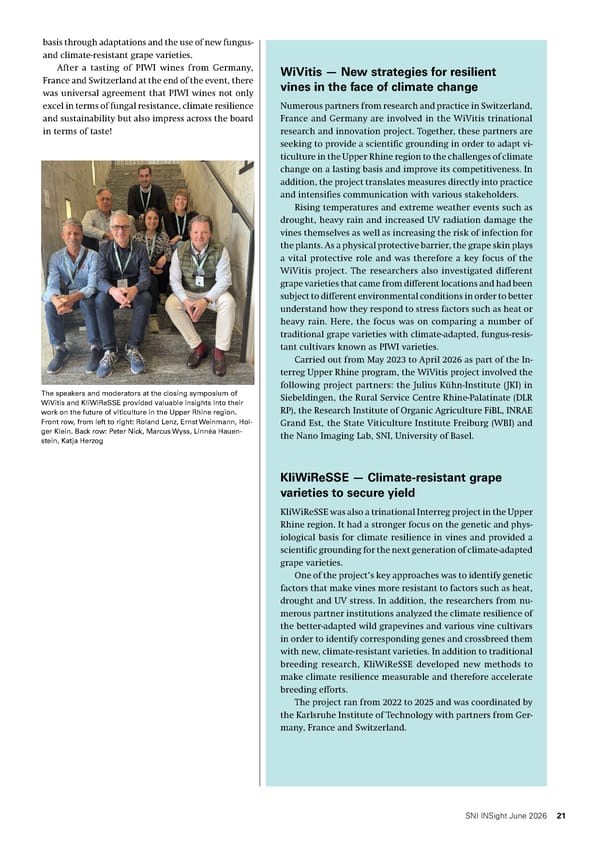
basis through adaptations and the use of new fungus- and climate-resistant grape varieties. After a tasting of PIWI wines from Germany, France and Switzerland at the end of the event, there was universal agreement that PIWI wines not only excel in terms of fungal resistance, climate resilience and sustainability but also impress across the board in terms of taste! WiVitis — New strategies for resilient vines in the face of climate change Numerous partners from research and practice in Switzerland, France and Germany are involved in the WiVitis trinational research and innovation project. Together, these partners are seeking to provide a scientific grounding in order to adapt vi- ticulture in the Upper Rhine region to the challenges of climate change on a lasting basis and improve its competitiveness. In addition, the project translates measures directly into practice and intensifies communication with various stakeholders. Rising temperatures and extreme weather events such as drought, heavy rain and increased UV radiation damage the vines themselves as well as increasing the risk of infection for the plants. As a physical protective barrier, the grape skin plays a vital protective role and was therefore a key focus of the WiVitis project. The researchers also investigated different grape varieties that came from different locations and had been subject to different environmental conditions in order to better understand how they respond to stress factors such as heat or heavy rain. Here, the focus was on comparing a number of traditional grape varieties with climate-adapted, fungus-resis- tant cultivars known as PIWI varieties. Carried out from May 2023 to April 2026 as part of the In- terreg Upper Rhine program, the WiVitis project involved the following project partners: the Julius Kühn-Institute (JKI) in Siebeldingen, the Rural Service Centre Rhine-Palatinate (DLR RP), the Research Institute of Organic Agriculture FiBL, INRAE Grand Est, the State Viticulture Institute Freiburg (WBI) and the Nano Imaging Lab, SNI, University of Basel. KliWiReSSE — Climate-resistant grape varieties to secure yield KliWiReSSE was also a trinational Interreg project in the Upper Rhine region. It had a stronger focus on the genetic and phys- iological basis for climate resilience in vines and provided a scientific grounding for the next generation of climate-adapted grape varieties. One of the project’s key approaches was to identify genetic factors that make vines more resistant to factors such as heat, drought and UV stress. In addition, the researchers from nu- merous partner institutions analyzed the climate resilience of the better-adapted wild grapevines and various vine cultivars in order to identify corresponding genes and crossbreed them with new, climate-resistant varieties. In addition to traditional breeding research, KliWiReSSE developed new methods to make climate resilience measurable and therefore accelerate breeding efforts. The project ran from 2022 to 2025 and was coordinated by the Karlsruhe Institute of Technology with partners from Ger- many, France and Switzerland. The speakers and moderators at the closing symposium of WiVitis and KliWiReSSE provided valuable insights into their work on the future of viticulture in the Upper Rhine region. Front row, from left to right: Roland Lenz, Ernst Weinmann, Hol- ger Klein. Back row: Peter Nick, Marcus Wyss, Linnéa Hauen- stein, Katja Herzog 21 SNI INSight June 2026
22 SNI INSight June 2026
Promising young talents The SNI supports outstanding young researchers. The level of expertise and passion that students already demonstrate by the end of their bachelor’s program is evident every year at SmallTalk – a small conference organized by the nano students themselves. 23 SNI INSight June 2026
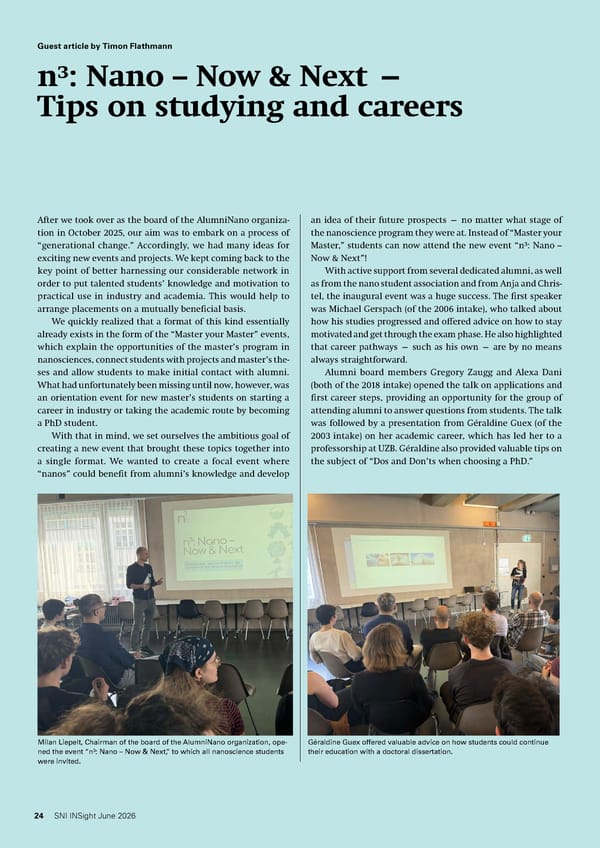
Guest article by Timon Flathmann n³: Nano – Now & Next — Tips on studying and careers After we took over as the board of the AlumniNano organiza- tion in October 2025, our aim was to embark on a process of “generational change.” Accordingly, we had many ideas for exciting new events and projects. We kept coming back to the key point of better harnessing our considerable network in order to put talented students’ knowledge and motivation to practical use in industry and academia. This would help to arrange placements on a mutually beneficial basis. We quickly realized that a format of this kind essentially already exists in the form of the “Master your Master” events, which explain the opportunities of the master’s program in nanosciences, connect students with projects and master’s the- ses and allow students to make initial contact with alumni. What had unfortunately been missing until now, however, was an orientation event for new master’s students on starting a career in industry or taking the academic route by becoming a PhD student. With that in mind, we set ourselves the ambitious goal of creating a new event that brought these topics together into a single format. We wanted to create a focal event where “nanos” could benefit from alumni’s knowledge and develop an idea of their future prospects — no matter what stage of the nanoscience program they were at. Instead of “Master your Master,” students can now attend the new event “n³: Nano – Now & Next”! With active support from several dedicated alumni, as well as from the nano student association and from Anja and Chris- tel, the inaugural event was a huge success. The first speaker was Michael Gerspach (of the 2006 intake), who talked about how his studies progressed and offered advice on how to stay motivated and get through the exam phase. He also highlighted that career pathways — such as his own — are by no means always straightforward. Alumni board members Gregory Zaugg and Alexa Dani (both of the 2018 intake) opened the talk on applications and first career steps, providing an opportunity for the group of attending alumni to answer questions from students. The talk was followed by a presentation from Géraldine Guex (of the 2003 intake) on her academic career, which has led her to a professorship at UZB. Géraldine also provided valuable tips on the subject of “Dos and Don’ts when choosing a PhD.” Milan Liepelt, Chairman of the board of the AlumniNano organization, ope- ned the event “n³: Nano – Now & Next, ” to which all nanoscience students were invited. Géraldine Guex offered valuable advice on how students could continue their education with a doctoral dissertation. 24 SNI INSight June 2026
At the end of the event, the attending alumni also had a brief opportunity to present specific project offers in their own areas at Bühlmann, Roche, Sefar, Sensirion and UZB. Hopefully, this will allow some students from the bachelor’s and master’s programs in nanosciences to find an exciting project or even a first job! Of course, the program also included an opportunity for socializing. Following an apéro, the evening continued with a social event at Cargobar, overlooking the Rhine. Attended by numerous other alumni, this event was an opportunity for re- laxed discussions over a cold drink. We’re delighted that some 20 students took the plunge and engaged with this new format. Around a third of them are currently enrolled on the master’s program. This goes to show that there is clearly demand for guidance on starting a career and on academic career options. We’re also delighted that the alumni — including some who traveled from far away — were keen to participate and pass on their knowledge, helping to make the event a huge success. For the next edition of “n³: Nano – Now & Next,” we’ll ad- dress the feedback we received and aim to make it a varied and multifaceted event. Hopefully, we’ll be able to welcome even more interested students so we can provide them with valuable advice and help them integrate into the nano network. See you soon! The AlumniNano board Following the presentations and discus- sions, the students had the opportunity to continue talking with the alumni and ask all their questions. “The tips and tricks from alumni on planning my master’s degree and starting my career were very help- ful. It’s great to be able to benefit from the experiences of previous nano students and make my own path easier as a result. Through n³, I also learned about a student job and was put in direct contact with the person in charge. In situations like this, the professional connections I’ve built through n³ definitely pay off.” Mattea Dyck, Nanoscience student at the University of Basel in the sixth semester 25 SNI INSight June 2026
SNI PhD School Successfully defended Three doctoral students from the SNI PhD School have successfully defended their dissertations over the past six months. They conducted their research at the Departments of Physics and Chemistry at the University of Basel and at the Paul Scherrer Institute. Congratulations and best wishes for the future! Measurement of tiny magnetic torques In his doctoral dissertation, Dr. Mathias Claus developed highly sensitive sensors for the measurement of extremely small mag- netic torques — with a view to analyzing ultrathin magnetic materials such as van der Waals heterostructures and two-di- mensional materials whose small volumes meant their mag- netic signals were barely detectable in the past. In his work at the Department of Physics, Mathias designed, produced and characterized various mechanical resonators made of silicon nitride for this purpose. He was able to demon- strate the performance of the measurement technique by quan- tifying the magnetic properties of individual bacteria. SNI post with video Publication Mathias Claus completed his dissertation at the Department of Physics. (Photo: M. Claus) 26 SNI INSight June 2026
Understanding proteins in the sulfur cycle In her doctoral dissertation, Dr. Seseg Bolotova has contrib- uted to our understanding of proteins involved in the metab- olism of sulfur compounds. She used X-ray crystallography and cryo-electron micros- copy to determine the structures of the enzymes and sub- strate-binding proteins involved in the metabolism of sul- fur-containing amino acid derivatives. By combining the structural data with biochemical, biophysical, and se- quence-based analyses, Seseg was able to elucidate the rela- tionships between the structures, sequences, and functions of these proteins. She identified the molecular basis of enzy- matic substrate specificity and catalytic activity. Subse- quently, Seseg proposed catalytic mechanisms for enzymes with previously uncharacterized activity and functions of related proteins unannotated in genomic databases. Publication Targeted use of protein-membrane interactions In his doctoral dissertation, Dr. Piotr Jaśko investigated how bi- ological membranes work and how their properties can be rep- licated in a targeted manner in artificial systems. He demon- strated that proteins can actively modify membranes, for example by supporting the fusion of lipid vesicles. He succeed- ed in integrating light-driven proteins into synthetic polymer membranes, which transport ions and convert energy. Addi- tionally, he showed that the incorporation of pore proteins into membranes successfully ensures selective molecular trans- port—a prerequisite for complex reactions in vesicle networks. SNI post with video Publication Piotr Jasko worked at the Department of Chemistry and the Paul Scherrer Institute while completing his doctoral dissertation. (Photo: P . Jasko) Seseg Bolotova worked on her doctoral dissertation at the Department of Chemistry and at the Biozentrum. 27 SNI INSight June 2026
Further information: Web page NCCR Precision Fact sheet Media release University of Basel On May 1, the new National Centre of Competence in Research (NCCR) “Precision” was launched, with numerous SNI members involved. The common goal of the researchers from seven participating Swiss research institutions is to raise the accuracy and sen- sitivity of measurements to unprecedented levels and thereby explore unknown physical phenomena beyond the Standard Model of particle physics. The focus is on the physical quantities of time and fre- quency. Four pillars form the foundation of the new NCCR. • Fundamental physics: Precision measurements on simple atoms and molecules to test physical theories and discover new phenomena • Quantum state control: Targeted manipulation of quantum systems to make measurements even more sensitive and precise • Photonic technologies: Development of new op- tical instruments such as ultranarrow linewidth lasers and frequency combs to enhance preci- sion and broaden the applicability of measure- ment systems • Precision sensing: Use of atomic and solid-state systems as high-resolution sensors, for example to detect minute electric and magnetic fields or for navigation and gravimetry measurements At the end of May, the first meeting of project teams took place in Zurich. In attendance were researchers from the two host institutions, ETH Zurich and the University of Basel, as well as from the Paul Scherrer Institute PSI, EPFL, the Federal Institute of Metrol- ogy (METAS), the University of Neuchâtel, and CSEM. A total of 32 research groups from across Switzer- land are involved – including numerous groups led by SNI members: Prof. Dr. Stefan Willitsch serves as Co-Director and Prof. Dr. Philipp Treutlein as Deputy Co-Director. Furthermore, Dr. Alexander Grimm (PSI) and the Basel-based professors from the De- partment of Physics Ilaria Zardo, Richard Warbur- ton, Tomasz Smoleński, Martino Poggio, Patrick Maletinsky and Daniel Malz are involved as princi- pal investigators from the SNI network. SNI Manag- ing Director Claudia Wirth is responsible for the finances of the teams from Basel. Launch of the National Centre of Competence in Research “Precision” The kick-off event for NCCR Precision took place in late May, with more than 30 project leaders in attendance. (Photo: NCCR Precision) Network 28 SNI INSight June 2026
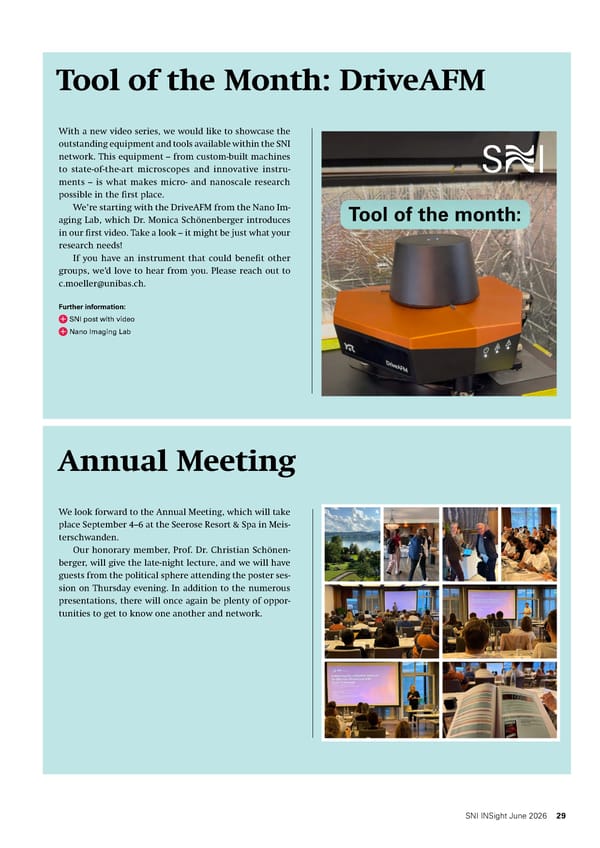
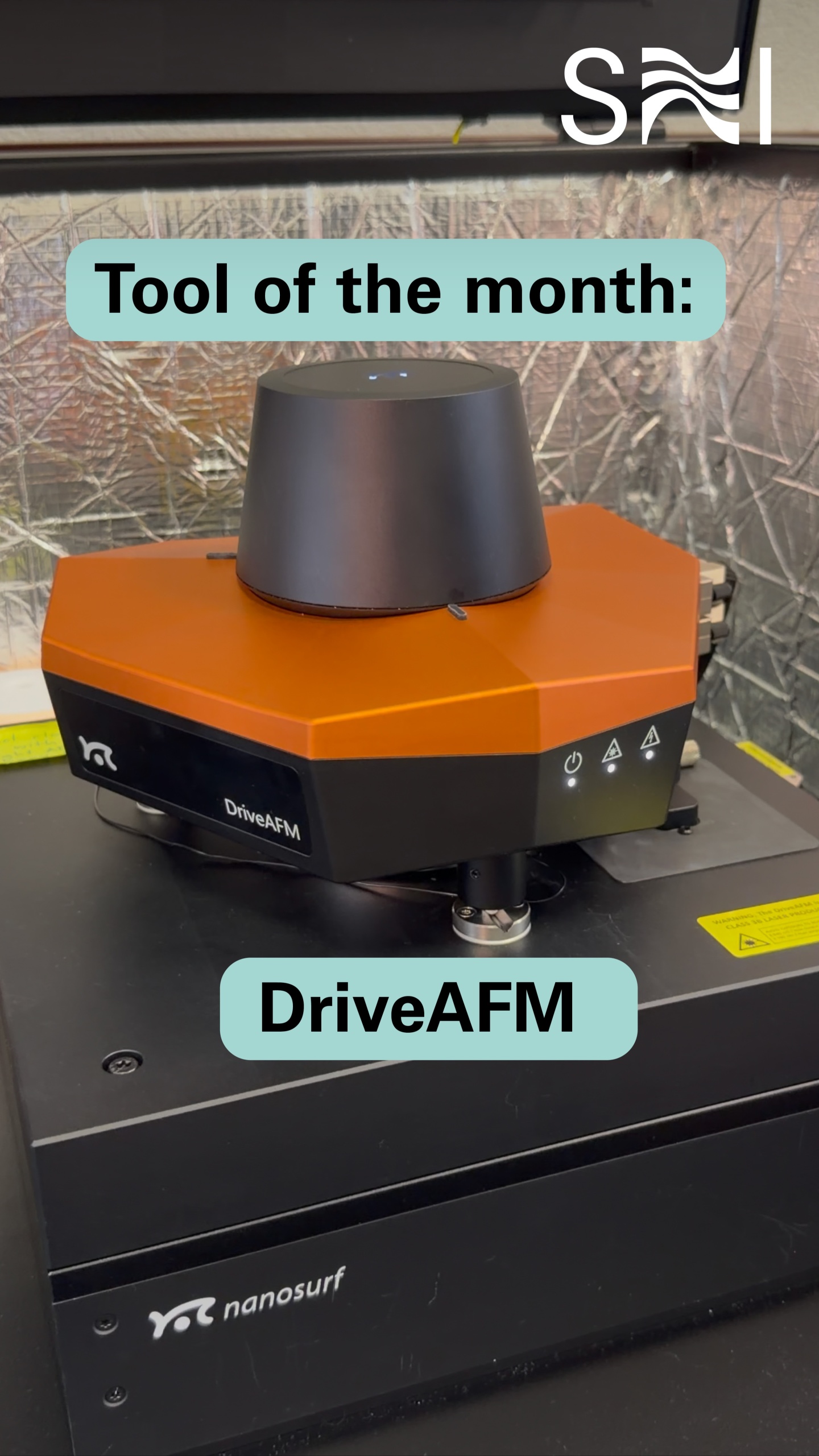
With a new video series, we would like to showcase the outstanding equipment and tools available within the SNI network. This equipment – from custom-built machines to state-of-the-art microscopes and innovative instru- ments – is what makes micro- and nanoscale research possible in the first place. We’re starting with the DriveAFM from the Nano Im- aging Lab, which Dr. Monica Schönenberger introduces in our first video. Take a look – it might be just what your research needs! If you have an instrument that could benefit other groups, we’d love to hear from you. Please reach out to c.moeller@unibas.ch. Further information: SNI post with video Nano Imaging Lab Tool of the Month: DriveAFM Annual Meeting We look forward to the Annual Meeting, which will take place September 4–6 at the Seerose Resort & Spa in Meis- terschwanden. Our honorary member, Prof. Dr. Christian Schönen- berger, will give the late-night lecture, and we will have guests from the political sphere attending the poster ses- sion on Thursday evening. In addition to the numerous presentations, there will once again be plenty of oppor- tunities to get to know one another and network. 29 SNI INSight June 2026
Who is who? A management team with diverse expertise We strive to provide as much information as possible about applied and basic research projects in the field of nanoscience and nanotechnology. In addition to the numerous researchers who generate these results, the SNI network also includes staff members who ensure that processes related to finance, human resources, administration, coordination of the study program and the doctoral school, commu- nication, public relations, and services run smoothly. To show both new and long-standing SNI members who is responsible for these different areas, we will briefly introduce the management team as well as the staff of the Nano Imaging Lab and the Nano Fabrication Lab in the upcoming issues of SNI INSight. We’ll start with the first half of the management team in alphabetical order. And even for SNI members who already know us, there’s sure to be some new information here. Network 30 SNI INSight June 2026
Andreas Baumgartner – Keen to understand the world I handle all things related to the SNI PhD School. For me person- ally, the most important aspects are the academic and social in- teractions with the doctoral students, as well as organizing the SNI’s “Nanoscience in the Snow” winter school, the rhetoric work- shop, and the workshop “From Lab to Startup.” I also organize the evaluation of project applications and the subsequent search for suitable doctoral candidates. I’m always delighted to answer queries from near and far — and to lend a hand with communi- cation and outreach activities. What’s your professional background? After a wide-ranging degree in “Interdisciplinary Natural Sci- ences” at ETH Zurich, I completed my doctoral dissertation in solid-state physics at ETH on the topics of atomic force microscopy and the quantum Hall effect. After three years as a postdoc in Nottingham (UK), where I primarily worked on quantum optics with semiconductors, I joined the University of Basel. Since then, I’ve been conducting research into, above all, superconducting nanostructures, atomically thin materials and quantum bits. Since 2017, I’ve been in charge of the PhD School at the SNI, which is a great way to nurture my broad scientific interests. What motivates you about your job? Personally, I’m driven by a desire to understand the world around me — and my work as a scientist and at the SNI PhD School is ideal in that sense. The latter constantly exposes you to wide-rang- ing topics from both an academic and organizational perspective. This is not only hugely exciting and never gets boring but also provides opportunities for deeper reflection. What are you currently working on? The evaluation of new project submissions has just begun, so I won’t have much capacity for other tasks for a while. Fun facts Tea or coffee? Coffee in the morning, then tea Cats or dogs? Dogs in the past, now cats — but really, neither Early bird or night owl? Night owl (if I’ve got a stubborn problem to deal with) Favorite place: Home sweet home with as many trips as possible (above: a view of my local mountain, the Wasser- fluh) Favorite food: All kinds of Indian food Last vacations: Traveling around China by train and diving in Sardinia, both with family Secret talent: I can read really bad sci-fi books right to the end “Andreas has an impressive knowledge of the natural sciences and is always keen to explain complex subject matter as clearly as possible.” Christel Möller on Andreas Baumgartner’s superpower 31 SNI INSight June 2026
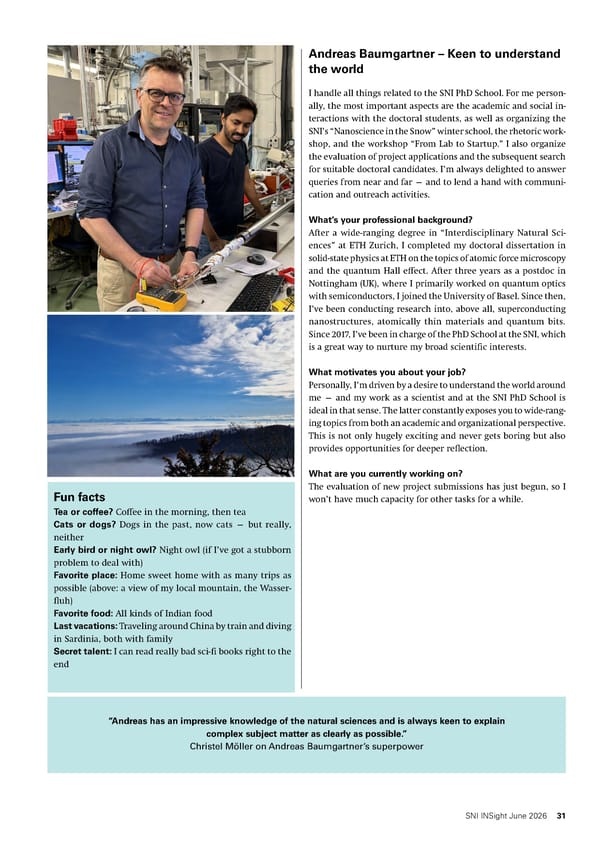
Kerstin Beyer-Hans – Constantly finds new ways to spark curiosity I work in public relations, organizing school visits and special events. In recent years, I have also been responsible for orga- nizing our Annual Meeting and the SNC. In general, I look for new ways to get people excited about the natural sciences — for example, through experiments for children at the Aarau Children’s Hospital or on train trips in collaboration with the Schweizer Südostbahn. I also create content for our new Nano. Neugier channels on TikTok, YouTube and Instagram. What’s your professional background? After completing a degree in physics in the city of Constance, I went on to do a doctorate at ETH Zurich. Since the time of my doctorate, I’ve always enjoyed interdisciplinary work and communicating with the public, including at the Scientifica science festival, for example. With that in mind, I’m delighted to have found my place in public relations at the SNI after completing my dissertation. What motivates you about your job? The conversations you have with people are really inspiring. It’s great to watch children’s eyes light up and to see young people getting excited about the natural sciences. There are so many fascinating things to discover in the natural sciences and that we can bring to life for people through simple exper- iments. The future will need natural scientists. Let’s find ways to awaken people’s curiosity. What are you currently working on? I’m currently planning a talk and a workshop at the Landquart Children’s Lab and preparing for a visit by a school class. In the background, preparations are also underway for the Sci- ence Days in Rust. I’m really looking forward to the upcoming events! Fun facts Tea or coffee? Both Cats or dogs? Dogs Early bird or night owl? Night owl Favorite place? La Roque-sur-Pernes (Vaucluse Mountains) Favorite food? Comfort food Dream vacation? Iceland Secret talent? Writing postcards “With great dedication and enthusiasm, Kerstin is always finding new ways to reach different target groups: developing creative and exciting experiments, presenting them with tremendous charm and preparing events to perfection.” Claudia Wirth on Kerstin Beyer-Hans’ superpower 32 SNI INSight June 2026
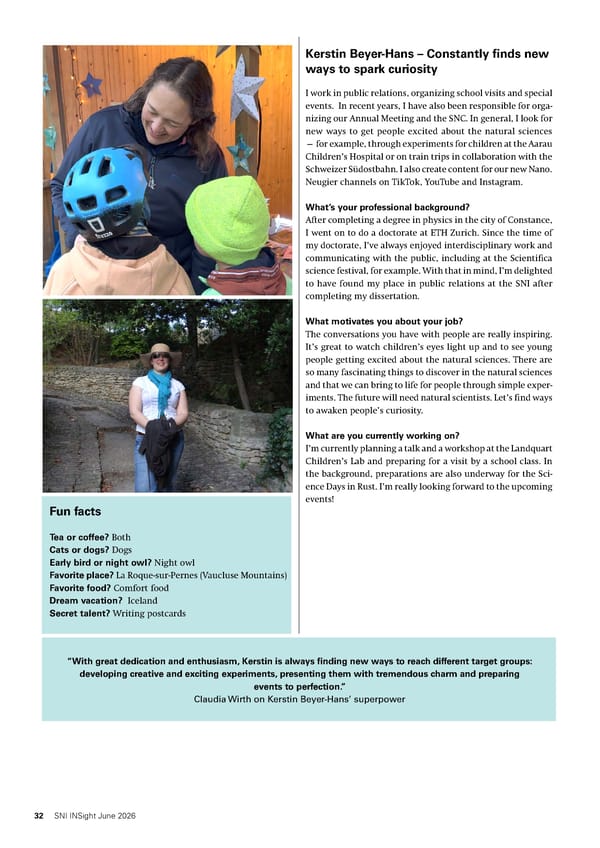
Anja Car – A passionate advocate for the nanoscience students My job is to ensure that the nanosciences study program not only exists but also endures and evolves. That puts me at the interface between various stakeholders: students, professors and faculty members from various departments as well as staff from the administration. This role calls for considerable co- ordination and sometimes even conflict resolution. A lot of my work entails direct communication — and a knack for pragmatic problem-solving. What’s your professional background? After studying chemical engineering at the University of Mari- bor in Slovenia, I went on to complete a dissertation on poly- mer membranes for gas separation in 2008. Following that, I worked as a postdoc in various research projects at the Helm- holtz-Zentrum Hereon in Geesthacht and at KAUST in Saudi Arabia. In 2012, I was awarded a Marie Curie Fellowship in order to continue my career at the University of Basel. After many years in research, I took on a new professional challenge as study coordinator at the SNI in 2017. As part of my profes- sional development, I completed an MBA in Innovation Man- agement in 2022, specializing in the education sector. What motivates you about your job? My everyday work is very varied but also dominated by emails and coordination. Even with the best-laid plans, there are al- ways unforeseen circumstances that get in the way. This is exactly the dynamic I love and is a source of motivation — because it means the job never gets boring. What are you currently working on? May is a month filled with great events and planning for the fall semester. One highlight is undoubtedly SmallTalk, which is held on an annual basis for students in the sixth semester. At the same time, I’m already working on allocating places on the block courses to students starting the new semester. Fun facts Tea or coffee? Coffee Cats or dogs? Dogs Early bird or night owl? No specific chronotype Favorite place? Nature Favorite food? Spaghetti in a hundred and one ways Dream vacation? The Galapagos Islands Secret talent? Juggling between students, teachers and the administration, creating more space for students in that mix while keeping everthing in balance :) “Anja has an incredible memory – she can really remember EVERYTHING!” Simone Chambers on Anja Car’s superpower 33 SNI INSight June 2026
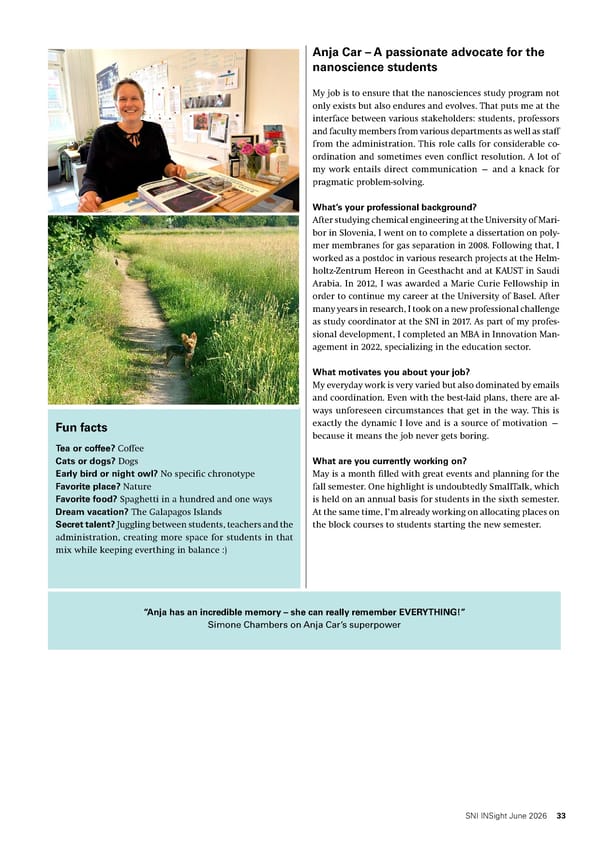
Simone Chambers – Enjoys working with people I handle administrative tasks in the coordination of the na- noscience study program. This involves many different areas, such as managing expenses and fees, and organizing evalua- tions for block courses and lectures. I also help organize some events, such as SmallTalk or the master’s graduation cere- mony. After completing an internal training course, I’ll also be able to keep our website up to date in the future. What is your professional background? After completing my apprenticeship as an industrial clerk (at Roche) and spending seven months as an au pair in London, I worked in the tourism industry in Crete and Turkey. Follow- ing my training as a foreign language hostess (NSH/Berlitz) in Basel, I organized VIP flights for Crossair/Swiss Int Airlines for 15 years. Since 2010, I have been working in the Philosophy Department at the University of Basel, and since December 2019, I have also been working in the SNI’s study coordination office. What motivates you about your job? I especially enjoy the variety in our study coordination work. Many tasks only come up once or twice a year, so it never gets boring. I’m also happy when events go smoothly and everyone is satisfied. Plus, I really enjoy working with people. What are you currently working on? Right now, we’re busy preparing everything for the Small Talk event on May 13. We need snacks, catering, certificates, name tags, gifts, and much more. At the same time, we’re also start- ing to organize the block courses again, and each of us has our own specific tasks. Fun facts Tea or coffee? Coffee, but I also enjoy tea in the winter Cats or dog? Cats, but I love dogs too Early bird or night owl? Early bird Favorite place? Home and by the sea Favorite food? Thai food and fresh asparagus Dream vacation? Iceland Secret talent? I can’t remember any movies at all, but I know—unnecessarily well—which actors and actresses starred in which films. “Simone shows empathy, treats others with understanding and kindness and creates a pleasant and motivating atmosphere with a warm smile.” Anja Car on Simone Chambers’ superpower 34 SNI INSight June 2026
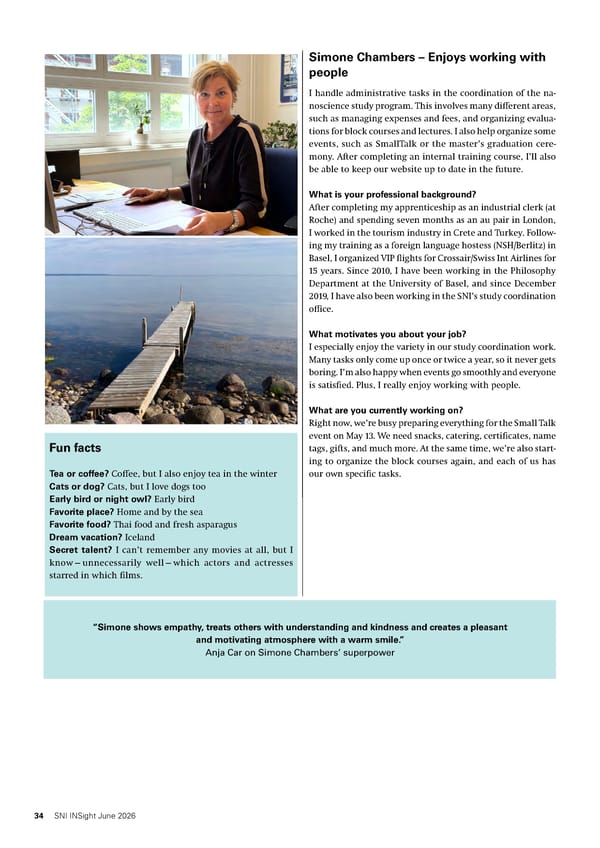
Sandra Hüni – Loves it when no two working days are alike I work in the exciting and varied world of events and outreach at the SNI, where I’m involved in everything from organizing and implementing events or outreach activities to post-event follow-up. What’s your professional background? I began my career with a commercial banking apprenticeship at the Swiss Bank Corporation. After successfully completing the apprenticeship, I stayed on at the corporation and worked as an investment adviser for foreign customers. I subsequently moved to another major Swiss bank, where I worked as a na- tionwide specialist on teller operations, including product man- agement of the various teller products. As I was also keen to get to know the world of work outside the banking sector, however, I then served as assistant to the president of the Swiss Physical Society (SPS) in 2006 before coming to work at the SNI in 2008. What motivates you about your job? I love that no two days are alike and that creativity is always called for in my work. It’s a great feeling when everything comes together nicely at an event and everyone is pleased with how it went. I also really value working as part of a fantastic team. What are you currently working on? Right now, I’m doing the preparatory work for the Annual Meet- ing 2026, and I’m already looking forward to seeing some of you in Meisterschwanden... ;-) Fun facts Tea or coffee? Tea Cats or dogs? Cats; I bring cat hair everywhere I go Early bird or night owl? A bit of both Favorite place: There are so many beautiful places. One of them can be seen in the photo. Favorite food: Italian, Austrian and Swiss cuisine Last vacation? High above Lake Thun with stunning views — it was wonderful! Secret talent: A keen sense of smell — I can smell every- thing before I see it. “Sandra keeps an eye on the big picture and stays in control of every detail. Her eye for detail is incredible. Some say she has a crystal ball that lets her foresee events and possible outcomes, enabling her to avoid potential pitfalls and take precautions.” Kerstin Beyer-Hans on Sandra Hüni’s superpower 35 SNI INSight June 2026
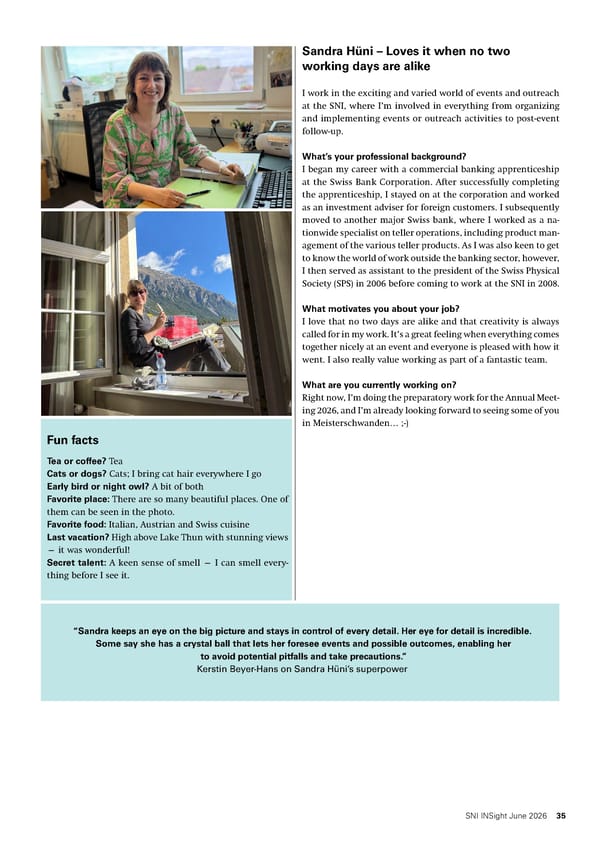
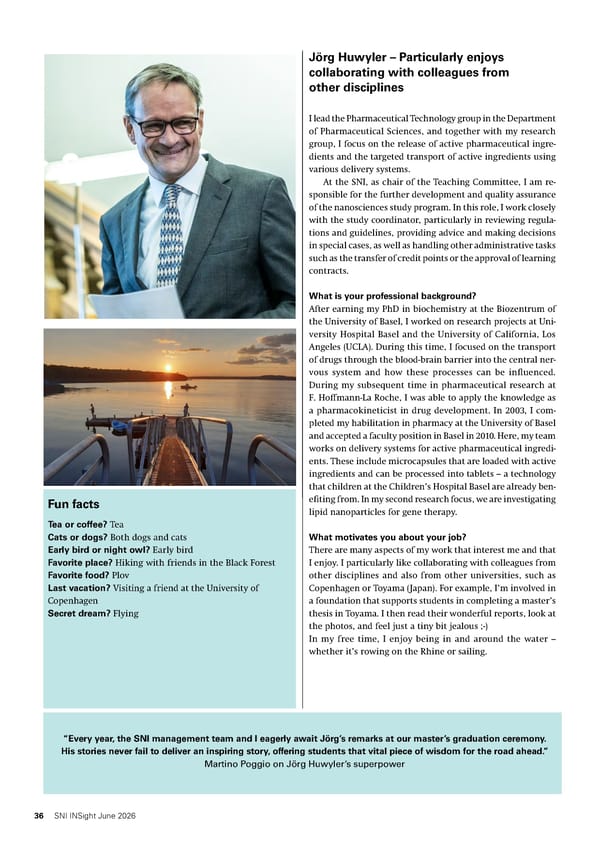
Jörg Huwyler – Particularly enjoys collaborating with colleagues from other disciplines I lead the Pharmaceutical Technology group in the Department of Pharmaceutical Sciences, and together with my research group, I focus on the release of active pharmaceutical ingre- dients and the targeted transport of active ingredients using various delivery systems. At the SNI, as chair of the Teaching Committee, I am re- sponsible for the further development and quality assurance of the nanosciences study program. In this role, I work closely with the study coordinator, particularly in reviewing regula- tions and guidelines, providing advice and making decisions in special cases, as well as handling other administrative tasks such as the transfer of credit points or the approval of learning contracts. What is your professional background? After earning my PhD in biochemistry at the Biozentrum of the University of Basel, I worked on research projects at Uni- versity Hospital Basel and the University of California, Los Angeles (UCLA). During this time, I focused on the transport of drugs through the blood-brain barrier into the central ner- vous system and how these processes can be influenced. During my subsequent time in pharmaceutical research at F. Hoffmann-La Roche, I was able to apply the knowledge as a pharmacokineticist in drug development. In 2003, I com- pleted my habilitation in pharmacy at the University of Basel and accepted a faculty position in Basel in 2010. Here, my team works on delivery systems for active pharmaceutical ingredi- ents. These include microcapsules that are loaded with active ingredients and can be processed into tablets – a technology that children at the Children’s Hospital Basel are already ben- efiting from. In my second research focus, we are investigating lipid nanoparticles for gene therapy. What motivates you about your job? There are many aspects of my work that interest me and that I enjoy. I particularly like collaborating with colleagues from other disciplines and also from other universities, such as Copenhagen or Toyama (Japan). For example, I’m involved in a foundation that supports students in completing a master’s thesis in Toyama. I then read their wonderful reports, look at the photos, and feel just a tiny bit jealous ;-) In my free time, I enjoy being in and around the water – whether it’s rowing on the Rhine or sailing. Fun facts Tea or coffee? Tea Cats or dogs? Both dogs and cats Early bird or night owl? Early bird Favorite place? Hiking with friends in the Black Forest Favorite food? Plov Last vacation? Visiting a friend at the University of Copenhagen Secret dream? Flying “Every year, the SNI management team and I eagerly await Jörg’s remarks at our master’s graduation ceremony. His stories never fail to deliver an inspiring story, offering students that vital piece of wisdom for the road ahead.” Martino Poggio on Jörg Huwyler’s superpower 36 SNI INSight June 2026
Each year, the annual report provides an engaging over- view of the diverse activities within the interdisciplinary SNI network. The 2025 annual report highlights key de- velopments in the areas of education (from bachelor’s to doctoral programs), basic and applied research, services offered by the Nano Technology Center, networking and outreach. For anyone wishing to delve deeper into the research top- ics from the Nano-Argovia program and the doctoral school, the scientific supplement offers a wealth of fasci- nating information. Further information: Animated version Annual Report 2025 Print version Annual Report 2025 Scientific supplement 2025 SNI Annual Report: Education, research, services and network 37 SNI INSight June 2026
38 SNI INSight June 2026
Inspiring children and teens Through exciting experiments and interactive activities, the SNI outreach team sparks an enthusiasm for the natu- ral sciences among children and teens – whether during school field trips to the University of Basel or at markets, science festivals and other public events. 39 SNI INSight June 2026
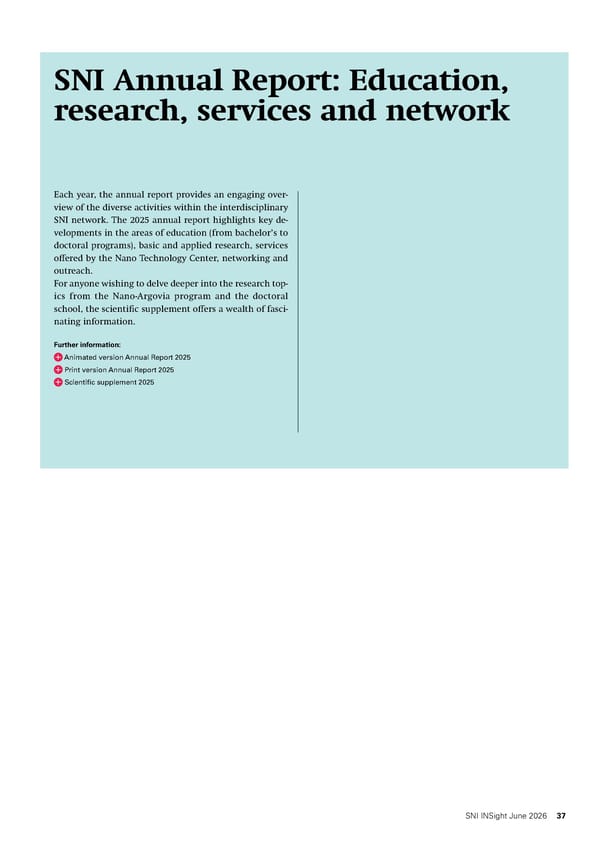
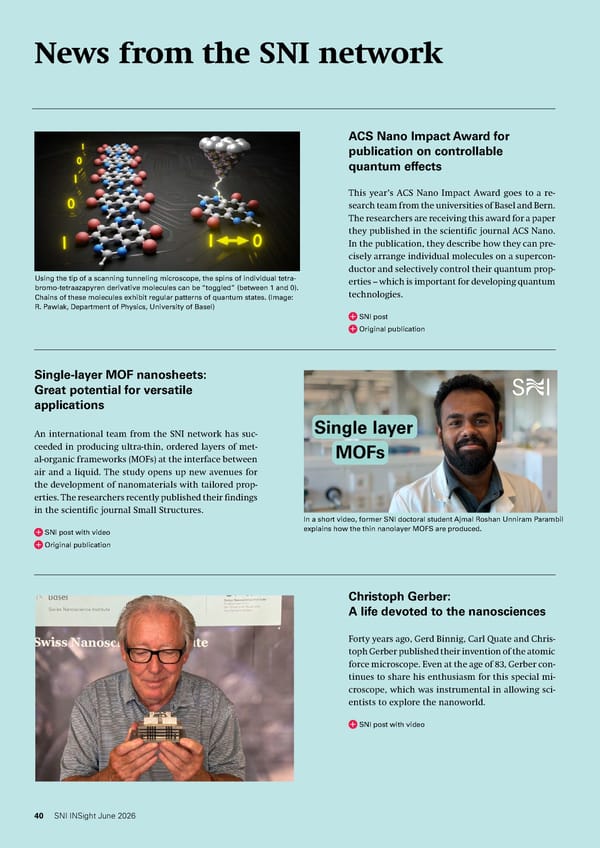
News from the SNI network Christoph Gerber: A life devoted to the nanosciences Forty years ago, Gerd Binnig, Carl Quate and Chris- toph Gerber published their invention of the atomic force microscope. Even at the age of 83, Gerber con- tinues to share his enthusiasm for this special mi- croscope, which was instrumental in allowing sci- entists to explore the nanoworld. SNI post with video Single-layer MOF nanosheets: Great potential for versatile applications An international team from the SNI network has suc- ceeded in producing ultra-thin, ordered layers of met- al-organic frameworks (MOFs) at the interface between air and a liquid. The study opens up new avenues for the development of nanomaterials with tailored prop- erties. The researchers recently published their findings in the scientific journal Small Structures. SNI post with video Original publication ACS Nano Impact Award for publication on controllable quantum effects This year’s ACS Nano Impact Award goes to a re- search team from the universities of Basel and Bern. The researchers are receiving this award for a paper they published in the scientific journal ACS Nano. In the publication, they describe how they can pre- cisely arrange individual molecules on a supercon- ductor and selectively control their quantum prop- erties – which is important for developing quantum technologies. SNI post Original publication Using the tip of a scanning tunneling microscope, the spins of individual tetra- bromo-tetraazapyren derivative molecules can be “toggled” (between 1 and 0). Chains of these molecules exhibit regular patterns of quantum states. (Image: R. Pawlak, Department of Physics, University of Basel) In a short video, former SNI doctoral student Ajmal Roshan Unniram Parambil explains how the thin nanolayer MOFS are produced. 40 SNI INSight June 2026
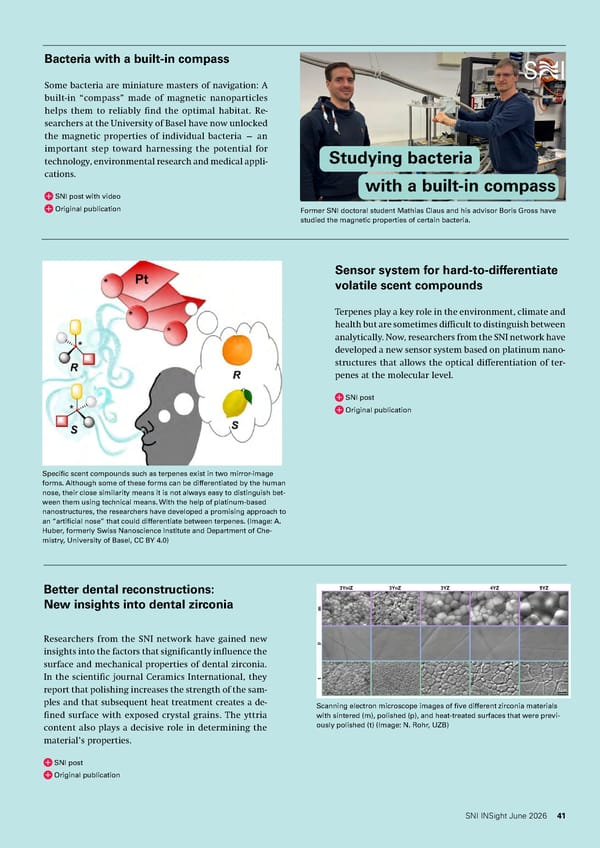
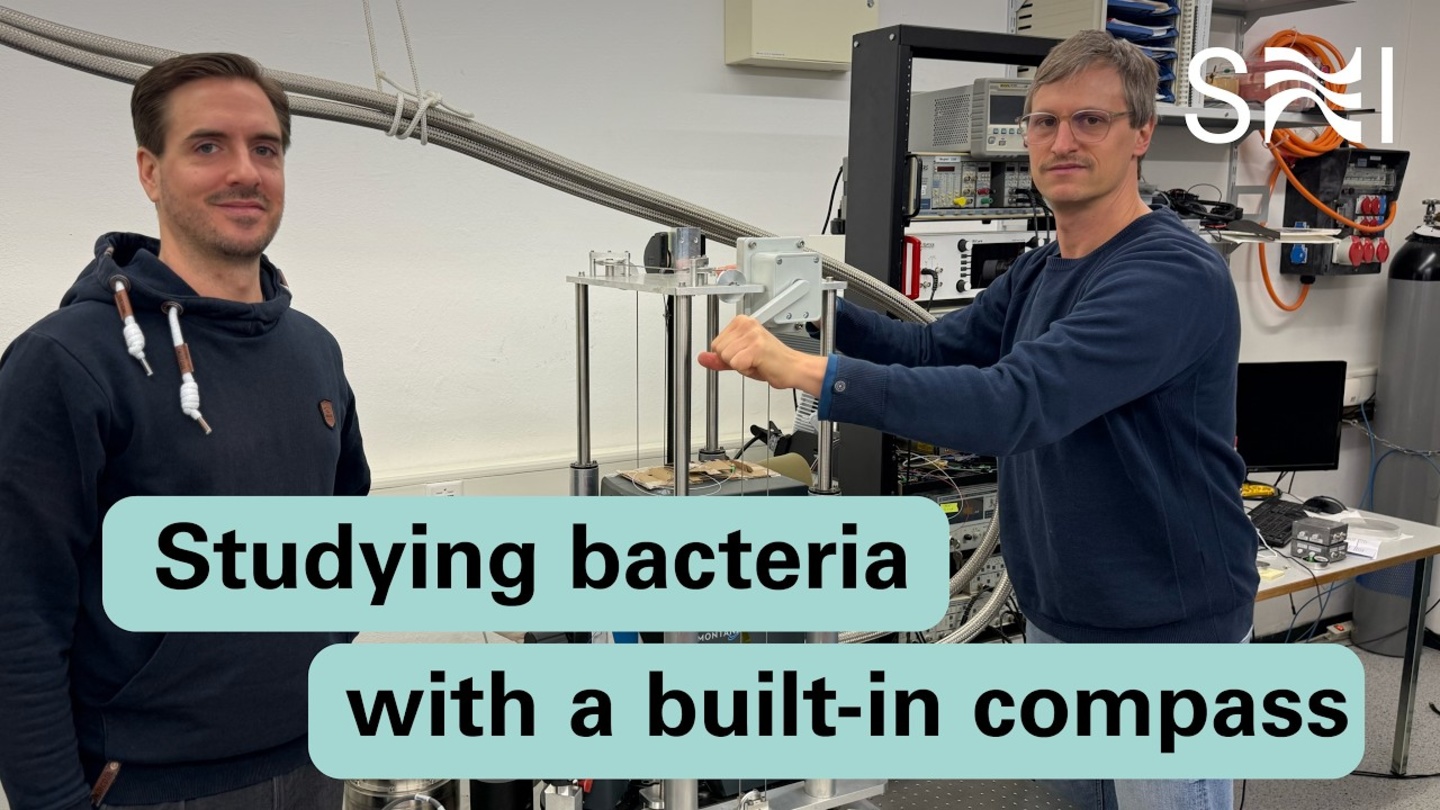
Bacteria with a built-in compass Some bacteria are miniature masters of navigation: A built-in “compass” made of magnetic nanoparticles helps them to reliably find the optimal habitat. Re- searchers at the University of Basel have now unlocked the magnetic properties of individual bacteria — an important step toward harnessing the potential for technology, environmental research and medical appli- cations. SNI post with video Original publication Sensor system for hard-to-differentiate volatile scent compounds Terpenes play a key role in the environment, climate and health but are sometimes difficult to distinguish between analytically. Now, researchers from the SNI network have developed a new sensor system based on platinum nano- structures that allows the optical differentiation of ter- penes at the molecular level. SNI post Original publication Better dental reconstructions: New insights into dental zirconia Researchers from the SNI network have gained new insights into the factors that significantly influence the surface and mechanical properties of dental zirconia. In the scientific journal Ceramics International, they report that polishing increases the strength of the sam- ples and that subsequent heat treatment creates a de- fined surface with exposed crystal grains. The yttria content also plays a decisive role in determining the material’s properties. SNI post Original publication Specific scent compounds such as terpenes exist in two mirror-image forms. Although some of these forms can be differentiated by the human nose, their close similarity means it is not always easy to distinguish bet- ween them using technical means. With the help of platinum-based nanostructures, the researchers have developed a promising approach to an “artificial nose” that could differentiate between terpenes. (Image: A. Huber, formerly Swiss Nanoscience Institute and Department of Che- mistry, University of Basel, CC BY 4.0) Scanning electron microscope images of five different zirconia materials with sintered (m), polished (p), and heat-treated surfaces that were previ- ously polished (t) (Image: N. Rohr, UZB) Former SNI doctoral student Mathias Claus and his advisor Boris Gross have studied the magnetic properties of certain bacteria. 41 SNI INSight June 2026
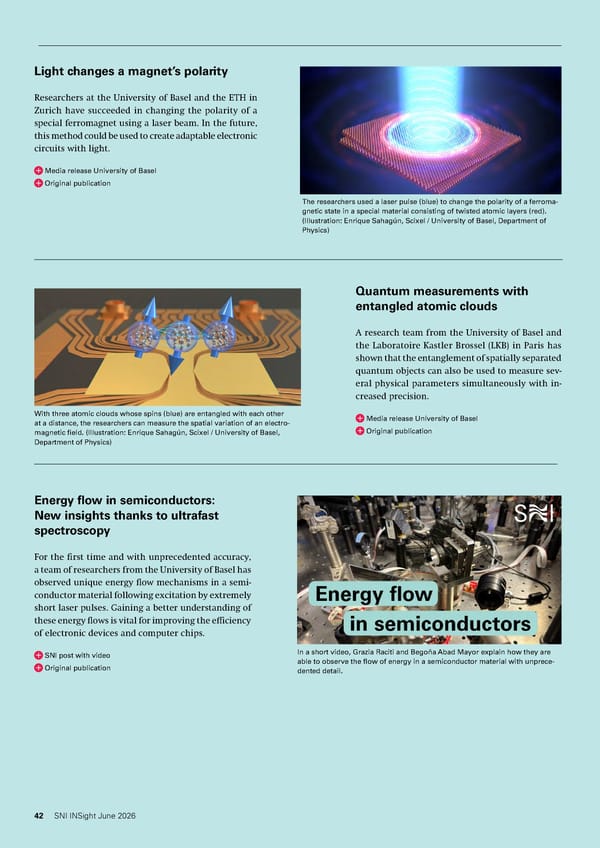
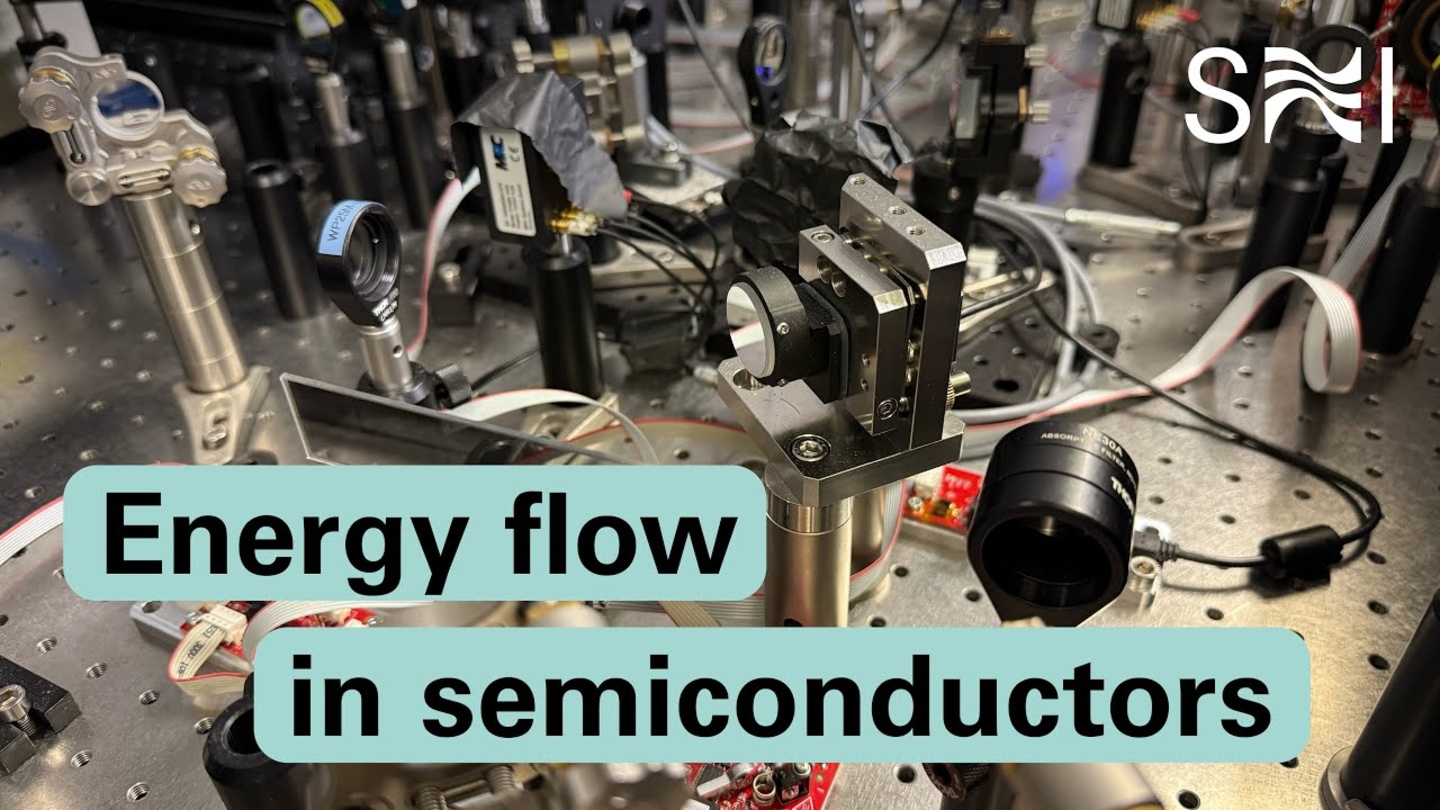
Quantum measurements with entangled atomic clouds A research team from the University of Basel and the Laboratoire Kastler Brossel (LKB) in Paris has shown that the entanglement of spatially separated quantum objects can also be used to measure sev- eral physical parameters simultaneously with in- creased precision. Media release University of Basel Original publication Light changes a magnet’s polarity Researchers at the University of Basel and the ETH in Zurich have succeeded in changing the polarity of a special ferromagnet using a laser beam. In the future, this method could be used to create adaptable electronic circuits with light. Media release University of Basel Original publication The researchers used a laser pulse (blue) to change the polarity of a ferroma- gnetic state in a special material consisting of twisted atomic layers (red). (Illustration: Enrique Sahagún, Scixel / University of Basel, Department of Physics) With three atomic clouds whose spins (blue) are entangled with each other at a distance, the researchers can measure the spatial variation of an electro- magnetic field. (Illustration: Enrique Sahagún, Scixel / University of Basel, Department of Physics) Energy flow in semiconductors: New insights thanks to ultrafast spectroscopy For the first time and with unprecedented accuracy, a team of researchers from the University of Basel has observed unique energy flow mechanisms in a semi- conductor material following excitation by extremely short laser pulses. Gaining a better understanding of these energy flows is vital for improving the efficiency of electronic devices and computer chips. SNI post with video Original publication In a short video, Grazia Raciti and Begoña Abad Mayor explain how they are able to observe the flow of energy in a semiconductor material with unprece- dented detail. 42 SNI INSight June 2026
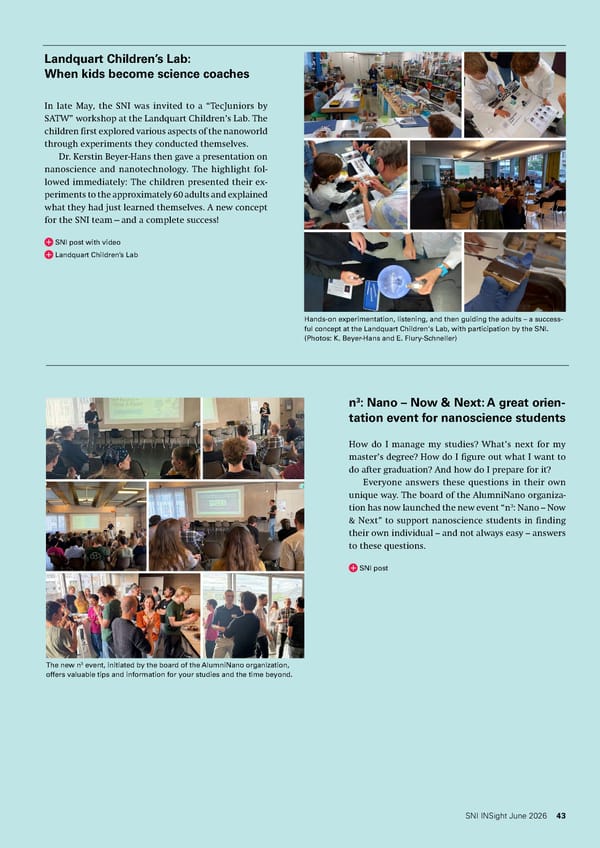
Landquart Children’s Lab: When kids become science coaches In late May, the SNI was invited to a “TecJuniors by SATW” workshop at the Landquart Children’s Lab. The children first explored various aspects of the nanoworld through experiments they conducted themselves. Dr. Kerstin Beyer-Hans then gave a presentation on nanoscience and nanotechnology. The highlight fol- lowed immediately: The children presented their ex- periments to the approximately 60 adults and explained what they had just learned themselves. A new concept for the SNI team—and a complete success! SNI post with video Landquart Children’s Lab n 3 : Nano – Now & Next: A great orien- tation event for nanoscience students How do I manage my studies? What’s next for my master’s degree? How do I figure out what I want to do after graduation? And how do I prepare for it? Everyone answers these questions in their own unique way. The board of the AlumniNano organiza- tion has now launched the new event “n 3 : Nano – Now & Next” to support nanoscience students in finding their own individual – and not always easy – answers to these questions. SNI post Hands-on experimentation, listening, and then guiding the adults – a success- ful concept at the Landquart Children‘s Lab, with participation by the SNI. (Photos: K. Beyer-Hans and E. Flury-Schneller) The new n 3 event, initiated by the board of the AlumniNano organization, offers valuable tips and information for your studies and the time beyond. 43 SNI INSight June 2026
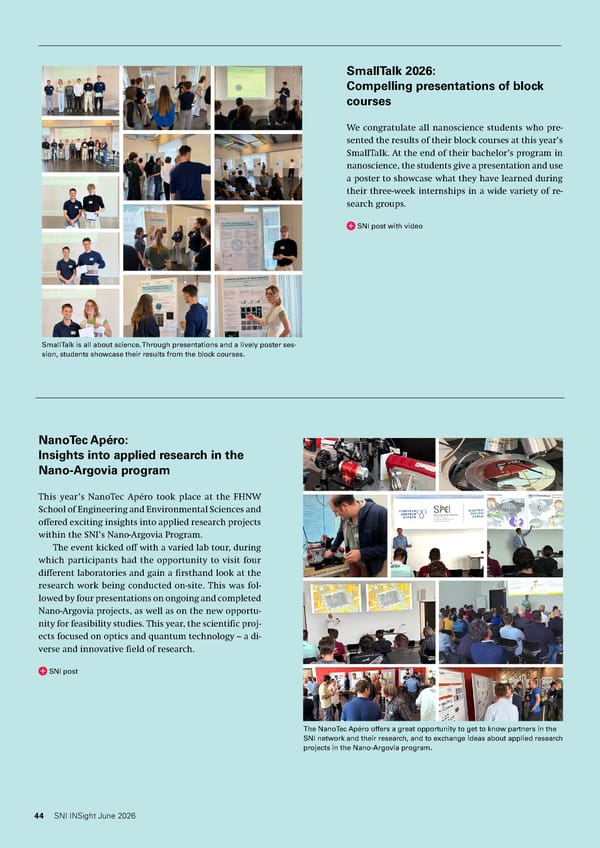
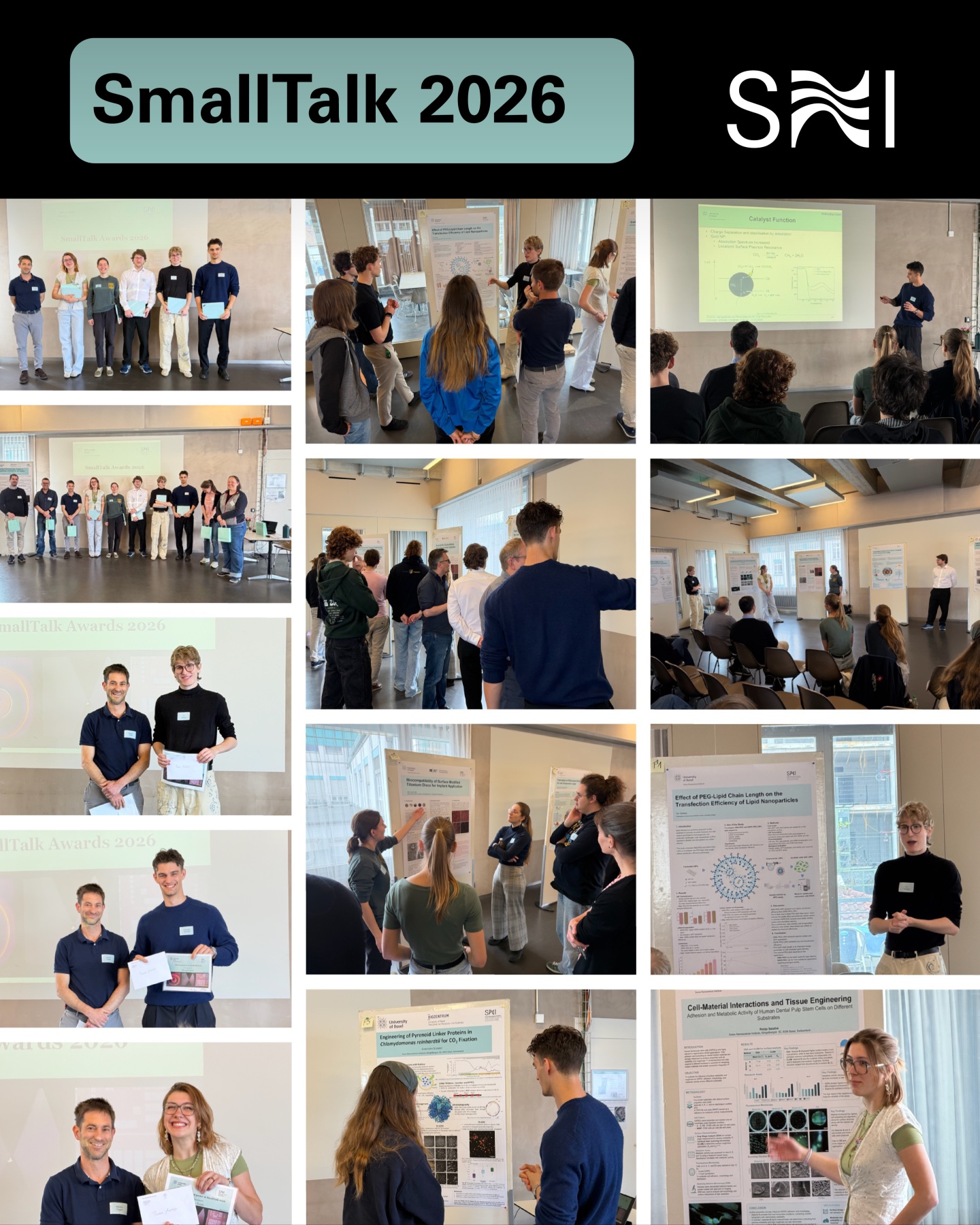
SmallTalk 2026: Compelling presentations of block courses We congratulate all nanoscience students who pre- sented the results of their block courses at this year’s SmallTalk. At the end of their bachelor’s program in nanoscience, the students give a presentation and use a poster to showcase what they have learned during their three-week internships in a wide variety of re- search groups. SNI post with video NanoTec Apéro: Insights into applied research in the Nano-Argovia program This year’s NanoTec Apéro took place at the FHNW School of Engineering and Environmental Sciences and offered exciting insights into applied research projects within the SNI’s Nano-Argovia Program. The event kicked off with a varied lab tour, during which participants had the opportunity to visit four different laboratories and gain a firsthand look at the research work being conducted on-site. This was fol- lowed by four presentations on ongoing and completed Nano-Argovia projects, as well as on the new opportu- nity for feasibility studies. This year, the scientific proj- ects focused on optics and quantum technology – a di- verse and innovative field of research. SNI post SmallTalk is all about science. Through presentations and a lively poster ses- sion, students showcase their results from the block courses. The NanoTec Apéro offers a great opportunity to get to know partners in the SNI network and their research, and to exchange ideas about applied research projects in the Nano-Argovia program. 44 SNI INSight June 2026
NanoCubes at the Museum Burghalde Lenzburg Starting Sunday, May 17, the Museum Burghalde Lenz- burg will offer a glimpse into the micro- and nanoworld. Integrated into the permanent exhibition, five Nano- Cubes use electron microscope images to provide a new perspective on the exhibits. SNI post with video Science in the children’s hospital At the end of April, we visited the Aarau Children’s Hospital, where we were able to bring science di- rectly to the children in an entertaining way. In the morning, the focus was on exciting optics experiments in the wards. In the afternoon, par- ents and patients were able to immerse themselves in the world of nanoscience and natural sciences through several small experiments in the reception area. SNI post with video At a press event at the Museum Burghalde Lenzburg, the team from the Museum Burghalde and the SNI presented the new NanoCubes, which provide an insight into the world of the smallest structures. The SNI Outreach Team provided children at the hospital with an educational, interactive change of pace. 45 SNI INSight June 2026
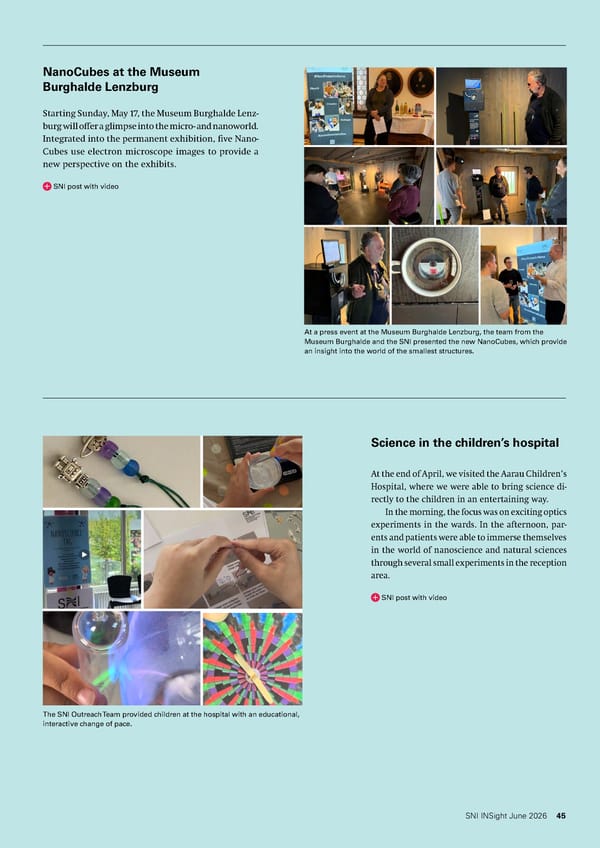
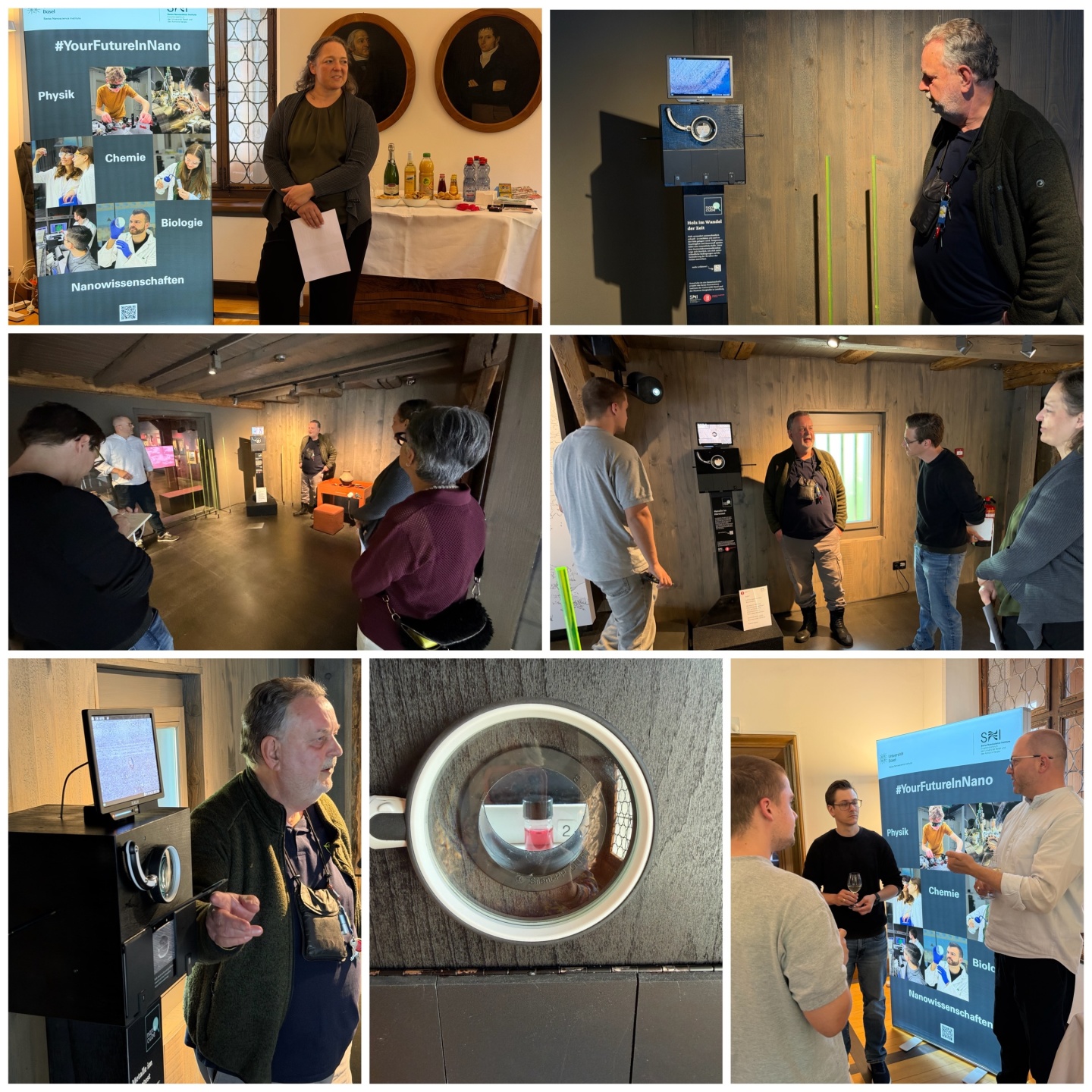
Rhetoric course: Bringing science to life On April 16 and 17, doctoral students from the SNI PhD School participated in an instructive and prac- tical rhetoric course. Under the professional guid- ance of science journalist Atlant Bieri, the young researchers experienced what is essential for effec- tive communication through numerous exercises. They learned how to present their scientific work in an engaging and coherent way, how to handle chal- lenging interview situations with confidence and competence and how to discuss topics respectfully with colleagues. SNI post Industry Night: A successful evening The Swiss Nanoscience Institute participated in the In- dustry Night for the first time on April 24 and it was a great success. From 5 p.m. to midnight, numerous visi- tors explored the SNI’s offerings at the University of Basel’s Pharma Center. SNI post with video Until midnight, visitors streamed into the Pharma Center to attend lectures on nano imaging and to conduct experiments. During their time in the SNI PhD School, doctoral students complete a work- shop in rhetoric and communication. (Photos: A. Baumgartner) 46 SNI INSight June 2026
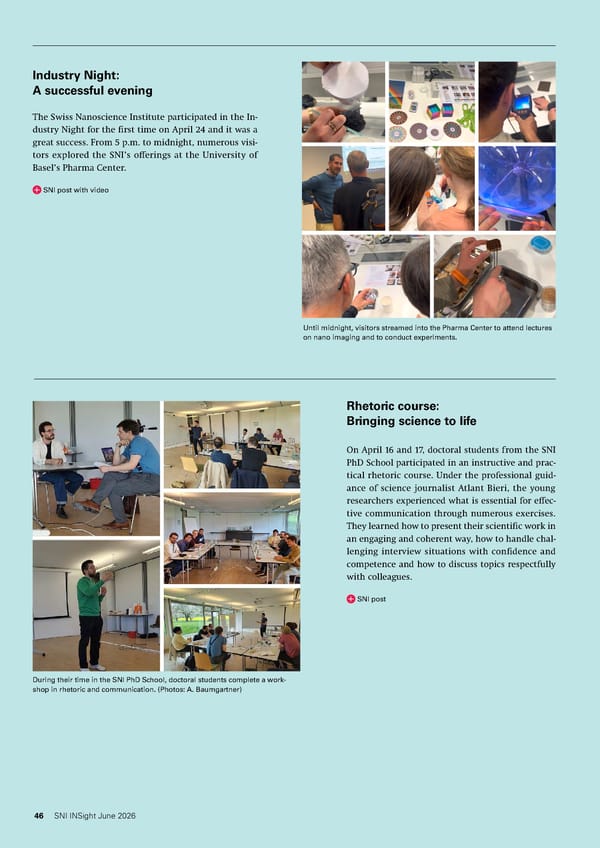
Nano Imaging Lab User Event 2026: An exciting array of supported research projects An extremely interesting and entertaining morning offered numerous impressive examples of the central role that high-resolution imaging plays in modern re- search projects. This year’s Nano Imaging Lab User Event provided users and interested parties from var- ious departments and institutions with diverse in- sights into projects to which the Nano Imaging Lab, with its five-member team and infrastructure, has contributed. SNI post Nanoscience in the Snow: The winter school of the SNI The annual “Nanoscience in the Snow” winter school took place this year in Waltensburg/Vuorz. For three days, participants enjoyed a diverse program: presenta- tions by doctoral students and researchers, a lively poster session, plenty of time for discussions on current research questions—and, of course, fun in the snow. The winter school is an ideal opportunity to present one’s own research to a broader audience while gaining new insights into other nanoscientific topics. This year, Alessandro Bruno won the Best Poster Award. SNI post Once a year, users of the Nano Imaging Lab provide insights into their exci- ting research, which is supported by the Nano Imaging Lab. Science and networking are the focus every year at the „Nanoscience in the Snow“ winter school. (Photos: A. Baumgartner, A. Grimm) 47 SNI INSight June 2026
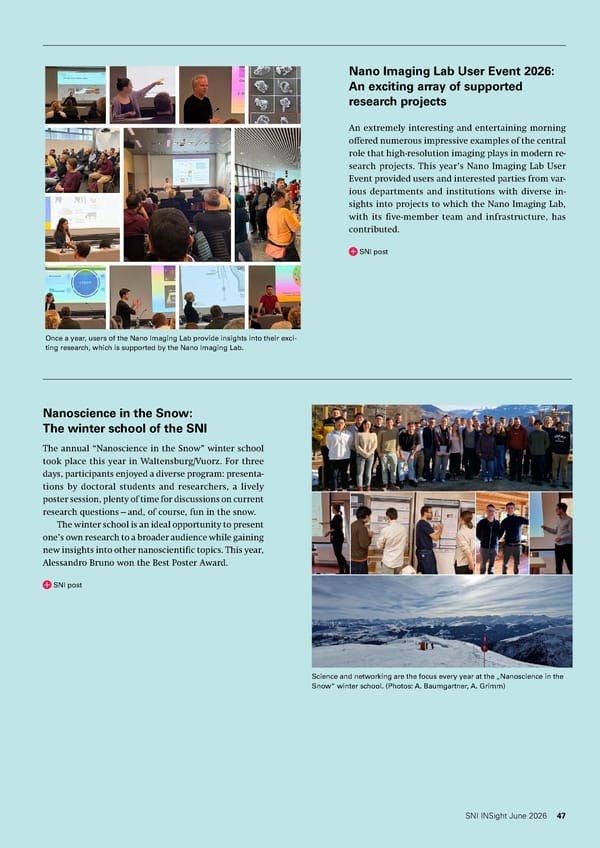
During school visits, the SNI team puts together a varied program that provides an insight into nanoscience. Insights into the nanoworld: Students from the Alte Kantonsschule Aarau visit the SNI In January 2026, we welcomed students from the Alte Kantonsschule Aarau, who got an introduction to na- noscience as part of a tech week organized by IngCH. After a brief theoretical session, the students explored various aspects of nanoscience through a hands-on experiment parcour — from atomic force microscopy (AFM) to the lotus effect, structural colors and UV-sensitive beads. They also gained insights into the interdisciplinary nanoscience study program at the University of Basel and experienced real research on the nanometer scale during a lab tour. SNI post 48 SNI INSight June 2026
SNI INSight Showcasing research and activities of the Swiss Nanoscience Institute About this publication Design concept: STUDIO NEO Concept, text and layout: C. Möller, M. Poggio Translations and proofreading: UNIWORKS (Erlangen, Germany) Image credits: C. Möller and named sources © Swiss Nanoscience Institute, June 2026 Cover image: Calcium carbonate exists in a previously unk- nown, almond-shaped crystal structure. This is being investigated in the Nano-Argovia project μAlmond. (Photo: A. Stumpo, FHNW and Univer- sity of Basel) 49 SNI INSight June 2026
University of Basel Petersplatz 1 4001 Basel Switzerland www.unibas.ch Swiss Nanoscience Institute University of Basel Klingelbergstrasse 82 4056 Basel Switzerland www.nanoscience.ch Educating Talents since 1460.