
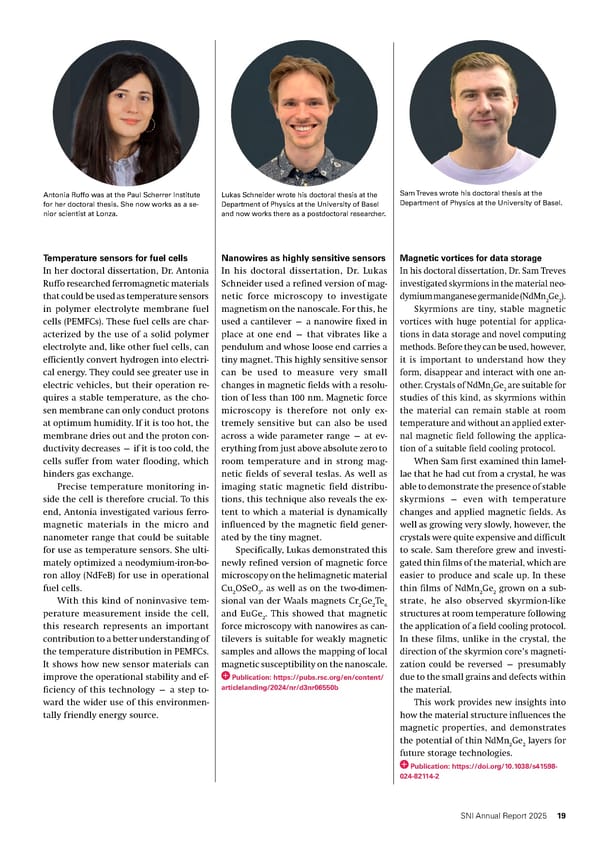
Temperature sensors for fuel cells In her doctoral dissertation, Dr. Antonia Ruffo researched ferromagnetic materials that could be used as temperature sensors in polymer electrolyte membrane fuel cells (PEMFCs). These fuel cells are char- acterized by the use of a solid polymer electrolyte and, like other fuel cells, can efficiently convert hydrogen into electri- cal energy. They could see greater use in electric vehicles, but their operation re- quires a stable temperature, as the cho- sen membrane can only conduct protons at optimum humidity. If it is too hot, the membrane dries out and the proton con- ductivity decreases — if it is too cold, the cells suffer from water flooding, which hinders gas exchange. Precise temperature monitoring in- side the cell is therefore crucial. To this end, Antonia investigated various ferro- magnetic materials in the micro and nanometer range that could be suitable for use as temperature sensors. She ulti- mately optimized a neodymium-iron-bo- ron alloy (NdFeB) for use in operational fuel cells. With this kind of noninvasive tem- perature measurement inside the cell, this research represents an important contribution to a better understanding of the temperature distribution in PEMFCs. It shows how new sensor materials can improve the operational stability and ef- ficiency of this technology — a step to- ward the wider use of this environmen- tally friendly energy source. Antonia Ruffo was at the Paul Scherrer Institute for her doctoral thesis. She now works as a se- nior scientist at Lonza. Nanowires as highly sensitive sensors In his doctoral dissertation, Dr. Lukas Schneider used a refined version of mag- netic force microscopy to investigate magnetism on the nanoscale. For this, he used a cantilever — a nanowire fixed in place at one end — that vibrates like a pendulum and whose loose end carries a tiny magnet. This highly sensitive sensor can be used to measure very small changes in magnetic fields with a resolu- tion of less than 100 nm. Magnetic force microscopy is therefore not only ex- tremely sensitive but can also be used across a wide parameter range — at ev- erything from just above absolute zero to room temperature and in strong mag- netic fields of several teslas. As well as imaging static magnetic field distribu- tions, this technique also reveals the ex- tent to which a material is dynamically influenced by the magnetic field gener- ated by the tiny magnet. Specifically, Lukas demonstrated this newly refined version of magnetic force microscopy on the helimagnetic material Cu 2 OSeO 3 , as well as on the two-dimen- sional van der Waals magnets Cr 2 Ge 2 Te 6 and EuGe 2 . This showed that magnetic force microscopy with nanowires as can- tilevers is suitable for weakly magnetic samples and allows the mapping of local magnetic susceptibility on the nanoscale. Publication: https://pubs.rsc.org/en/content/ articlelanding/2024/nr/d3nr06550b Lukas Schneider wrote his doctoral thesis at the Department of Physics at the University of Basel and now works there as a postdoctoral researcher. Magnetic vortices for data storage In his doctoral dissertation, Dr. Sam Treves investigated skyrmions in the material neo- dymium manganese germanide (NdMn 2 Ge 2 ). Skyrmions are tiny, stable magnetic vortices with huge potential for applica- tions in data storage and novel computing methods. Before they can be used, however, it is important to understand how they form, disappear and interact with one an- other. Crystals of NdMn 2 Ge 2 are suitable for studies of this kind, as skyrmions within the material can remain stable at room temperature and without an applied exter- nal magnetic field following the applica- tion of a suitable field cooling protocol. When Sam first examined thin lamel- lae that he had cut from a crystal, he was able to demonstrate the presence of stable skyrmions — even with temperature changes and applied magnetic fields. As well as growing very slowly, however, the crystals were quite expensive and difficult to scale. Sam therefore grew and investi- gated thin films of the material, which are easier to produce and scale up. In these thin films of NdMn 2 Ge 2 grown on a sub- strate, he also observed skyrmion-like structures at room temperature following the application of a field cooling protocol. In these films, unlike in the crystal, the direction of the skyrmion core’s magneti- zation could be reversed — presumably due to the small grains and defects within the material. This work provides new insights into how the material structure influences the magnetic properties, and demonstrates the potential of thin NdMn 2 Ge 2 layers for future storage technologies. Publication: https://doi.org/10.1038/s41598- 024-82114-2 Sam Treves wrote his doctoral thesis at the Department of Physics at the University of Basel. 19 SNI Annual Report 2025
 Annual Report 2025 - Swiss Nanoscience Institute Page 18 Page 20