
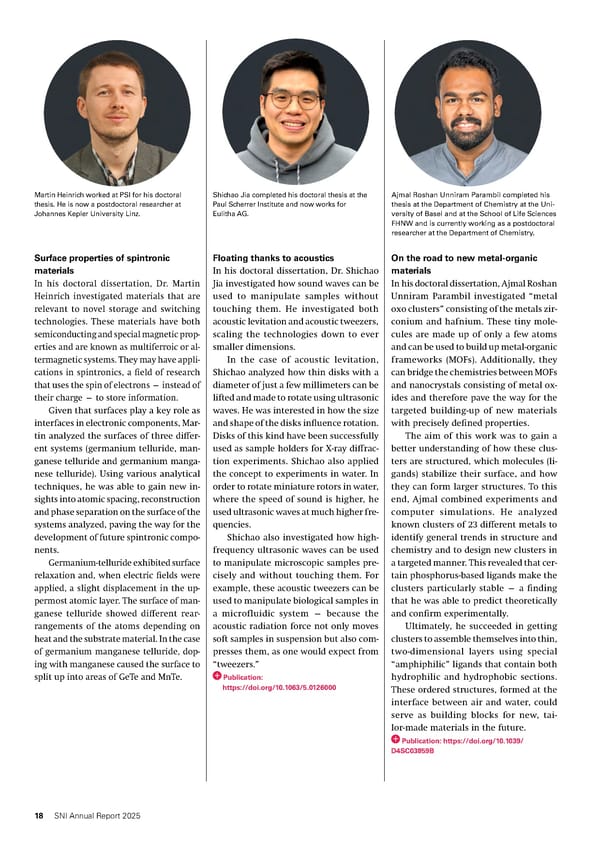
On the road to new metal-organic materials In his doctoral dissertation, Ajmal Roshan Unniram Parambil investigated “metal oxo clusters” consisting of the metals zir- conium and hafnium. These tiny mole- cules are made up of only a few atoms and can be used to build up metal-organic frameworks (MOFs). Additionally, they can bridge the chemistries between MOFs and nanocrystals consisting of metal ox- ides and therefore pave the way for the targeted building-up of new materials with precisely defined properties. The aim of this work was to gain a better understanding of how these clus- ters are structured, which molecules (li- gands) stabilize their surface, and how they can form larger structures. To this end, Ajmal combined experiments and computer simulations. He analyzed known clusters of 23 different metals to identify general trends in structure and chemistry and to design new clusters in a targeted manner. This revealed that cer- tain phosphorus-based ligands make the clusters particularly stable — a finding that he was able to predict theoretically and confirm experimentally. Ultimately, he succeeded in getting clusters to assemble themselves into thin, two-dimensional layers using special “amphiphilic” ligands that contain both hydrophilic and hydrophobic sections. These ordered structures, formed at the interface between air and water, could serve as building blocks for new, tai- lor-made materials in the future. Publication: https://doi.org/10.1039/ D4SC03859B Ajmal Roshan Unniram Parambil completed his thesis at the Department of Chemistry at the Uni- versity of Basel and at the School of Life Sciences FHNW and is currently working as a postdoctoral researcher at the Department of Chemistry. Surface properties of spintronic materials In his doctoral dissertation, Dr. Martin Heinrich investigated materials that are relevant to novel storage and switching technologies. These materials have both semiconducting and special magnetic prop- erties and are known as multiferroic or al- termagnetic systems. They may have appli- cations in spintronics, a field of research that uses the spin of electrons — instead of their charge — to store information. Given that surfaces play a key role as interfaces in electronic components, Mar- tin analyzed the surfaces of three differ- ent systems (germanium telluride, man- ganese telluride and germanium manga- nese telluride). Using various analytical techniques, he was able to gain new in- sights into atomic spacing, reconstruction and phase separation on the surface of the systems analyzed, paving the way for the development of future spintronic compo- nents. Germanium-telluride exhibited surface relaxation and, when electric fields were applied, a slight displacement in the up- permost atomic layer. The surface of man- ganese telluride showed different rear- rangements of the atoms depending on heat and the substrate material. In the case of germanium manganese telluride, dop- ing with manganese caused the surface to split up into areas of GeTe and MnTe. Martin Heinrich worked at PSI for his doctoral thesis. He is now a postdoctoral researcher at Johannes Kepler University Linz. Floating thanks to acoustics In his doctoral dissertation, Dr. Shichao Jia investigated how sound waves can be used to manipulate samples without touching them. He investigated both acoustic levitation and acoustic tweezers, scaling the technologies down to ever smaller dimensions. In the case of acoustic levitation, Shichao analyzed how thin disks with a diameter of just a few millimeters can be lifted and made to rotate using ultrasonic waves. He was interested in how the size and shape of the disks influence rotation. Disks of this kind have been successfully used as sample holders for X-ray diffrac- tion experiments. Shichao also applied the concept to experiments in water. In order to rotate miniature rotors in water, where the speed of sound is higher, he used ultrasonic waves at much higher fre- quencies. Shichao also investigated how high- frequency ultrasonic waves can be used to manipulate microscopic samples pre- cisely and without touching them. For example, these acoustic tweezers can be used to manipulate biological samples in a microfluidic system — because the acoustic radiation force not only moves soft samples in suspension but also com- presses them, as one would expect from “tweezers.” Publication: https://doi.org/10.1063/5.0126000 Shichao Jia completed his doctoral thesis at the Paul Scherrer Institute and now works for Eulitha AG. 18 SNI Annual Report 2025
 Annual Report 2025 - Swiss Nanoscience Institute Page 17 Page 19