
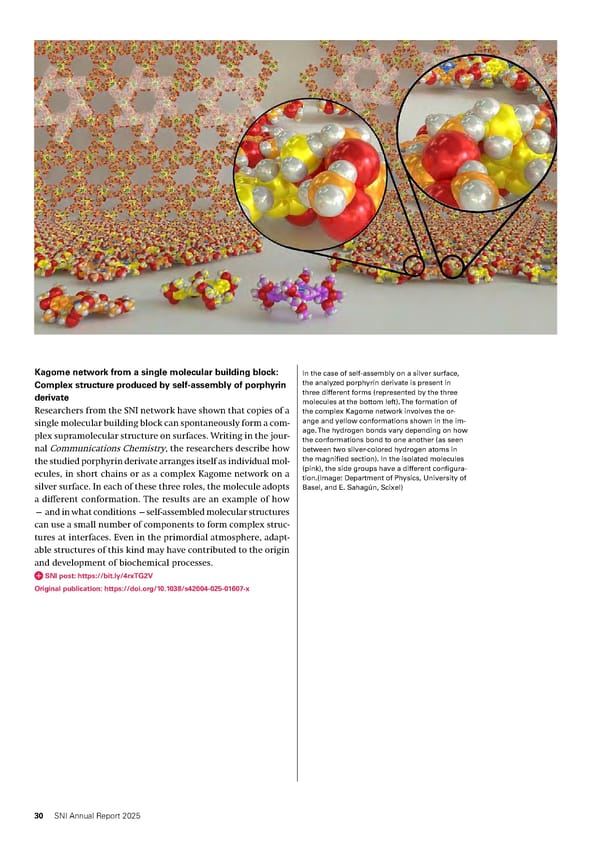
Kagome network from a single molecular building block: Complex structure produced by self-assembly of porphyrin derivate Researchers from the SNI network have shown that copies of a single molecular building block can spontaneously form a com- plex supramolecular structure on surfaces. Writing in the jour- nal Communications Chemistry, the researchers describe how the studied porphyrin derivate arranges itself as individual mol- ecules, in short chains or as a complex Kagome network on a silver surface. In each of these three roles, the molecule adopts a different conformation. The results are an example of how — and in what conditions —self-assembled molecular structures can use a small number of components to form complex struc- tures at interfaces. Even in the primordial atmosphere, adapt- able structures of this kind may have contributed to the origin and development of biochemical processes. SNI post: https://bit.ly/4rxTG2V Original publication: https://doi.org/10.1038/s42004-025-01607-x In the case of self-assembly on a silver surface, the analyzed porphyrin derivate is present in three different forms (represented by the three molecules at the bottom left). The formation of the complex Kagome network involves the or- ange and yellow conformations shown in the im- age. The hydrogen bonds vary depending on how the conformations bond to one another (as seen between two silver-colored hydrogen atoms in the magnified section). In the isolated molecules (pink), the side groups have a different configura- tion.(Image: Department of Physics, University of Basel, and E. Sahagún, Scixel) 30 SNI Annual Report 2025
 Annual Report 2025 - Swiss Nanoscience Institute Page 29 Page 31