
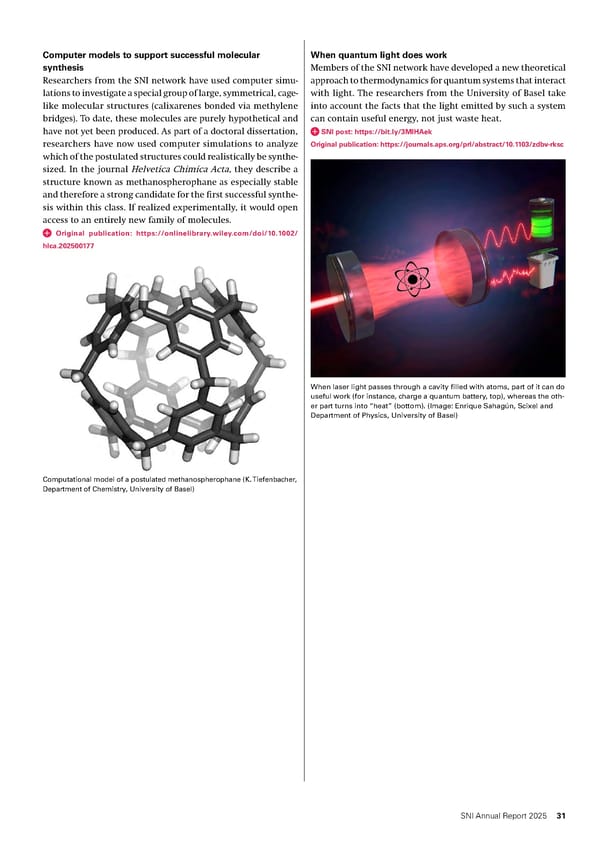
When quantum light does work Members of the SNI network have developed a new theoretical approach to thermodynamics for quantum systems that interact with light. The researchers from the University of Basel take into account the facts that the light emitted by such a system can contain useful energy, not just waste heat. SNI post: https://bit.ly/3MlHAek Original publication: https://journals.aps.org/prl/abstract/10.1103/zdbv-rksc When laser light passes through a cavity filled with atoms, part of it can do useful work (for instance, charge a quantum battery, top), whereas the oth- er part turns into “heat” (bottom). (Image: Enrique Sahagún, Scixel and Department of Physics, University of Basel) Computer models to support successful molecular synthesis Researchers from the SNI network have used computer simu- lations to investigate a special group of large, symmetrical, cage- like molecular structures (calixarenes bonded via methylene bridges). To date, these molecules are purely hypothetical and have not yet been produced. As part of a doctoral dissertation, researchers have now used computer simulations to analyze which of the postulated structures could realistically be synthe- sized. In the journal Helvetica Chimica Acta, they describe a structure known as methanospherophane as especially stable and therefore a strong candidate for the first successful synthe- sis within this class. If realized experimentally, it would open access to an entirely new family of molecules. Original publication: https://onlinelibrary.wiley.com/doi/10.1002/ hlca.202500177 Computational model of a postulated methanospherophane (K. Tiefenbacher, Department of Chemistry, University of Basel) 31 SNI Annual Report 2025
 Annual Report 2025 - Swiss Nanoscience Institute Page 30 Page 32