
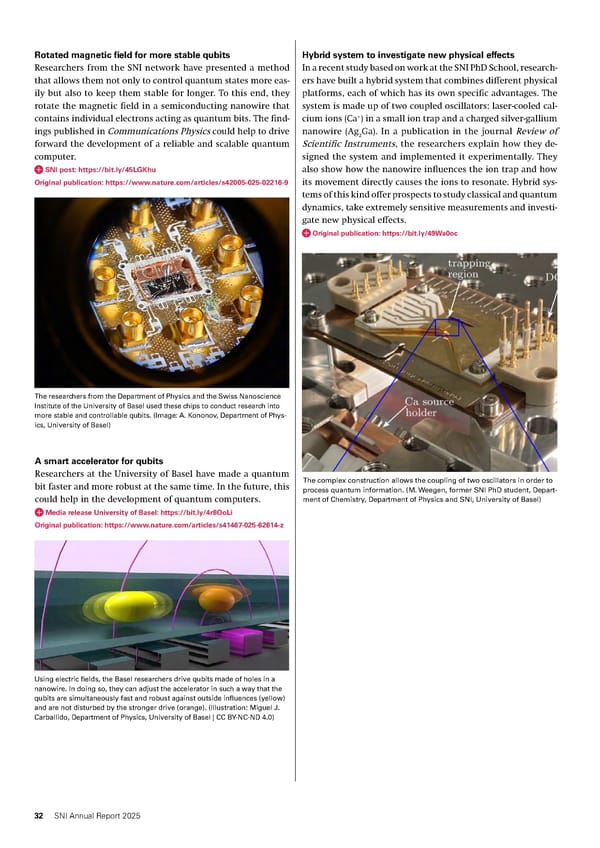
The complex construction allows the coupling of two oscillators in order to process quantum information. (M. Weegen, former SNI PhD student, Depart- ment of Chemistry, Department of Physics and SNI, University of Basel) Hybrid system to investigate new physical effects In a recent study based on work at the SNI PhD School, research- ers have built a hybrid system that combines different physical platforms, each of which has its own specific advantages. The system is made up of two coupled oscillators: laser-cooled cal- cium ions (Ca + ) in a small ion trap and a charged silver-gallium nanowire (Ag 2 Ga). In a publication in the journal Review of Scientific Instruments, the researchers explain how they de- signed the system and implemented it experimentally. They also show how the nanowire influences the ion trap and how its movement directly causes the ions to resonate. Hybrid sys- tems of this kind offer prospects to study classical and quantum dynamics, take extremely sensitive measurements and investi- gate new physical effects. Original publication: https://bit.ly/49Wa0oc The researchers from the Department of Physics and the Swiss Nanoscience Institute of the University of Basel used these chips to conduct research into more stable and controllable qubits. (Image: A. Kononov, Department of Phys- ics, University of Basel) Rotated magnetic field for more stable qubits Researchers from the SNI network have presented a method that allows them not only to control quantum states more eas- ily but also to keep them stable for longer. To this end, they rotate the magnetic field in a semiconducting nanowire that contains individual electrons acting as quantum bits. The find- ings published in Communications Physics could help to drive forward the development of a reliable and scalable quantum computer. SNI post: https://bit.ly/45LGKhu Original publication: https://www.nature.com/articles/s42005-025-02216-9 A smart accelerator for qubits Researchers at the University of Basel have made a quantum bit faster and more robust at the same time. In the future, this could help in the development of quantum computers. Media release University of Basel: https://bit.ly/4r8OoLi Original publication: https://www.nature.com/articles/s41467-025-62614-z Using electric fields, the Basel researchers drive qubits made of holes in a nanowire. In doing so, they can adjust the accelerator in such a way that the qubits are simultaneously fast and robust against outside influences (yellow) and are not disturbed by the stronger drive (orange). (Illustration: Miguel J. Carballido, Department of Physics, University of Basel | CC BY-NC-ND 4.0) 32 SNI Annual Report 2025
 Annual Report 2025 - Swiss Nanoscience Institute Page 31 Page 33