
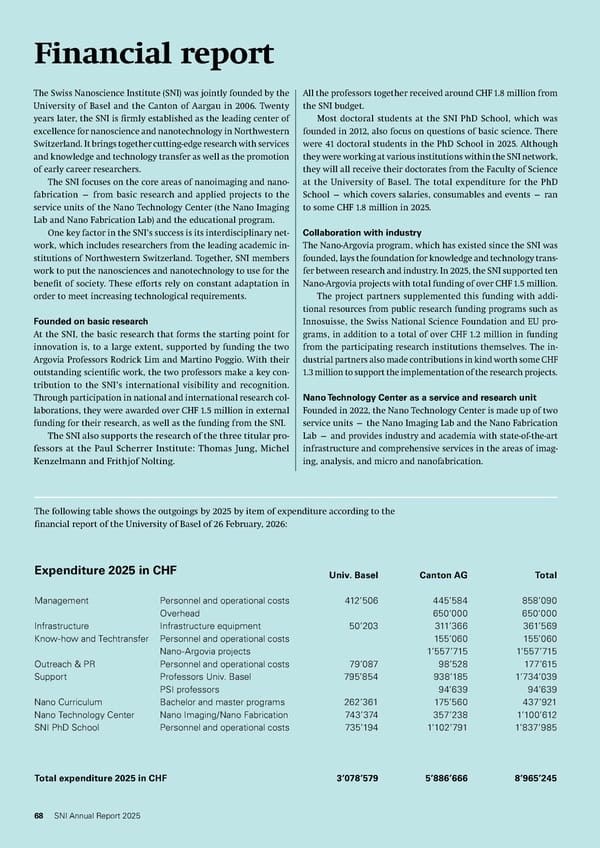
Financial report The Swiss Nanoscience Institute (SNI) was jointly founded by the University of Basel and the Canton of Aargau in 2006. Twenty years later, the SNI is firmly established as the leading center of excellence for nanoscience and nanotechnology in Northwestern Switzerland. It brings together cutting-edge research with services and knowledge and technology transfer as well as the promotion of early career researchers. The SNI focuses on the core areas of nanoimaging and nano- fabrication — from basic research and applied projects to the service units of the Nano Technology Center (the Nano Imaging Lab and Nano Fabrication Lab) and the educational program. One key factor in the SNI’s success is its interdisciplinary net- work, which includes researchers from the leading academic in- stitutions of Northwestern Switzerland. Together, SNI members work to put the nanosciences and nanotechnology to use for the benefit of society. These efforts rely on constant adaptation in order to meet increasing technological requirements. Founded on basic research At the SNI, the basic research that forms the starting point for innovation is, to a large extent, supported by funding the two Argovia Professors Rodrick Lim and Martino Poggio. With their outstanding scientific work, the two professors make a key con- tribution to the SNI’s international visibility and recognition. Through participation in national and international research col- laborations, they were awarded over CHF 1.5 million in external funding for their research, as well as the funding from the SNI. The SNI also supports the research of the three titular pro- fessors at the Paul Scherrer Institute: Thomas Jung, Michel Kenzelmann and Frithjof Nolting. All the professors together received around CHF 1.8 million from the SNI budget. Most doctoral students at the SNI PhD School, which was founded in 2012, also focus on questions of basic science. There were 41 doctoral students in the PhD School in 2025. Although they were working at various institutions within the SNI network, they will all receive their doctorates from the Faculty of Science at the University of Basel. The total expenditure for the PhD School — which covers salaries, consumables and events — ran to some CHF 1.8 million in 2025. Collaboration with industry The Nano-Argovia program, which has existed since the SNI was founded, lays the foundation for knowledge and technology trans- fer between research and industry. In 2025, the SNI supported ten Nano-Argovia projects with total funding of over CHF 1.5 million. The project partners supplemented this funding with addi- tional resources from public research funding programs such as Innosuisse, the Swiss National Science Foundation and EU pro- grams, in addition to a total of over CHF 1.2 million in funding from the participating research institutions themselves. The in- dustrial partners also made contributions in kind worth some CHF 1.3 million to support the implementation of the research projects. Nano Technology Center as a service and research unit Founded in 2022, the Nano Technology Center is made up of two service units — the Nano Imaging Lab and the Nano Fabrication Lab — and provides industry and academia with state-of-the-art infrastructure and comprehensive services in the areas of imag- ing, analysis, and micro and nanofabrication. Expenditure 2025 in CHF The following table shows the outgoings by 2025 by item of expenditure according to the financial report of the University of Basel of 26 February, 2026: Management Infrastructure Know-how and Techtransfer Outreach & PR Support Nano Curriculum Nano Technology Center SNI PhD School Personnel and operational costs Overhead Infrastructure equipment Personnel and operational costs Nano-Argovia projects Personnel and operational costs Professors Univ. Basel PSI professors Bachelor and master programs Nano Imaging/Nano Fabrication Personnel and operational costs Univ. Basel 412’506 50’203 79’087 795’854 262’361 743’374 735’194 3’078’579 Canton AG 445’584 650‘000 311’366 155’060 1’557’715 98’528 938’185 94’639 175’560 357’238 1’102’791 5’886’666 Total 858’090 650‘000 361’569 155’060 1’557’715 177’615 1’734’039 94’639 437’921 1’100’612 1’837’985 8’965’245 Total expenditure 2025 in CHF 68 SNI Annual Report 2025
 Annual Report 2025 - Swiss Nanoscience Institute Page 67 Page 69