
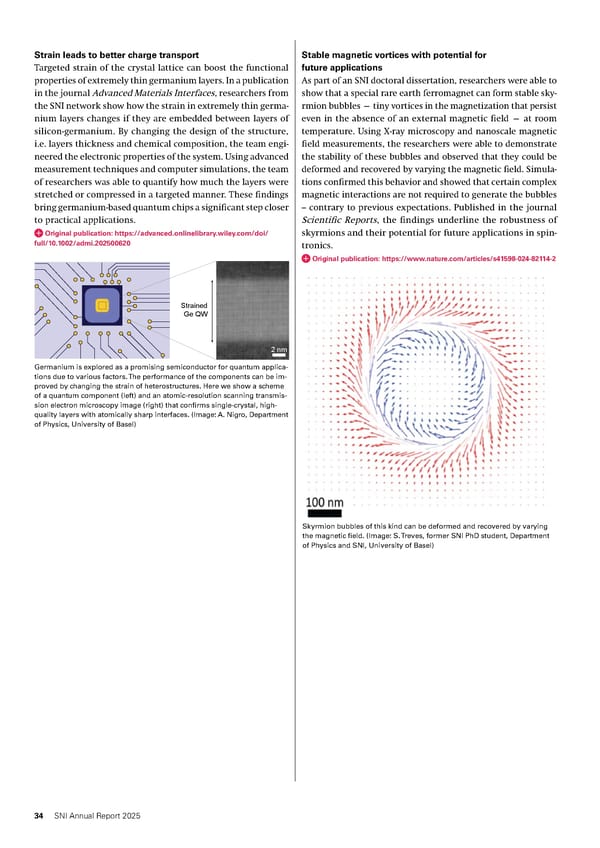
Stable magnetic vortices with potential for future applications As part of an SNI doctoral dissertation, researchers were able to show that a special rare earth ferromagnet can form stable sky- rmion bubbles — tiny vortices in the magnetization that persist even in the absence of an external magnetic field — at room temperature. Using X-ray microscopy and nanoscale magnetic field measurements, the researchers were able to demonstrate the stability of these bubbles and observed that they could be deformed and recovered by varying the magnetic field. Simula- tions confirmed this behavior and showed that certain complex magnetic interactions are not required to generate the bubbles – contrary to previous expectations. Published in the journal Scientific Reports, the findings underline the robustness of skyrmions and their potential for future applications in spin- tronics. Original publication: https://www.nature.com/articles/s41598-024-82114-2 Strained Ge QW 2 nm Germanium is explored as a promising semiconductor for quantum applica- tions due to various factors. The performance of the components can be im- proved by changing the strain of heterostructures. Here we show a scheme of a quantum component (left) and an atomic-resolution scanning transmis- sion electron microscopy image (right) that confirms single-crystal, high- quality layers with atomically sharp interfaces. (Image: A. Nigro, Department of Physics, University of Basel) Strain leads to better charge transport Targeted strain of the crystal lattice can boost the functional properties of extremely thin germanium layers. In a publication in the journal Advanced Materials Interfaces, researchers from the SNI network show how the strain in extremely thin germa- nium layers changes if they are embedded between layers of silicon-germanium. By changing the design of the structure, i.e. layers thickness and chemical composition, the team engi- neered the electronic properties of the system. Using advanced measurement techniques and computer simulations, the team of researchers was able to quantify how much the layers were stretched or compressed in a targeted manner. These findings bring germanium-based quantum chips a significant step closer to practical applications. Original publication: https://advanced.onlinelibrary.wiley.com/doi/ full/10.1002/admi.202500620 Skyrmion bubbles of this kind can be deformed and recovered by varying the magnetic field. (Image: S. Treves, former SNI PhD student, Department of Physics and SNI, University of Basel) 34 SNI Annual Report 2025
 Annual Report 2025 - Swiss Nanoscience Institute Page 33 Page 35