
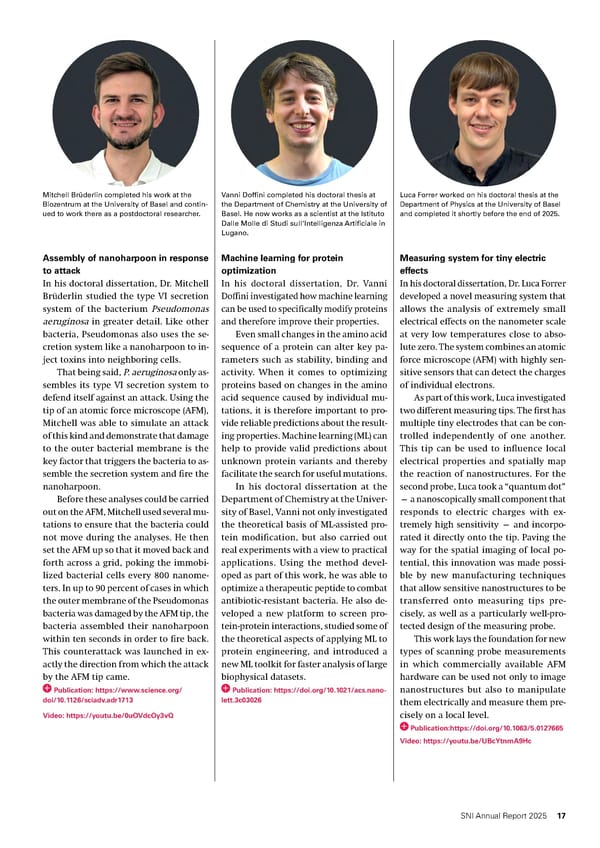
Machine learning for protein optimization In his doctoral dissertation, Dr. Vanni Doffini investigated how machine learning can be used to specifically modify proteins and therefore improve their properties. Even small changes in the amino acid sequence of a protein can alter key pa- rameters such as stability, binding and activity. When it comes to optimizing proteins based on changes in the amino acid sequence caused by individual mu- tations, it is therefore important to pro- vide reliable predictions about the result- ing properties. Machine learning (ML) can help to provide valid predictions about unknown protein variants and thereby facilitate the search for useful mutations. In his doctoral dissertation at the Department of Chemistry at the Univer- sity of Basel, V anni not only investigated the theoretical basis of ML-assisted pro- tein modification, but also carried out real experiments with a view to practical applications. Using the method devel- oped as part of this work, he was able to optimize a therapeutic peptide to combat antibiotic-resistant bacteria. He also de- veloped a new platform to screen pro- tein-protein interactions, studied some of the theoretical aspects of applying ML to protein engineering, and introduced a new ML toolkit for faster analysis of large biophysical datasets. Publication: https://doi.org/10.1021/acs.nano- lett.3c03026 Vanni Doffini completed his doctoral thesis at the Department of Chemistry at the University of Basel. He now works as a scientist at the Istituto Dalle Molle di Studi sull‘Intelligenza Artificiale in Lugano. Mitchell Brüderlin completed his work at the Biozentrum at the University of Basel and contin- ued to work there as a postdoctoral researcher. Assembly of nanoharpoon in response to attack In his doctoral dissertation, Dr. Mitchell Brüderlin studied the type VI secretion system of the bacterium Pseudomonas aeruginosa in greater detail. Like other bacteria, Pseudomonas also uses the se- cretion system like a nanoharpoon to in- ject toxins into neighboring cells. That being said, P. aeruginosa only as- sembles its type VI secretion system to defend itself against an attack. Using the tip of an atomic force microscope (AFM), Mitchell was able to simulate an attack of this kind and demonstrate that damage to the outer bacterial membrane is the key factor that triggers the bacteria to as- semble the secretion system and fire the nanoharpoon. Before these analyses could be carried out on the AFM, Mitchell used several mu- tations to ensure that the bacteria could not move during the analyses. He then set the AFM up so that it moved back and forth across a grid, poking the immobi- lized bacterial cells every 800 nanome- ters. In up to 90 percent of cases in which the outer membrane of the Pseudomonas bacteria was damaged by the AFM tip, the bacteria assembled their nanoharpoon within ten seconds in order to fire back. This counterattack was launched in ex- actly the direction from which the attack by the AFM tip came. Publication: https://www.science.org/ doi/10.1126/sciadv.adr1713 Video: https://youtu.be/0uOVdcOy3vQ Measuring system for tiny electric effects In his doctoral dissertation, Dr. Luca Forrer developed a novel measuring system that allows the analysis of extremely small electrical effects on the nanometer scale at very low temperatures close to abso- lute zero. The system combines an atomic force microscope (AFM) with highly sen- sitive sensors that can detect the charges of individual electrons. As part of this work, Luca investigated two different measuring tips. The first has multiple tiny electrodes that can be con- trolled independently of one another. This tip can be used to influence local electrical properties and spatially map the reaction of nanostructures. For the second probe, Luca took a “quantum dot” — a nanoscopically small component that responds to electric charges with ex- tremely high sensitivity — and incorpo- rated it directly onto the tip. Paving the way for the spatial imaging of local po- tential, this innovation was made possi- ble by new manufacturing techniques that allow sensitive nanostructures to be transferred onto measuring tips pre- cisely, as well as a particularly well-pro- tected design of the measuring probe. This work lays the foundation for new types of scanning probe measurements in which commercially available AFM hardware can be used not only to image nanostructures but also to manipulate them electrically and measure them pre- cisely on a local level. Publication:https://doi.org/10.1063/5.0127665 Video: https://youtu.be/UBcYtnmA9Hc Luca Forrer worked on his doctoral thesis at the Department of Physics at the University of Basel and completed it shortly before the end of 2025. 17 SNI Annual Report 2025
 Annual Report 2025 - Swiss Nanoscience Institute Page 16 Page 18