
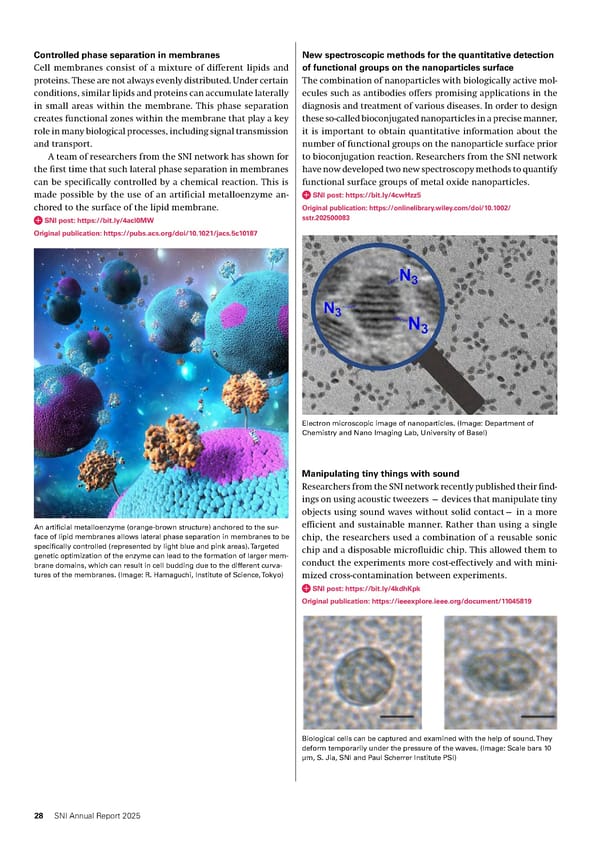
An artificial metalloenzyme (orange-brown structure) anchored to the sur- face of lipid membranes allows lateral phase separation in membranes to be specifically controlled (represented by light blue and pink areas). Targeted genetic optimization of the enzyme can lead to the formation of larger mem- brane domains, which can result in cell budding due to the different curva- tures of the membranes. (Image: R. Hamaguchi, Institute of Science, Tokyo) Controlled phase separation in membranes Cell membranes consist of a mixture of different lipids and proteins. These are not always evenly distributed. Under certain conditions, similar lipids and proteins can accumulate laterally in small areas within the membrane. This phase separation creates functional zones within the membrane that play a key role in many biological processes, including signal transmission and transport. A team of researchers from the SNI network has shown for the first time that such lateral phase separation in membranes can be specifically controlled by a chemical reaction. This is made possible by the use of an artificial metalloenzyme an- chored to the surface of the lipid membrane. SNI post: https://bit.ly/4acl0MW Original publication: https://pubs.acs.org/doi/10.1021/jacs.5c10187 New spectroscopic methods for the quantitative detection of functional groups on the nanoparticles surface The combination of nanoparticles with biologically active mol- ecules such as antibodies offers promising applications in the diagnosis and treatment of various diseases. In order to design these so-called bioconjugated nanoparticles in a precise manner, it is important to obtain quantitative information about the number of functional groups on the nanoparticle surface prior to bioconjugation reaction. Researchers from the SNI network have now developed two new spectroscopy methods to quantify functional surface groups of metal oxide nanoparticles. SNI post: https://bit.ly/4cwHzz5 Original publication: https://onlinelibrary.wiley.com/doi/10.1002/ sstr.202500083 Electron microscopic image of nanoparticles. (Image: Department of Chemistry and Nano Imaging Lab, University of Basel) Manipulating tiny things with sound Researchers from the SNI network recently published their find- ings on using acoustic tweezers — devices that manipulate tiny objects using sound waves without solid contact— in a more efficient and sustainable manner. Rather than using a single chip, the researchers used a combination of a reusable sonic chip and a disposable microfluidic chip. This allowed them to conduct the experiments more cost-effectively and with mini- mized cross-contamination between experiments. SNI post: https://bit.ly/4kdhKpk Original publication: https://ieeexplore.ieee.org/document/11045819 Biological cells can be captured and examined with the help of sound. They deform temporarily under the pressure of the waves. (Image: Scale bars 10 μm, S. Jia, SNI and Paul Scherrer Institute PSI) 28 SNI Annual Report 2025
 Annual Report 2025 - Swiss Nanoscience Institute Page 27 Page 29