
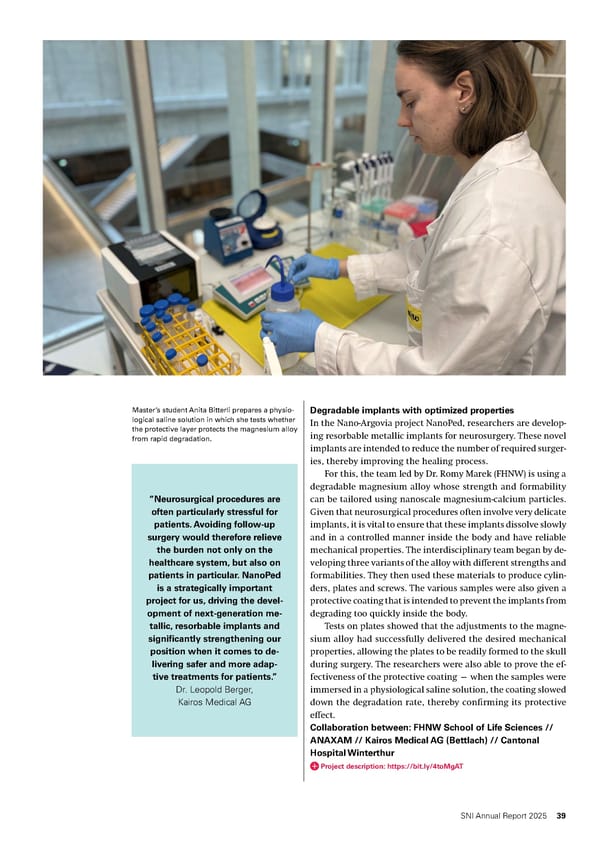
Degradable implants with optimized properties In the Nano-Argovia project NanoPed, researchers are develop- ing resorbable metallic implants for neurosurgery. These novel implants are intended to reduce the number of required surger- ies, thereby improving the healing process. For this, the team led by Dr. Romy Marek (FHNW) is using a degradable magnesium alloy whose strength and formability can be tailored using nanoscale magnesium-calcium particles. Given that neurosurgical procedures often involve very delicate implants, it is vital to ensure that these implants dissolve slowly and in a controlled manner inside the body and have reliable mechanical properties. The interdisciplinary team began by de- veloping three variants of the alloy with different strengths and formabilities. They then used these materials to produce cylin- ders, plates and screws. The various samples were also given a protective coating that is intended to prevent the implants from degrading too quickly inside the body. Tests on plates showed that the adjustments to the magne- sium alloy had successfully delivered the desired mechanical properties, allowing the plates to be readily formed to the skull during surgery. The researchers were also able to prove the ef- fectiveness of the protective coating — when the samples were immersed in a physiological saline solution, the coating slowed down the degradation rate, thereby confirming its protective effect. Collaboration between: FHNW School of Life Sciences // ANAXAM // Kairos Medical AG (Bettlach) // Cantonal Hospital Winterthur Project description: https://bit.ly/4toMgAT Master’s student Anita Bitterli prepares a physio- logical saline solution in which she tests whether the protective layer protects the magnesium alloy from rapid degradation. “Neurosurgical procedures are often particularly stressful for patients. Avoiding follow-up surgery would therefore relieve the burden not only on the healthcare system, but also on patients in particular. NanoPed is a strategically important project for us, driving the devel- opment of next-generation me- tallic, resorbable implants and significantly strengthening our position when it comes to de- livering safer and more adap- tive treatments for patients.” Dr. Leopold Berger, Kairos Medical AG 39 SNI Annual Report 2025
 Annual Report 2025 - Swiss Nanoscience Institute Page 38 Page 40