
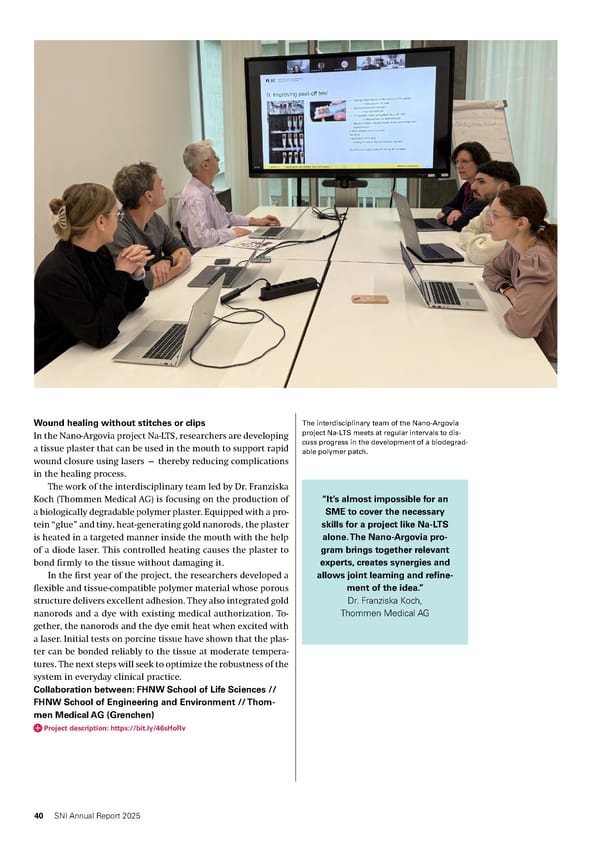
Wound healing without stitches or clips In the Nano-Argovia project Na-LTS, researchers are developing a tissue plaster that can be used in the mouth to support rapid wound closure using lasers — thereby reducing complications in the healing process. The work of the interdisciplinary team led by Dr. Franziska Koch (Thommen Medical AG) is focusing on the production of a biologically degradable polymer plaster. Equipped with a pro- tein “glue” and tiny, heat-generating gold nanorods, the plaster is heated in a targeted manner inside the mouth with the help of a diode laser. This controlled heating causes the plaster to bond firmly to the tissue without damaging it. In the first year of the project, the researchers developed a flexible and tissue-compatible polymer material whose porous structure delivers excellent adhesion. They also integrated gold nanorods and a dye with existing medical authorization. To- gether, the nanorods and the dye emit heat when excited with a laser. Initial tests on porcine tissue have shown that the plas- ter can be bonded reliably to the tissue at moderate tempera- tures. The next steps will seek to optimize the robustness of the system in everyday clinical practice. Collaboration between: FHNW School of Life Sciences // FHNW School of Engineering and Environment // Thom- men Medical AG (Grenchen) Project description: https://bit.ly/46sHoRv “It’s almost impossible for an SME to cover the necessary skills for a project like Na-LTS alone. The Nano-Argovia pro- gram brings together relevant experts, creates synergies and allows joint learning and refine- ment of the idea.” Dr. Franziska Koch, Thommen Medical AG The interdisciplinary team of the Nano-Argovia project Na-LTS meets at regular intervals to dis- cuss progress in the development of a biodegrad- able polymer patch. 40 SNI Annual Report 2025
 Annual Report 2025 - Swiss Nanoscience Institute Page 39 Page 41