
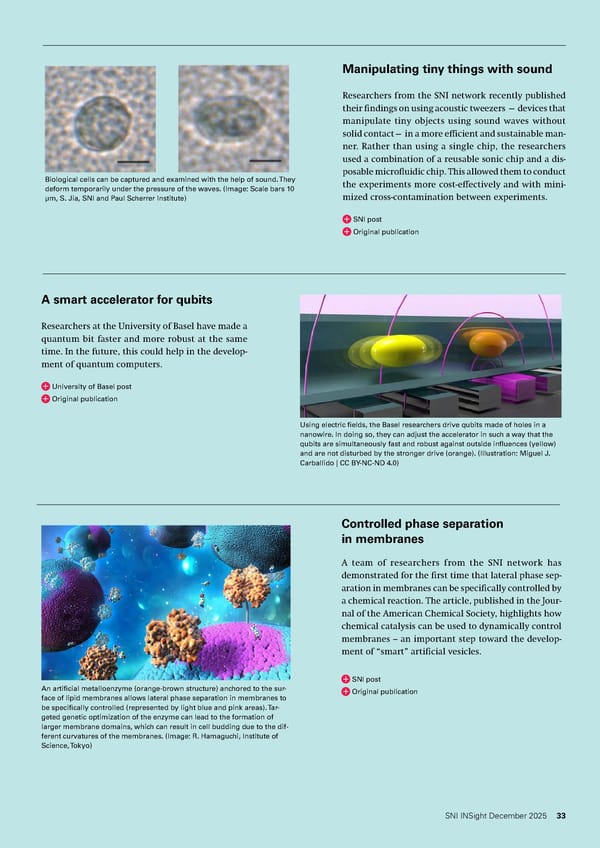
Manipulating tiny things with sound Researchers from the SNI network recently published their findings on using acoustic tweezers — devices that manipulate tiny objects using sound waves without solid contact— in a more efficient and sustainable man- ner. Rather than using a single chip, the researchers used a combination of a reusable sonic chip and a dis- posable microfluidic chip. This allowed them to conduct the experiments more cost-effectively and with mini- mized cross-contamination between experiments. SNI post Original publication Biological cells can be captured and examined with the help of sound. They deform temporarily under the pressure of the waves. (Image: Scale bars 10 μm, S. Jia, SNI and Paul Scherrer Institute) A smart accelerator for qubits Researchers at the University of Basel have made a quantum bit faster and more robust at the same time. In the future, this could help in the develop- ment of quantum computers. University of Basel post Original publication Using electric fields, the Basel researchers drive qubits made of holes in a nanowire. In doing so, they can adjust the accelerator in such a way that the qubits are simultaneously fast and robust against outside influences (yellow) and are not disturbed by the stronger drive (orange). (Illustration: Miguel J. Carballido | CC BY-NC-ND 4.0) Controlled phase separation in membranes A team of researchers from the SNI network has demonstrated for the first time that lateral phase sep- aration in membranes can be specifically controlled by a chemical reaction. The article, published in the Jour- nal of the American Chemical Society, highlights how chemical catalysis can be used to dynamically control membranes – an important step toward the develop- ment of “smart” artificial vesicles. SNI post Original publication An artificial metalloenzyme (orange-brown structure) anchored to the sur- face of lipid membranes allows lateral phase separation in membranes to be specifically controlled (represented by light blue and pink areas). Tar- geted genetic optimization of the enzyme can lead to the formation of larger membrane domains, which can result in cell budding due to the dif- ferent curvatures of the membranes. (Image: R. Hamaguchi, Institute of Science, Tokyo) 33 SNI INSight December 2025
 SNI Insight December 2025 Page 32 Page 34