
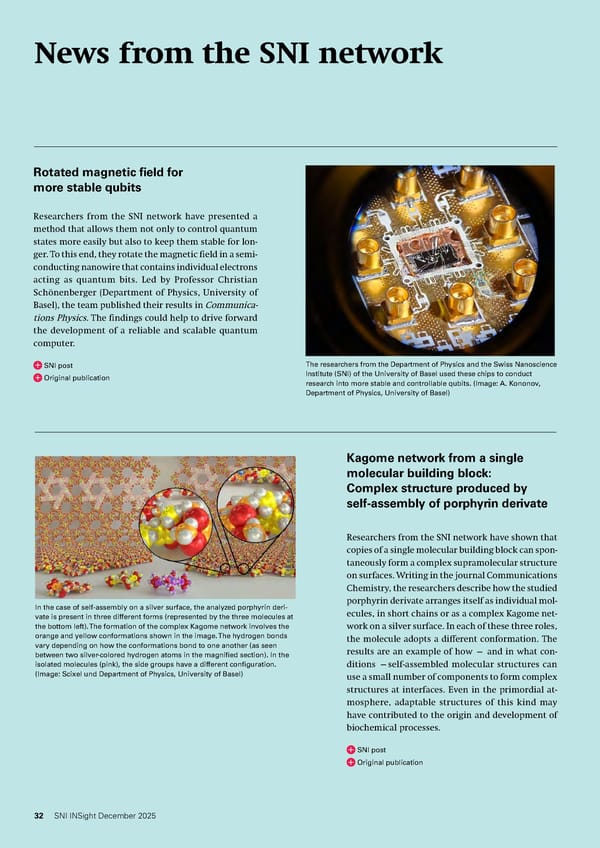
News from the SNI network Kagome network from a single molecular building block: Complex structure produced by self-assembly of porphyrin derivate Researchers from the SNI network have shown that copies of a single molecular building block can spon- taneously form a complex supramolecular structure on surfaces. Writing in the journal Communications Chemistry, the researchers describe how the studied porphyrin derivate arranges itself as individual mol- ecules, in short chains or as a complex Kagome net- work on a silver surface. In each of these three roles, the molecule adopts a different conformation. The results are an example of how — and in what con- ditions —self-assembled molecular structures can use a small number of components to form complex structures at interfaces. Even in the primordial at- mosphere, adaptable structures of this kind may have contributed to the origin and development of biochemical processes. SNI post Original publication Rotated magnetic field for more stable qubits Researchers from the SNI network have presented a method that allows them not only to control quantum states more easily but also to keep them stable for lon- ger. To this end, they rotate the magnetic field in a semi- conducting nanowire that contains individual electrons acting as quantum bits. Led by Professor Christian Schönenberger (Department of Physics, University of Basel), the team published their results in Communica- tions Physics. The findings could help to drive forward the development of a reliable and scalable quantum computer. SNI post Original publication In the case of self-assembly on a silver surface, the analyzed porphyrin deri- vate is present in three different forms (represented by the three molecules at the bottom left). The formation of the complex Kagome network involves the orange and yellow conformations shown in the image. The hydrogen bonds vary depending on how the conformations bond to one another (as seen between two silver-colored hydrogen atoms in the magnified section). In the isolated molecules (pink), the side groups have a different configuration. (Image: Scixel und Department of Physics, University of Basel) The researchers from the Department of Physics and the Swiss Nanoscience Institute (SNI) of the University of Basel used these chips to conduct research into more stable and controllable qubits. (Image: A. Kononov, Department of Physics, University of Basel) 32 SNI INSight December 2025
 SNI Insight December 2025 Page 31 Page 33