
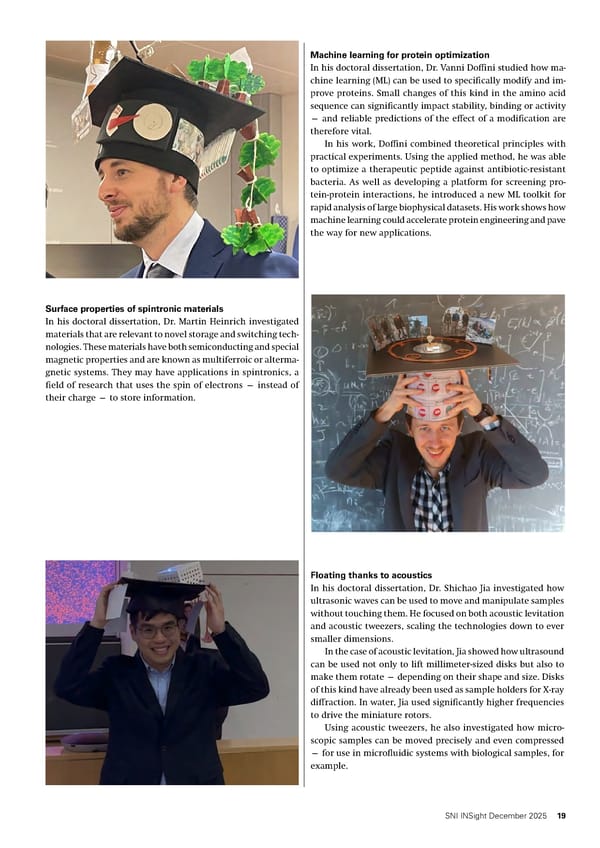
Machine learning for protein optimization In his doctoral dissertation, Dr. Vanni Doffini studied how ma- chine learning (ML) can be used to specifically modify and im- prove proteins. Small changes of this kind in the amino acid sequence can significantly impact stability, binding or activity — and reliable predictions of the effect of a modification are therefore vital. In his work, Doffini combined theoretical principles with practical experiments. Using the applied method, he was able to optimize a therapeutic peptide against antibiotic-resistant bacteria. As well as developing a platform for screening pro- tein-protein interactions, he introduced a new ML toolkit for rapid analysis of large biophysical datasets. His work shows how machine learning could accelerate protein engineering and pave the way for new applications. Surface properties of spintronic materials In his doctoral dissertation, Dr. Martin Heinrich investigated materials that are relevant to novel storage and switching tech- nologies. These materials have both semiconducting and special magnetic properties and are known as multiferroic or alterma- gnetic systems. They may have applications in spintronics, a field of research that uses the spin of electrons — instead of their charge — to store information. Floating thanks to acoustics In his doctoral dissertation, Dr. Shichao Jia investigated how ultrasonic waves can be used to move and manipulate samples without touching them. He focused on both acoustic levitation and acoustic tweezers, scaling the technologies down to ever smaller dimensions. In the case of acoustic levitation, Jia showed how ultrasound can be used not only to lift millimeter-sized disks but also to make them rotate — depending on their shape and size. Disks of this kind have already been used as sample holders for X-ray diffraction. In water, Jia used significantly higher frequencies to drive the miniature rotors. Using acoustic tweezers, he also investigated how micro- scopic samples can be moved precisely and even compressed — for use in microfluidic systems with biological samples, for example. 19 SNI INSight December 2025
 SNI Insight December 2025 Page 18 Page 20