
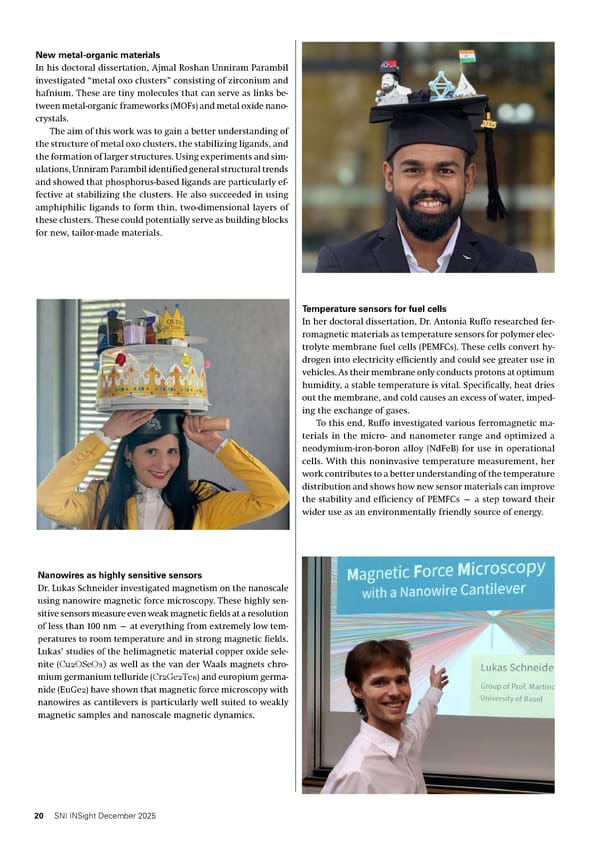
New metal-organic materials In his doctoral dissertation, Ajmal Roshan Unniram Parambil investigated “metal oxo clusters” consisting of zirconium and hafnium. These are tiny molecules that can serve as links be- tween metal-organic frameworks (MOFs) and metal oxide nano- crystals. The aim of this work was to gain a better understanding of the structure of metal oxo clusters, the stabilizing ligands, and the formation of larger structures. Using experiments and sim- ulations, Unniram Parambil identified general structural trends and showed that phosphorus-based ligands are particularly ef- fective at stabilizing the clusters. He also succeeded in using amphiphilic ligands to form thin, two-dimensional layers of these clusters. These could potentially serve as building blocks for new, tailor-made materials. Temperature sensors for fuel cells In her doctoral dissertation, Dr. Antonia Ruffo researched fer- romagnetic materials as temperature sensors for polymer elec- trolyte membrane fuel cells (PEMFCs). These cells convert hy- drogen into electricity efficiently and could see greater use in vehicles. As their membrane only conducts protons at optimum humidity, a stable temperature is vital. Specifically, heat dries out the membrane, and cold causes an excess of water, imped- ing the exchange of gases. To this end, Ruffo investigated various ferromagnetic ma- terials in the micro- and nanometer range and optimized a neodymium-iron-boron alloy (NdFeB) for use in operational cells. With this noninvasive temperature measurement, her work contributes to a better understanding of the temperature distribution and shows how new sensor materials can improve the stability and efficiency of PEMFCs — a step toward their wider use as an environmentally friendly source of energy. Nanowires as highly sensitive sensors Dr. Lukas Schneider investigated magnetism on the nanoscale using nanowire magnetic force microscopy. These highly sen- sitive sensors measure even weak magnetic fields at a resolution of less than 100 nm — at everything from extremely low tem- peratures to room temperature and in strong magnetic fields. Lukas’ studies of the helimagnetic material copper oxide sele- nite (Cu₂OSeO₃) as well as the van der Waals magnets chro- mium germanium telluride (Cr₂Ge₂Te₆) and europium germa- nide (EuGe₂) have shown that magnetic force microscopy with nanowires as cantilevers is particularly well suited to weakly magnetic samples and nanoscale magnetic dynamics. 20 SNI INSight December 2025
 SNI Insight December 2025 Page 19 Page 21