
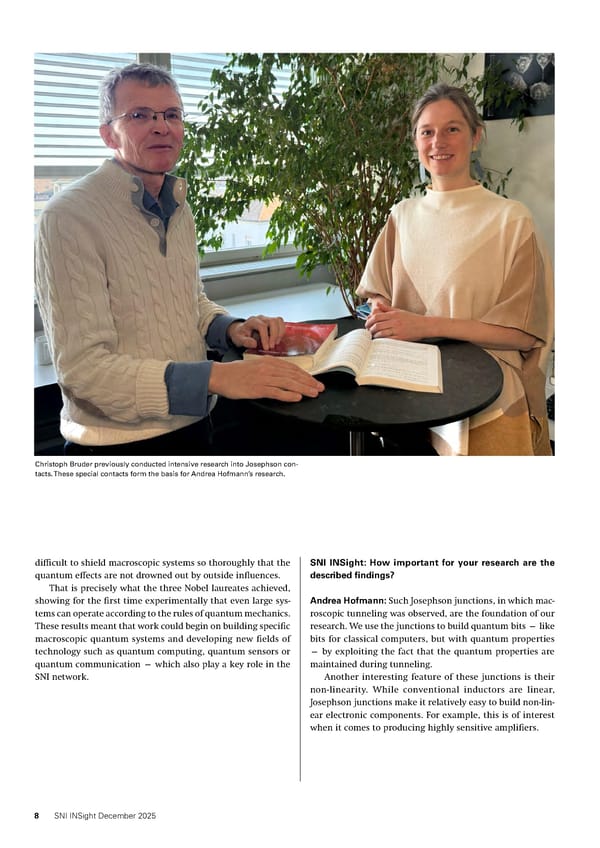
difficult to shield macroscopic systems so thoroughly that the quantum effects are not drowned out by outside influences. That is precisely what the three Nobel laureates achieved, showing for the first time experimentally that even large sys- tems can operate according to the rules of quantum mechanics. These results meant that work could begin on building specific macroscopic quantum systems and developing new fields of technology such as quantum computing, quantum sensors or quantum communication — which also play a key role in the SNI network. SNI INSight: How important for your research are the described findings? Andrea Hofmann: Such Josephson junctions, in which mac- roscopic tunneling was observed, are the foundation of our research. We use the junctions to build quantum bits — like bits for classical computers, but with quantum properties — by exploiting the fact that the quantum properties are maintained during tunneling. Another interesting feature of these junctions is their non-linearity. While conventional inductors are linear, Josephson junctions make it relatively easy to build non-lin- ear electronic components. For example, this is of interest when it comes to producing highly sensitive amplifiers. Christoph Bruder previously conducted intensive research into Josephson con- tacts. These special contacts form the basis for Andrea Hofmann’s research. 8 SNI INSight December 2025
 SNI Insight December 2025 Page 7 Page 9