
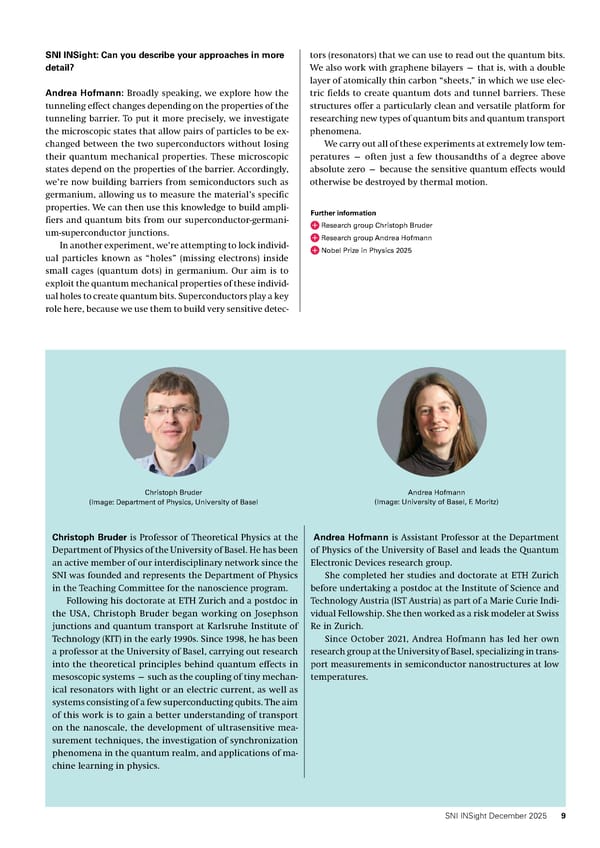
Christoph Bruder is Professor of Theoretical Physics at the Department of Physics of the University of Basel. He has been an active member of our interdisciplinary network since the SNI was founded and represents the Department of Physics in the Teaching Committee for the nanoscience program. Following his doctorate at ETH Zurich and a postdoc in the USA, Christoph Bruder began working on Josephson junctions and quantum transport at Karlsruhe Institute of Technology (KIT) in the early 1990s. Since 1998, he has been a professor at the University of Basel, carrying out research into the theoretical principles behind quantum effects in mesoscopic systems — such as the coupling of tiny mechan- ical resonators with light or an electric current, as well as systems consisting of a few superconducting qubits. The aim of this work is to gain a better understanding of transport on the nanoscale, the development of ultrasensitive mea- surement techniques, the investigation of synchronization phenomena in the quantum realm, and applications of ma- chine learning in physics. Further information Research group Christoph Bruder Research group Andrea Hofmann Nobel Prize in Physics 2025 Andrea Hofmann is Assistant Professor at the Department of Physics of the University of Basel and leads the Quantum Electronic Devices research group. She completed her studies and doctorate at ETH Zurich before undertaking a postdoc at the Institute of Science and Technology Austria (IST Austria) as part of a Marie Curie Indi- vidual Fellowship. She then worked as a risk modeler at Swiss Re in Zurich. Since October 2021, Andrea Hofmann has led her own research group at the University of Basel, specializing in trans- port measurements in semiconductor nanostructures at low temperatures. SNI INSight: Can you describe your approaches in more detail? Andrea Hofmann: Broadly speaking, we explore how the tunneling effect changes depending on the properties of the tunneling barrier. To put it more precisely, we investigate the microscopic states that allow pairs of particles to be ex- changed between the two superconductors without losing their quantum mechanical properties. These microscopic states depend on the properties of the barrier. Accordingly, we’re now building barriers from semiconductors such as germanium, allowing us to measure the material’s specific properties. We can then use this knowledge to build ampli- fiers and quantum bits from our superconductor-germani- um-superconductor junctions. In another experiment, we’re attempting to lock individ- ual particles known as “holes” (missing electrons) inside small cages (quantum dots) in germanium. Our aim is to exploit the quantum mechanical properties of these individ- ual holes to create quantum bits. Superconductors play a key role here, because we use them to build very sensitive detec- tors (resonators) that we can use to read out the quantum bits. We also work with graphene bilayers — that is, with a double layer of atomically thin carbon “sheets,” in which we use elec- tric fields to create quantum dots and tunnel barriers. These structures offer a particularly clean and versatile platform for researching new types of quantum bits and quantum transport phenomena. We carry out all of these experiments at extremely low tem- peratures — often just a few thousandths of a degree above absolute zero — because the sensitive quantum effects would otherwise be destroyed by thermal motion. Christoph Bruder (Image: Department of Physics, University of Basel Andrea Hofmann (Image: University of Basel, F. Moritz) 9 SNI INSight December 2025
 SNI Insight December 2025 Page 8 Page 10