
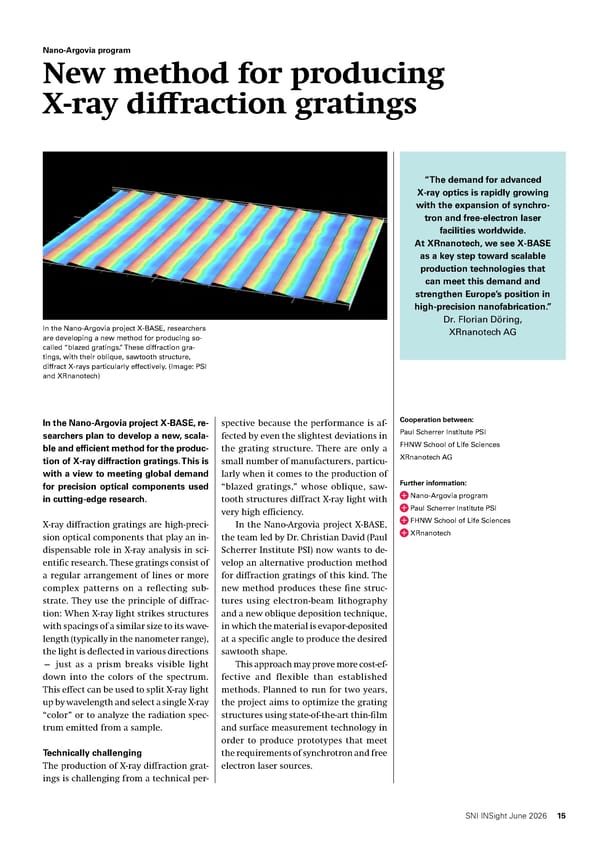
In the Nano-Argovia project X-BASE, researchers are developing a new method for producing so- called “blazed gratings. ” These diffraction gra- tings, with their oblique, sawtooth structure, diffract X-rays particularly effectively. (Image: PSI and XRnanotech) Nano-Argovia program New method for producing X-ray diffraction gratings In the Nano-Argovia project X-BASE, re- searchers plan to develop a new, scala- ble and efficient method for the produc- tion of X-ray diffraction gratings. This is with a view to meeting global demand for precision optical components used in cutting-edge research. X-ray diffraction gratings are high-preci- sion optical components that play an in- dispensable role in X-ray analysis in sci- entific research. These gratings consist of a regular arrangement of lines or more complex patterns on a reflecting sub- strate. They use the principle of diffrac- tion: When X-ray light strikes structures with spacings of a similar size to its wave- length (typically in the nanometer range), the light is deflected in various directions — just as a prism breaks visible light down into the colors of the spectrum. This effect can be used to split X-ray light up by wavelength and select a single X-ray “color” or to analyze the radiation spec- trum emitted from a sample. Technically challenging The production of X-ray diffraction grat- ings is challenging from a technical per- spective because the performance is af- fected by even the slightest deviations in the grating structure. There are only a small number of manufacturers, particu- larly when it comes to the production of “blazed gratings,” whose oblique, saw- tooth structures diffract X-ray light with very high efficiency. In the Nano-Argovia project X-BASE, the team led by Dr. Christian David (Paul Scherrer Institute PSI) now wants to de- velop an alternative production method for diffraction gratings of this kind. The new method produces these fine struc- tures using electron-beam lithography and a new oblique deposition technique, in which the material is evapor-deposited at a specific angle to produce the desired sawtooth shape. This approach may prove more cost-ef- fective and flexible than established methods. Planned to run for two years, the project aims to optimize the grating structures using state-of-the-art thin-film and surface measurement technology in order to produce prototypes that meet the requirements of synchrotron and free electron laser sources. Cooperation between: Paul Scherrer Institute PSI FHNW School of Life Sciences XRnanotech AG Further information: Nano-Argovia program Paul Scherrer Institute PSI FHNW School of Life Sciences XRnanotech “The demand for advanced X-ray optics is rapidly growing with the expansion of synchro- tron and free-electron laser facilities worldwide. At XRnanotech, we see X-BASE as a key step toward scalable production technologies that can meet this demand and strengthen Europe’s position in high-precision nanofabrication.” Dr. Florian Döring, XRnanotech AG 15 SNI INSight June 2026
 SNI INSight - June 2026 Page 14 Page 16