
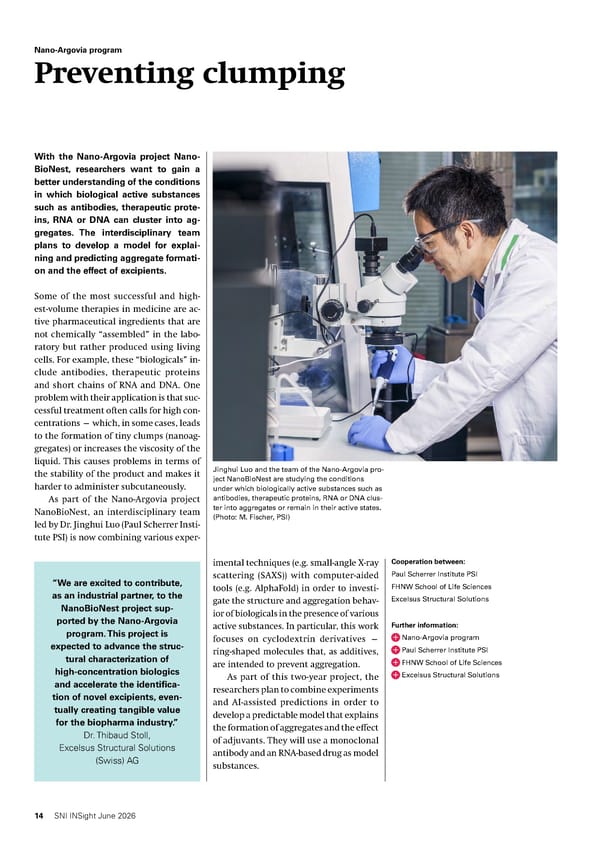
Nano-Argovia program Preventing clumping With the Nano-Argovia project Nano- BioNest, researchers want to gain a better understanding of the conditions in which biological active substances such as antibodies, therapeutic prote- ins, RNA or DNA can cluster into ag- gregates. The interdisciplinary team plans to develop a model for explai- ning and predicting aggregate formati- on and the effect of excipients. Some of the most successful and high- est-volume therapies in medicine are ac- tive pharmaceutical ingredients that are not chemically “assembled” in the labo- ratory but rather produced using living cells. For example, these “biologicals” in- clude antibodies, therapeutic proteins and short chains of RNA and DNA. One problem with their application is that suc- cessful treatment often calls for high con- centrations — which, in some cases, leads to the formation of tiny clumps (nanoag- gregates) or increases the viscosity of the liquid. This causes problems in terms of the stability of the product and makes it harder to administer subcutaneously. As part of the Nano-Argovia project NanoBioNest, an interdisciplinary team led by Dr. Jinghui Luo (Paul Scherrer Insti- tute PSI) is now combining various exper- imental techniques (e.g. small-angle X-ray scattering (SAXS)) with computer-aided tools (e.g. AlphaFold) in order to investi- gate the structure and aggregation behav- ior of biologicals in the presence of various active substances. In particular, this work focuses on cyclodextrin derivatives — ring-shaped molecules that, as additives, are intended to prevent aggregation. As part of this two-year project, the researchers plan to combine experiments and AI-assisted predictions in order to develop a predictable model that explains the formation of aggregates and the effect of adjuvants. They will use a monoclonal antibody and an RNA-based drug as model substances. Jinghui Luo and the team of the Nano-Argovia pro- ject NanoBioNest are studying the conditions under which biologically active substances such as antibodies, therapeutic proteins, RNA or DNA clus- ter into aggregates or remain in their active states. (Photo: M. Fischer, PSI) “We are excited to contribute, as an industrial partner, to the NanoBioNest project sup- ported by the Nano-Argovia program. This project is expected to advance the struc- tural characterization of high-concentration biologics and accelerate the identifica- tion of novel excipients, even- tually creating tangible value for the biopharma industry.” Dr. Thibaud Stoll, Excelsus Structural Solutions (Swiss) AG Cooperation between: Paul Scherrer Institute PSI FHNW School of Life Sciences Excelsus Structural Solutions Further information: Nano-Argovia program Paul Scherrer Institute PSI FHNW School of Life Sciences Excelsus Structural Solutions 14 SNI INSight June 2026
 SNI INSight - June 2026 Page 13 Page 15