
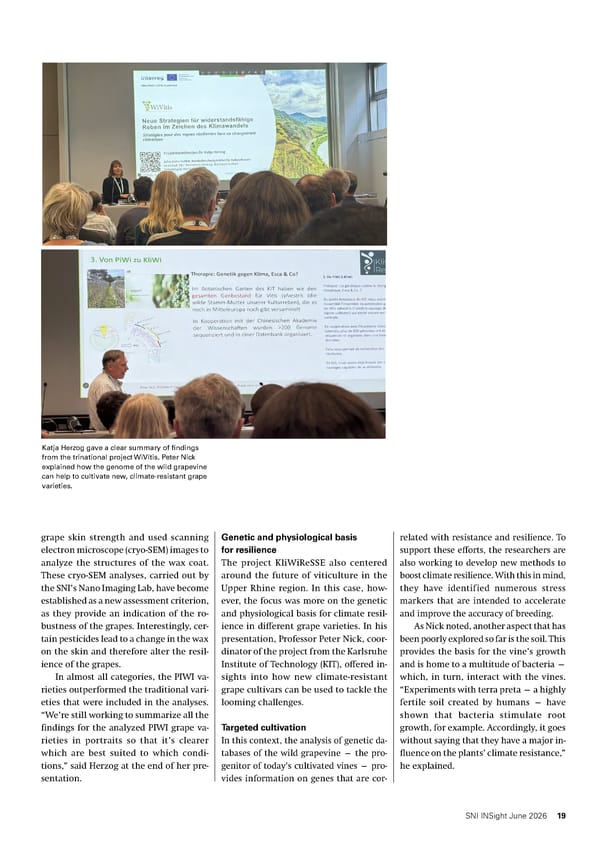
grape skin strength and used scanning electron microscope (cryo-SEM) images to analyze the structures of the wax coat. These cryo-SEM analyses, carried out by the SNI’s Nano Imaging Lab, have become established as a new assessment criterion, as they provide an indication of the ro- bustness of the grapes. Interestingly, cer- tain pesticides lead to a change in the wax on the skin and therefore alter the resil- ience of the grapes. In almost all categories, the PIWI va- rieties outperformed the traditional vari- eties that were included in the analyses. “We’re still working to summarize all the findings for the analyzed PIWI grape va- rieties in portraits so that it’s clearer which are best suited to which condi- tions,” said Herzog at the end of her pre- sentation. Genetic and physiological basis for resilience The project KliWiReSSE also centered around the future of viticulture in the Upper Rhine region. In this case, how- ever, the focus was more on the genetic and physiological basis for climate resil- ience in different grape varieties. In his presentation, Professor Peter Nick, coor- dinator of the project from the Karlsruhe Institute of Technology (KIT), offered in- sights into how new climate-resistant grape cultivars can be used to tackle the looming challenges. Targeted cultivation In this context, the analysis of genetic da- tabases of the wild grapevine — the pro- genitor of today’s cultivated vines — pro- vides information on genes that are cor- related with resistance and resilience. To support these efforts, the researchers are also working to develop new methods to boost climate resilience. With this in mind, they have identified numerous stress markers that are intended to accelerate and improve the accuracy of breeding. As Nick noted, another aspect that has been poorly explored so far is the soil. This provides the basis for the vine’s growth and is home to a multitude of bacteria — which, in turn, interact with the vines. “Experiments with terra preta — a highly fertile soil created by humans — have shown that bacteria stimulate root growth, for example. Accordingly, it goes without saying that they have a major in- fluence on the plants’ climate resistance,” he explained. Katja Herzog gave a clear summary of findings from the trinational project WiVitis. Peter Nick explained how the genome of the wild grapevine can help to cultivate new, climate-resistant grape varieties. 19 SNI INSight June 2026
 SNI INSight - June 2026 Page 18 Page 20