
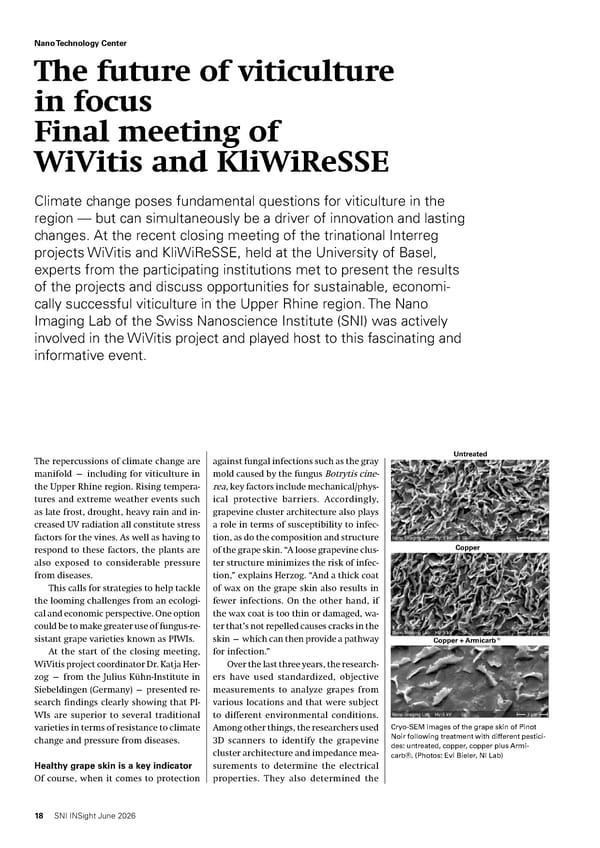
The future of viticulture in focus Final meeting of WiVitis and KliWiReSSE Climate change poses fundamental questions for viticulture in the region — but can simultaneously be a driver of innovation and lasting changes. At the recent closing meeting of the trinational Interreg projects WiVitis and KliWiReSSE, held at the University of Basel, experts from the participating institutions met to present the results of the projects and discuss opportunities for sustainable, economi- cally successful viticulture in the Upper Rhine region. The Nano Imaging Lab of the Swiss Nanoscience Institute (SNI) was actively involved in the WiVitis project and played host to this fascinating and informative event. The repercussions of climate change are manifold — including for viticulture in the Upper Rhine region. Rising tempera- tures and extreme weather events such as late frost, drought, heavy rain and in- creased UV radiation all constitute stress factors for the vines. As well as having to respond to these factors, the plants are also exposed to considerable pressure from diseases. This calls for strategies to help tackle the looming challenges from an ecologi- cal and economic perspective. One option could be to make greater use of fungus-re- sistant grape varieties known as PIWIs. At the start of the closing meeting, WiVitis project coordinator Dr. Katja Her- zog — from the Julius Kühn-Institute in Siebeldingen (Germany) — presented re- search findings clearly showing that PI- WIs are superior to several traditional varieties in terms of resistance to climate change and pressure from diseases. Healthy grape skin is a key indicator Of course, when it comes to protection against fungal infections such as the gray mold caused by the fungus Botrytis cine- rea, key factors include mechanical/phys- ical protective barriers. Accordingly, grapevine cluster architecture also plays a role in terms of susceptibility to infec- tion, as do the composition and structure of the grape skin. “A loose grapevine clus- ter structure minimizes the risk of infec- tion,” explains Herzog. “And a thick coat of wax on the grape skin also results in fewer infections. On the other hand, if the wax coat is too thin or damaged, wa- ter that’s not repelled causes cracks in the skin — which can then provide a pathway for infection.” Over the last three years, the research- ers have used standardized, objective measurements to analyze grapes from various locations and that were subject to different environmental conditions. Among other things, the researchers used 3D scanners to identify the grapevine cluster architecture and impedance mea- surements to determine the electrical properties. They also determined the Nano Technology Center Cryo-SEM images of the grape skin of Pinot Noir following treatment with different pestici- des: untreated, copper, copper plus Armi- carb®. (Photos: Evi Bieler, NI Lab) Copper Untreated Copper + Armicarb ® 18 SNI INSight June 2026
 SNI INSight - June 2026 Page 17 Page 19