
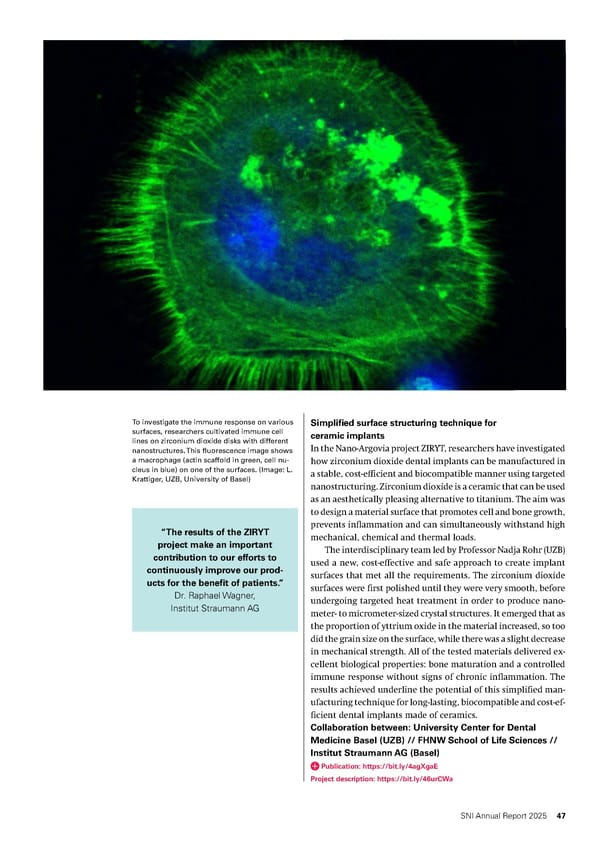
To investigate the immune response on various surfaces, researchers cultivated immune cell lines on zirconium dioxide disks with different nanostructures. This fluorescence image shows a macrophage (actin scaffold in green, cell nu- cleus in blue) on one of the surfaces. (Image: L. Krattiger, UZB, University of Basel) Simplified surface structuring technique for ceramic implants In the Nano-Argovia project ZIRYT, researchers have investigated how zirconium dioxide dental implants can be manufactured in a stable, cost-efficient and biocompatible manner using targeted nanostructuring. Zirconium dioxide is a ceramic that can be used as an aesthetically pleasing alternative to titanium. The aim was to design a material surface that promotes cell and bone growth, prevents inflammation and can simultaneously withstand high mechanical, chemical and thermal loads. The interdisciplinary team led by Professor Nadja Rohr (UZB) used a new, cost-effective and safe approach to create implant surfaces that met all the requirements. The zirconium dioxide surfaces were first polished until they were very smooth, before undergoing targeted heat treatment in order to produce nano- meter- to micrometer-sized crystal structures. It emerged that as the proportion of yttrium oxide in the material increased, so too did the grain size on the surface, while there was a slight decrease in mechanical strength. All of the tested materials delivered ex- cellent biological properties: bone maturation and a controlled immune response without signs of chronic inflammation. The results achieved underline the potential of this simplified man- ufacturing technique for long-lasting, biocompatible and cost-ef- ficient dental implants made of ceramics. Collaboration between: University Center for Dental Medicine Basel (UZB) // FHNW School of Life Sciences // Institut Straumann AG (Basel) Publication: https://bit.ly/4agXgaE Project description: https://bit.ly/46urCWa “The results of the ZIRYT project make an important contribution to our efforts to continuously improve our prod- ucts for the benefit of patients.” Dr. Raphael Wagner, Institut Straumann AG 47 SNI Annual Report 2025
 Annual Report 2025 - Swiss Nanoscience Institute Page 46 Page 48