
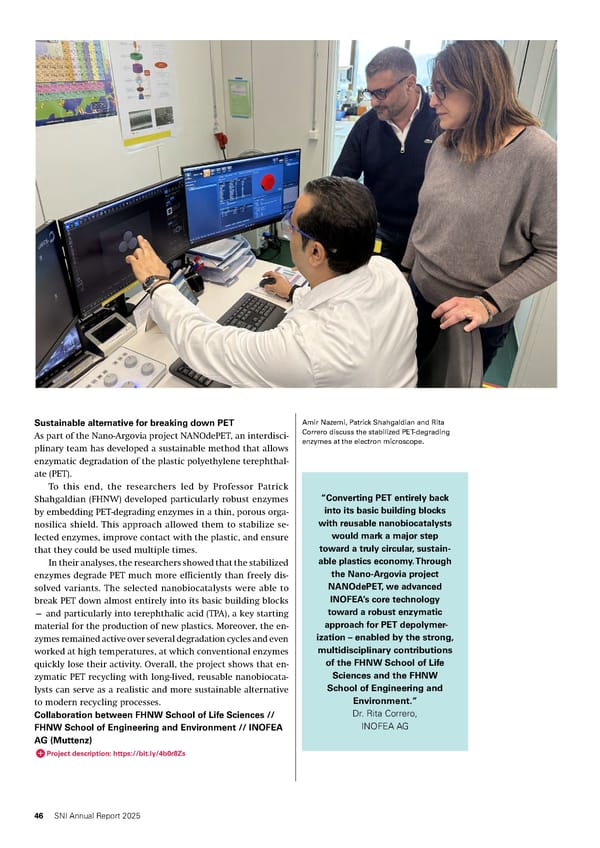
Sustainable alternative for breaking down PET As part of the Nano-Argovia project NANOdePET, an interdisci- plinary team has developed a sustainable method that allows enzymatic degradation of the plastic polyethylene terephthal- ate (PET). To this end, the researchers led by Professor Patrick Shahgaldian (FHNW) developed particularly robust enzymes by embedding PET-degrading enzymes in a thin, porous orga- nosilica shield. This approach allowed them to stabilize se- lected enzymes, improve contact with the plastic, and ensure that they could be used multiple times. In their analyses, the researchers showed that the stabilized enzymes degrade PET much more efficiently than freely dis- solved variants. The selected nanobiocatalysts were able to break PET down almost entirely into its basic building blocks — and particularly into terephthalic acid (TPA), a key starting material for the production of new plastics. Moreover, the en- zymes remained active over several degradation cycles and even worked at high temperatures, at which conventional enzymes quickly lose their activity. Overall, the project shows that en- zymatic PET recycling with long-lived, reusable nanobiocata- lysts can serve as a realistic and more sustainable alternative to modern recycling processes. Collaboration between FHNW School of Life Sciences // FHNW School of Engineering and Environment // INOFEA AG (Muttenz) Project description: https://bit.ly/4b0r8Zs “Converting PET entirely back into its basic building blocks with reusable nanobiocatalysts would mark a major step toward a truly circular, sustain- able plastics economy. Through the Nano-Argovia project NANOdePET, we advanced INOFEA’s core technology toward a robust enzymatic approach for PET depolymer- ization – enabled by the strong, multidisciplinary contributions of the FHNW School of Life Sciences and the FHNW School of Engineering and Environment. ” Dr. Rita Correro, INOFEA AG Amir Nazemi, Patrick Shahgaldian and Rita Correro discuss the stabilized PET-degrading enzymes at the electron microscope. 46 SNI Annual Report 2025
 Annual Report 2025 - Swiss Nanoscience Institute Page 45 Page 47