
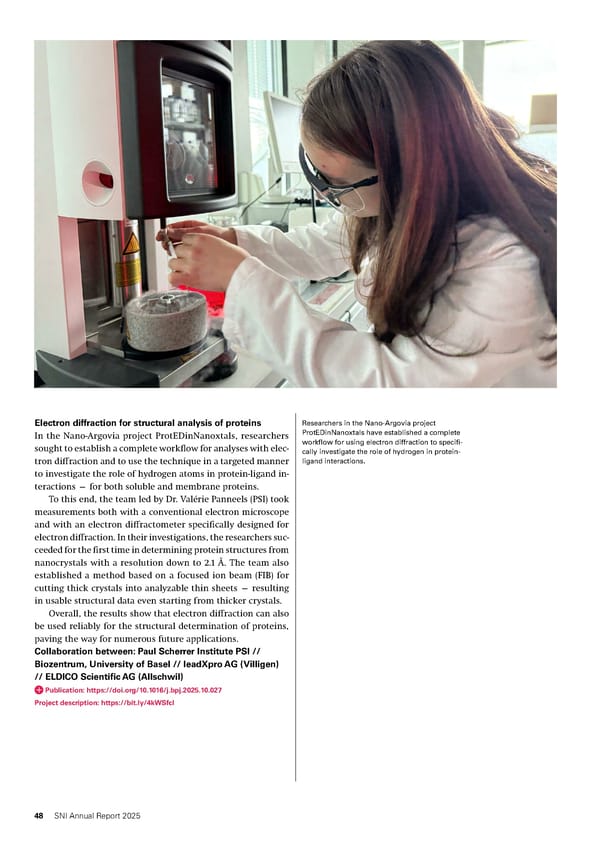
Electron diffraction for structural analysis of proteins In the Nano-Argovia project ProtEDinNanoxtals, researchers sought to establish a complete workflow for analyses with elec- tron diffraction and to use the technique in a targeted manner to investigate the role of hydrogen atoms in protein-ligand in- teractions — for both soluble and membrane proteins. To this end, the team led by Dr. Valérie Panneels (PSI) took measurements both with a conventional electron microscope and with an electron diffractometer specifically designed for electron diffraction. In their investigations, the researchers suc- ceeded for the first time in determining protein structures from nanocrystals with a resolution down to 2.1 Å. The team also established a method based on a focused ion beam (FIB) for cutting thick crystals into analyzable thin sheets — resulting in usable structural data even starting from thicker crystals. Overall, the results show that electron diffraction can also be used reliably for the structural determination of proteins, paving the way for numerous future applications. Collaboration between: Paul Scherrer Institute PSI // Biozentrum, University of Basel // leadXpro AG (Villigen) // ELDICO Scientific AG (Allschwil) Publication: https://doi.org/10.1016/j.bpj.2025.10.027 Project description: https://bit.ly/4kWSfcl Researchers in the Nano-Argovia project ProtEDinNanoxtals have established a complete workflow for using electron diffraction to specifi- cally investigate the role of hydrogen in protein- ligand interactions. 48 SNI Annual Report 2025
 Annual Report 2025 - Swiss Nanoscience Institute Page 47 Page 49