
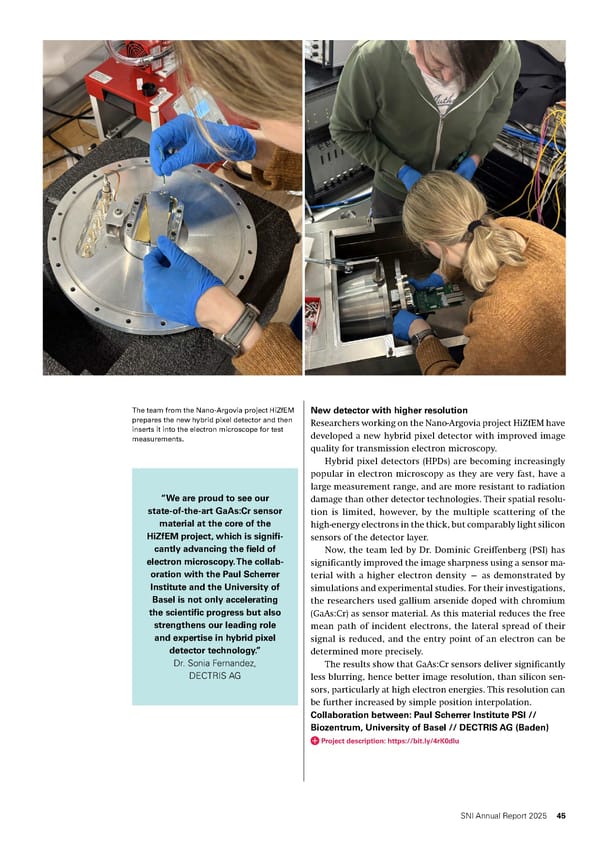
The team from the Nano-Argovia project HiZfEM prepares the new hybrid pixel detector and then inserts it into the electron microscope for test measurements. New detector with higher resolution Researchers working on the Nano-Argovia project HiZfEM have developed a new hybrid pixel detector with improved image quality for transmission electron microscopy. Hybrid pixel detectors (HPDs) are becoming increasingly popular in electron microscopy as they are very fast, have a large measurement range, and are more resistant to radiation damage than other detector technologies. Their spatial resolu- tion is limited, however, by the multiple scattering of the high-energy electrons in the thick, but comparably light silicon sensors of the detector layer. Now, the team led by Dr. Dominic Greiffenberg (PSI) has significantly improved the image sharpness using a sensor ma- terial with a higher electron density — as demonstrated by simulations and experimental studies. For their investigations, the researchers used gallium arsenide doped with chromium (GaAs:Cr) as sensor material. As this material reduces the free mean path of incident electrons, the lateral spread of their signal is reduced, and the entry point of an electron can be determined more precisely. The results show that GaAs:Cr sensors deliver significantly less blurring, hence better image resolution, than silicon sen- sors, particularly at high electron energies. This resolution can be further increased by simple position interpolation. Collaboration between: Paul Scherrer Institute PSI // Biozentrum, University of Basel // DECTRIS AG (Baden) Project description: https://bit.ly/4rK0dIu “We are proud to see our state-of-the-art GaAs:Cr sensor material at the core of the HiZfEM project, which is signifi- cantly advancing the field of electron microscopy. The collab- oration with the Paul Scherrer Institute and the University of Basel is not only accelerating the scientific progress but also strengthens our leading role and expertise in hybrid pixel detector technology.” Dr. Sonia Fernandez, DECTRIS AG 45 SNI Annual Report 2025
 Annual Report 2025 - Swiss Nanoscience Institute Page 44 Page 46