
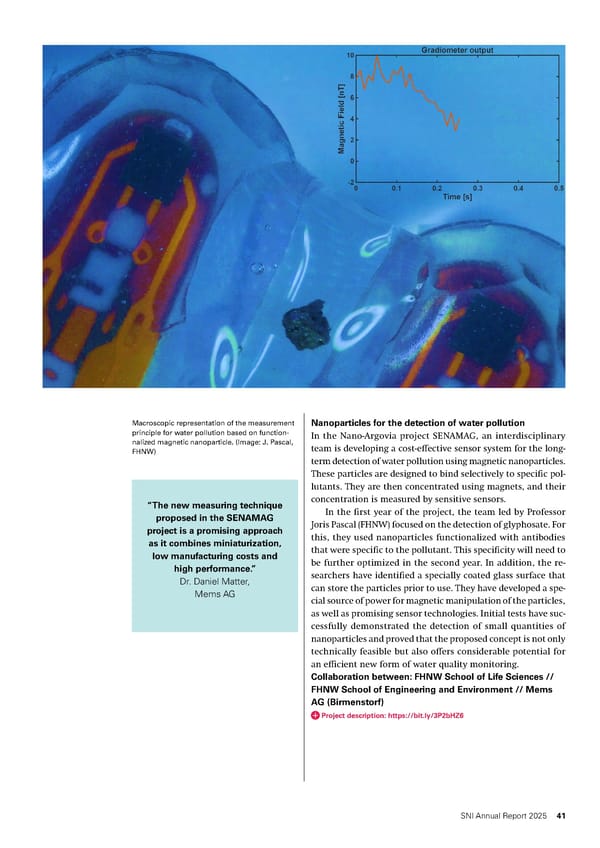
Nanoparticles for the detection of water pollution In the Nano-Argovia project SENAMAG, an interdisciplinary team is developing a cost-effective sensor system for the long- term detection of water pollution using magnetic nanoparticles. These particles are designed to bind selectively to specific pol- lutants. They are then concentrated using magnets, and their concentration is measured by sensitive sensors. In the first year of the project, the team led by Professor Joris Pascal (FHNW) focused on the detection of glyphosate. For this, they used nanoparticles functionalized with antibodies that were specific to the pollutant. This specificity will need to be further optimized in the second year. In addition, the re- searchers have identified a specially coated glass surface that can store the particles prior to use. They have developed a spe- cial source of power for magnetic manipulation of the particles, as well as promising sensor technologies. Initial tests have suc- cessfully demonstrated the detection of small quantities of nanoparticles and proved that the proposed concept is not only technically feasible but also offers considerable potential for an efficient new form of water quality monitoring. Collaboration between: FHNW School of Life Sciences // FHNW School of Engineering and Environment // Mems AG (Birmenstorf) Project description: https://bit.ly/3P2bHZ6 Macroscopic representation of the measurement principle for water pollution based on function- nalized magnetic nanoparticle. (Image: J. Pascal, FHNW) “The new measuring technique proposed in the SENAMAG project is a promising approach as it combines miniaturization, low manufacturing costs and high performance.” Dr. Daniel Matter, Mems AG 41 SNI Annual Report 2025
 Annual Report 2025 - Swiss Nanoscience Institute Page 40 Page 42