
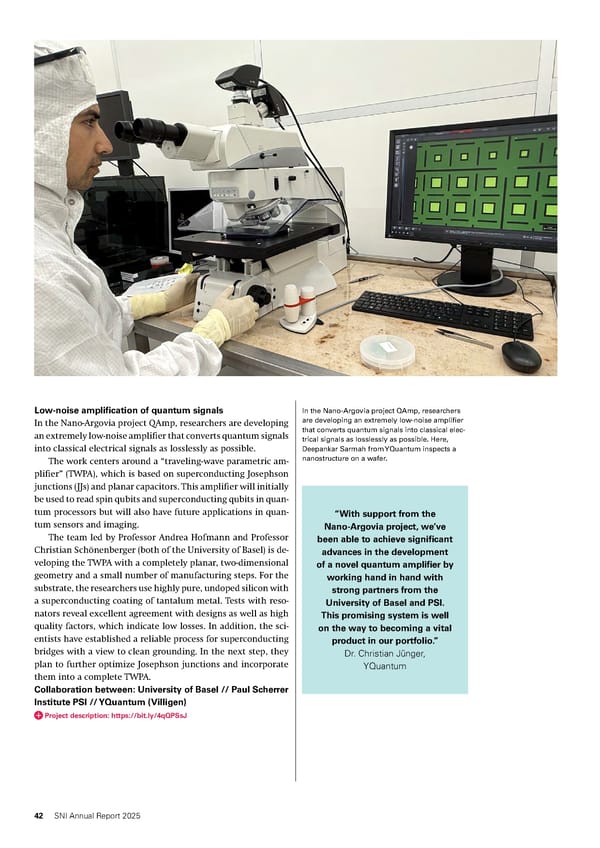
Low-noise amplification of quantum signals In the Nano-Argovia project QAmp, researchers are developing an extremely low-noise amplifier that converts quantum signals into classical electrical signals as losslessly as possible. The work centers around a “traveling-wave parametric am- plifier” (TWPA), which is based on superconducting Josephson junctions (JJs) and planar capacitors. This amplifier will initially be used to read spin qubits and superconducting qubits in quan- tum processors but will also have future applications in quan- tum sensors and imaging. The team led by Professor Andrea Hofmann and Professor Christian Schönenberger (both of the University of Basel) is de- veloping the TWPA with a completely planar, two-dimensional geometry and a small number of manufacturing steps. For the substrate, the researchers use highly pure, undoped silicon with a superconducting coating of tantalum metal. Tests with reso- nators reveal excellent agreement with designs as well as high quality factors, which indicate low losses. In addition, the sci- entists have established a reliable process for superconducting bridges with a view to clean grounding. In the next step, they plan to further optimize Josephson junctions and incorporate them into a complete TWPA. Collaboration between: University of Basel // Paul Scherrer Institute PSI // YQuantum (Villigen) Project description: https://bit.ly/4qQPSsJ “With support from the Nano-Argovia project, we’ve been able to achieve significant advances in the development of a novel quantum amplifier by working hand in hand with strong partners from the University of Basel and PSI. This promising system is well on the way to becoming a vital product in our portfolio.” Dr. Christian Jünger, YQuantum In the Nano-Argovia project QAmp, researchers are developing an extremely low-noise amplifier that converts quantum signals into classical elec- trical signals as losslessly as possible. Here, Deepankar Sarmah from YQuantum inspects a nanostructure on a wafer. 42 SNI Annual Report 2025
 Annual Report 2025 - Swiss Nanoscience Institute Page 41 Page 43