
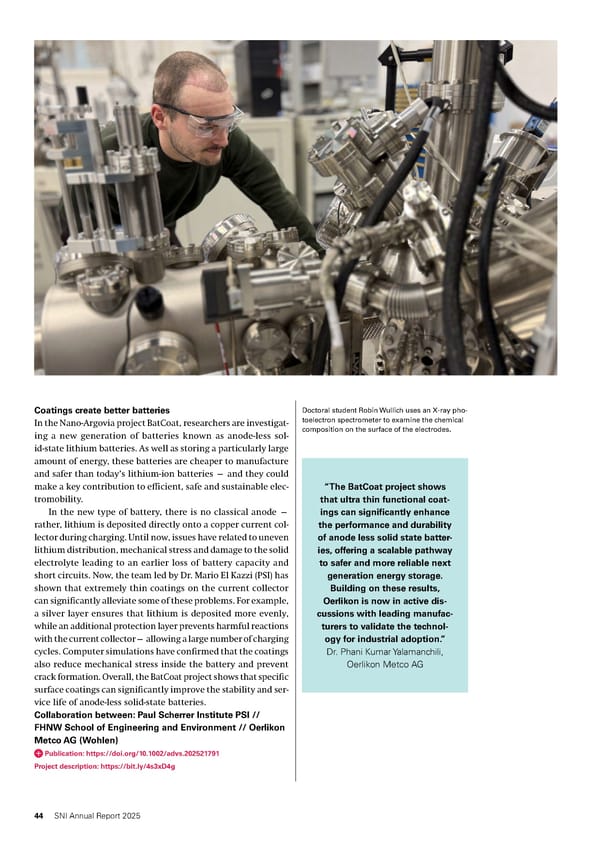
Coatings create better batteries In the Nano-Argovia project BatCoat, researchers are investigat- ing a new generation of batteries known as anode-less sol- id-state lithium batteries. As well as storing a particularly large amount of energy, these batteries are cheaper to manufacture and safer than today’s lithium-ion batteries — and they could make a key contribution to efficient, safe and sustainable elec- tromobility. In the new type of battery, there is no classical anode — rather, lithium is deposited directly onto a copper current col- lector during charging. Until now, issues have related to uneven lithium distribution, mechanical stress and damage to the solid electrolyte leading to an earlier loss of battery capacity and short circuits. Now, the team led by Dr. Mario El Kazzi (PSI) has shown that extremely thin coatings on the current collector can significantly alleviate some of these problems. For example, a silver layer ensures that lithium is deposited more evenly, while an additional protection layer prevents harmful reactions with the current collector— allowing a large number of charging cycles. Computer simulations have confirmed that the coatings also reduce mechanical stress inside the battery and prevent crack formation. Overall, the BatCoat project shows that specific surface coatings can significantly improve the stability and ser- vice life of anode-less solid-state batteries. Collaboration between: Paul Scherrer Institute PSI // FHNW School of Engineering and Environment // Oerlikon Metco AG (Wohlen) Publication: https://doi.org/10.1002/advs.202521791 Project description: https://bit.ly/4s3xD4g “The BatCoat project shows that ultra thin functional coat- ings can significantly enhance the performance and durability of anode less solid state batter- ies, offering a scalable pathway to safer and more reliable next generation energy storage. Building on these results, Oerlikon is now in active dis- cussions with leading manufac- turers to validate the technol- ogy for industrial adoption.” Dr. Phani Kumar Yalamanchili, Oerlikon Metco AG Doctoral student Robin Wullich uses an X-ray pho- toelectron spectrometer to examine the chemical composition on the surface of the electrodes. 44 SNI Annual Report 2025
 Annual Report 2025 - Swiss Nanoscience Institute Page 43 Page 45