
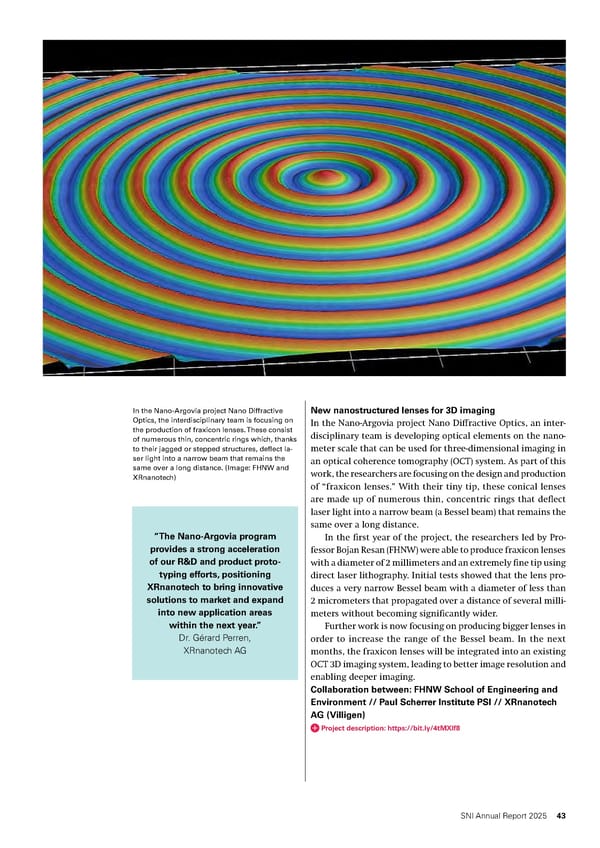
New nanostructured lenses for 3D imaging In the Nano-Argovia project Nano Diffractive Optics, an inter- disciplinary team is developing optical elements on the nano- meter scale that can be used for three-dimensional imaging in an optical coherence tomography (OCT) system. As part of this work, the researchers are focusing on the design and production of “fraxicon lenses.” With their tiny tip, these conical lenses are made up of numerous thin, concentric rings that deflect laser light into a narrow beam (a Bessel beam) that remains the same over a long distance. In the first year of the project, the researchers led by Pro- fessor Bojan Resan (FHNW) were able to produce fraxicon lenses with a diameter of 2 millimeters and an extremely fine tip using direct laser lithography. Initial tests showed that the lens pro- duces a very narrow Bessel beam with a diameter of less than 2 micrometers that propagated over a distance of several milli- meters without becoming significantly wider. Further work is now focusing on producing bigger lenses in order to increase the range of the Bessel beam. In the next months, the fraxicon lenses will be integrated into an existing OCT 3D imaging system, leading to better image resolution and enabling deeper imaging. Collaboration between: FHNW School of Engineering and Environment // Paul Scherrer Institute PSI // XRnanotech AG (Villigen) Project description: https://bit.ly/4tMXlf8 “The Nano-Argovia program provides a strong acceleration of our R&D and product proto- typing efforts, positioning XRnanotech to bring innovative solutions to market and expand into new application areas within the next year.” Dr. Gérard Perren, XRnanotech AG In the Nano-Argovia project Nano Diffractive Optics, the interdisciplinary team is focusing on the production of fraxicon lenses. These consist of numerous thin, concentric rings which, thanks to their jagged or stepped structures, deflect la- ser light into a narrow beam that remains the same over a long distance. (Image: FHNW and XRnanotech) 43 SNI Annual Report 2025
 Annual Report 2025 - Swiss Nanoscience Institute Page 42 Page 44