
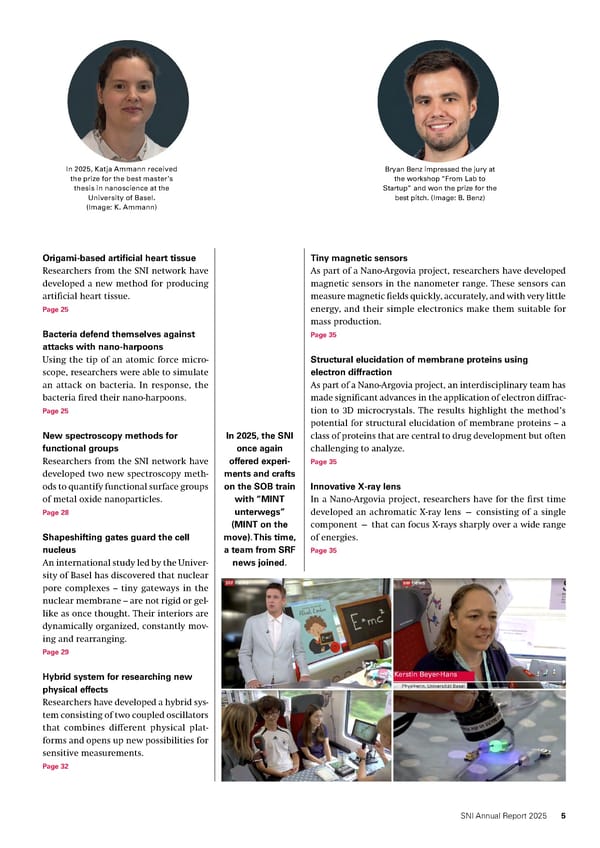
In 2025, the SNI once again offered experi- ments and crafts on the SOB train with “MINT unterwegs” (MINT on the move). This time, a team from SRF news joined. Tiny magnetic sensors As part of a Nano-Argovia project, researchers have developed magnetic sensors in the nanometer range. These sensors can measure magnetic fields quickly, accurately, and with very little energy, and their simple electronics make them suitable for mass production. Page 35 Structural elucidation of membrane proteins using electron diffraction As part of a Nano-Argovia project, an interdisciplinary team has made significant advances in the application of electron diffrac- tion to 3D microcrystals. The results highlight the method’s potential for structural elucidation of membrane proteins – a class of proteins that are central to drug development but often challenging to analyze. Page 35 Innovative X-ray lens In a Nano-Argovia project, researchers have for the first time developed an achromatic X-ray lens — consisting of a single component — that can focus X-rays sharply over a wide range of energies. Page 35 Origami-based artificial heart tissue Researchers from the SNI network have developed a new method for producing artificial heart tissue. Page 25 Bacteria defend themselves against attacks with nano-harpoons Using the tip of an atomic force micro- scope, researchers were able to simulate an attack on bacteria. In response, the bacteria fired their nano-harpoons. Page 25 New spectroscopy methods for functional groups Researchers from the SNI network have developed two new spectroscopy meth- ods to quantify functional surface groups of metal oxide nanoparticles. Page 28 Shapeshifting gates guard the cell nucleus An international study led by the Univer- sity of Basel has discovered that nuclear pore complexes – tiny gateways in the nuclear membrane – are not rigid or gel- like as once thought. Their interiors are dynamically organized, constantly mov- ing and rearranging. Page 29 Hybrid system for researching new physical effects Researchers have developed a hybrid sys- tem consisting of two coupled oscillators that combines different physical plat- forms and opens up new possibilities for sensitive measurements. Page 32 Bryan Benz impressed the jury at the workshop “From Lab to Startup” and won the prize for the best pitch. (Image: B. Benz) In 2025, Katja Ammann received the prize for the best master‘s thesis in nanoscience at the University of Basel. (Image: K. Ammann) Kerstin Beyer-Hans 5 SNI Annual Report 2025
 Annual Report 2025 - Swiss Nanoscience Institute Page 4 Page 6